Underground cable safety for groundworkers comes down to planning before digging, locating services with a CAT and Genny scan, confirming with trial holes, and digging by hand near known cables. Out-of-date records and skipped checks cause most strikes. A clean scan is never a guarantee the ground is clear.
Request service records early, since they can take time to arrive.
Write a dig plan for each area and brief the whole gang on it.
Scan the full dig width with a CAT and Genny, and re-scan after any change.
Confirm located services with trial holes before using machine work near them.
If a cable is struck, make the area safe, call the network operator and preserve the scene.
Why Underground Cable Strikes Still Happen on UK Sites
Every year, groundworkers strike buried cables that nobody expected to find. Most of these strikes are not caused by bad luck. They happen because plans are out of date, locators are misread, or the dig starts before anyone checks what is underneath.
The reasons are usually simple. Service records are incomplete. Old cables were never recorded. Temporary supplies appear mid-project. Under pressure to hit a programme date, crews skip checks they would never skip on a quiet day. Each of these is a problem that good habits can fix.
The ten tips below set out how to plan, locate, dig and respond. Each one is practical, and each one is something a site team can start on Monday.
Tip 1 to 3: Plan the Dig Before Anyone Picks Up a Spade
Planning is where most cable strikes are prevented, and it is the cheapest place to fix them.
Tip 1: Request service records early. Contact the utility owners and ask for plans of their apparatus in the work area. Do this well before the programme requires it, because records can take time to arrive.
Tip 2: Walk the site with the plans. Check the drawings against what you can see on the ground: manhole covers, marker posts, street furniture and old ducts.
Tip 3: Write a dig plan for each area. Record the route, expected depth, the services present and the controls in place.
A dig plan only works if the people digging have read it. Brief the gang, not just the site manager.
Tip 4 to 6: Locate Services Using CAT and Genny Cable Avoidance Tools
Records tell you where cables should be. A locator tells you where they actually are.
Tip 4: Use a CAT and Genny scan on every dig, and know which mode you are in. A Cable Avoidance Tool (CAT) with a Genny signal generator is a common way to trace live cables.
Tip 5: Mark what you find, and mark it precisely. Use paint or flags to mark each service on the ground as you locate it.
Tip 6: Confirm with trial holes before machine work. Where a service is close to the planned excavation, use hand digging or vacuum excavation to expose it before using a machine.
Why a Locator Alone Is Not Enough
A locator can miss cables that are not live, cables that are deeper than expected, and cables that are not in the signal path at all. Ground conditions, nearby metal, reinforced concrete and poor connections can distort readings. Two failure modes are worth knowing about specifically. First, a signal can “bleed” onto adjacent services, so the peak reading may sit on a pipe rather than the cable you are looking for. Second, a cable that is not connected to anything at the time of the survey may carry no passive signal and may not accept an active signal, so it can be invisible to the tool.
Watch Out A clean scan is not a clearance certificate. HSG47 expects locating to be combined with plans, trial holes and safe digging practice, not replaced by them.
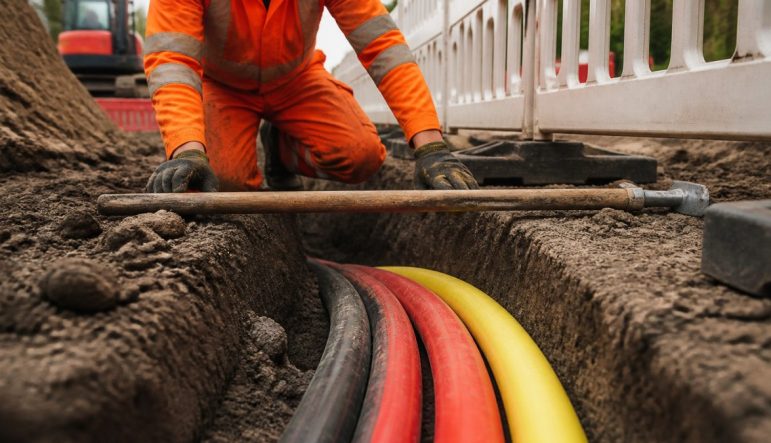
Groundworker using a CAT and Genny to ensure underground cable safety near a marked service line
The three locating steps in this section each rely on a clear action, so the key points are easy to scan.
Tip 7 to 8: Dig Safely, Protect Cables and Keep Warning Tape Visible
Even with a good plan and a clean scan, the digging itself needs care.
Tip 7: Dig by hand near known services. Within a safe distance of a located cable, switch to hand digging or suction tools. Machines should stop well short of the marked line.
Tip 8: Protect cables and keep warning tape visible. Where cables are exposed or near the surface, use protection such as tiles, ducts or ramps. Check that warning tape is in place above buried services and remains visible during backfilling. Tape and mesh give warning to the next person who digs, and they also reduce the risk of a strike if the cable is reached.
Tip 9: Build Safety Into Daily Habits and Briefings
Safe digging depends on what people do every day, not on one good plan. Short, regular briefings keep cable safety in front of the team.
Start each shift with a short review of the dig plan and marked services
Stop and re-scan whenever the dig moves or the ground changes
Encourage any worker to halt work if they are unsure
Record near misses so the whole team learns from them
Many groundworkers know the rules but struggle to act on them under pressure. Regular practice and clear expectations from supervisors close that gap.
What to Do if an Underground Cable Is Damaged
Most guides stop at prevention. The first hour after a strike is where outcomes are decided, and it is the part groundworkers are least prepared for. If a cable is struck, the first priority is to keep everyone safe. Stop work, move people away from the area, and do not touch the damaged cable or any exposed conductor. Assume it is live, even a cable that was thought to be dead can be re-energised, and a damaged cable can arc without anyone touching it.
The First 60 Minutes
Make the area safe. Stop all plant, establish an exclusion zone around the strike, and keep people clear. Do not attempt to move the cable, cover it, or retrieve tools from the excavation.
Call the network operator’s emergency number immediately. Network operators typically publish an emergency number for cable damage and dangerous situations. Report the location, the type of damage, and whether anyone is hurt. If there is a fire, an explosion risk, or someone is injured or unconscious, call 999 first and then the network operator.
Do not reset or re-energise anything. Do not operate switches, isolators or plant in the vicinity unless the network operator directs you to.
Keep the area controlled until the operator confirms it is safe. That means a physical barrier and a person on the barrier, not just tape.
Preserve the scene. Do not backfill, move spoil, or tidy up before the operator and any investigator have seen the strike. Photograph the excavation, the damaged cable, the locating marks and the dig plan as they were at the time.
Reporting and Investigation
A cable strike is a reportable event in most cases. Under the Reporting of Injuries, Diseases and Dangerous Occurrences Regulations (RIDDOR), certain dangerous occurrences, including electrical incidents that cause injury or fire, must be reported to the Health and Safety Executive. The site’s health and safety lead should confirm whether the strike meets the reporting threshold and make the report within the required timescale. Separately, the network operator will want its own incident report, and the site should keep a record that includes the time, location, services involved, the locating method used, the dig plan, and witness statements.
A short, factual incident report is worth more than a long one written a week later. Capture it the same day, while memories and marks are fresh.
Learning From the Strike
Once the area is safe and the reports are filed, review what happened against the dig plan and the locating record. Common findings include plans that were out of date, a scan that was not repeated after the dig moved, marks that were lost during backfilling, or a machine that was used closer to the service than the plan allowed. Feed those findings into the next briefing so the whole gang learns from the event, not just the people who were there.
Key Takeaway The first hour is about people, not paperwork. Make the area safe, call the network operator, preserve the scene, then investigate and report.
Underground Cable Strike Prevention Checklist for Your Next Dig
Use this before work starts in any new area:
Service records requested and received
Site walked and records checked against ground features
Dig plan written, signed and briefed to the whole gang
CAT and Genny scan completed across the full dig width
Services marked on the ground and marks kept visible
Trial holes dug where services sit close to the excavation
Hand digging or suction tools used near known cables
Cable protection and warning tape in place
Emergency contact details displayed on site
Re-scan planned after any change to the dig
Keeping this checklist on the site notice board or in the daily briefing pack makes it hard to skip a step.
Booking Your Team’s Next Step in Underground Cable Safety Training
Good plans and good locating only work when the people on site understand the risks and act on them. SJB Electrical Training delivers specialist, hands-on electrical safety and compliance training across the UK, including HSG47 and GS6 training, for contractors, maintenance teams and industrial organisations. Check our upcoming course dates to find a session that suits your team, or browse our electrical training courses to see what is available. If you want to compare options first, our HSG47 and GS6 excavation compliance guide sets out what the standards require. Book Training today to make sure your groundworkers know what to do when they are near a live cable.
Frequently Asked Questions
What are the main safety precautions when digging near underground cables?
Before any excavation starts, obtain plans of buried services, confirm the position of cables on site, and agree a method of working with the team. Use a cable avoidance tool to trace live cables, expose them by hand or with a suitable soft-dig method where they run close to the planned excavation, and keep mechanical plant clear of the marked route. Warning tape and marker mesh help signal cables to later workers. Anyone working close to cables should wear suitable protective equipment and be briefed on what to do if a strike occurs.
What does HSG47 recommend before excavation work begins?
HSG47, the HSE guidance on avoiding danger from underground services, recommends that duty holders gather information about buried services before work starts, including records from utility owners and the site survey. The guidance then expects a risk assessment, a plan for locating and identifying services, and suitable precautions for the chosen method of excavation. Briefing everyone involved and keeping the plan under review as the dig progresses are both part of the process.
Is a cable locator enough to confirm the position of an underground cable?
No. A cable locator, such as a CAT and Genny combination, can trace cables and pipes, but signals can be distorted by nearby services, and some cables cannot be detected reliably at all. Locators support a planned approach rather than replacing it. Use the tool to confirm what the records show, mark the route clearly, and expose the cable by hand or with a suitable soft-dig method before using mechanical plant nearby.
What should workers do if they uncover or damage an underground cable?
Stop work immediately, keep people clear of the area, and do not touch the damaged cable or attempt a repair. Treat every cable as live until its owner confirms otherwise. Call the emergency number for the network operator, follow the site emergency procedure, and report the incident to your supervisor. Record what happened so the strike can be reviewed and the method of working improved.
We use necessary cookies to keep this website secure and working. With your permission, we also use optional cookies to understand site performance and improve our services. Choose Accept All, Reject All or Preferences. You can change your choice at any time.
Cookie Policy
Necessary cookies support security and functions you request. Optional analytics and functional cookies are used only after consent. Some optional cookies may be set by service providers used on our pages. See the Cookie Policy for details.
Necessary cookies help make a website usable by enabling basic functions like page navigation and access to secure areas of the website. The website cannot function properly without these cookies.
Marketing cookies are used to track visitors across websites. The intention is to display ads that are relevant and engaging for the individual user and thereby more valuable for publishers and third party advertisers.
Preference cookies enable a website to remember information that changes the way the website behaves or looks, like your preferred language or the region that you are in.