What HSG47 and GS6 Compliance Actually Requires on Site
HSG47 and GS6 compliance is the practice of controlling the risks from underground services and overhead power lines during excavation work, following two separate Health and Safety Executive publications: HSG47 for buried services and GS6 for overhead lines. At SJB Electrical Training, we see the same pattern on site visits: crews can recite the regulations but freeze when the cable locator sounds off near a live service.
Your HSG47 Excavation Safety Checklist, Step by Step
An HSG47 excavation safety checklist works only if it is followed in order: plan, locate, mark, dig with care. Skipping the planning stage is the most common failure we see, and it is the one that turns a routine trench into a cable strike.
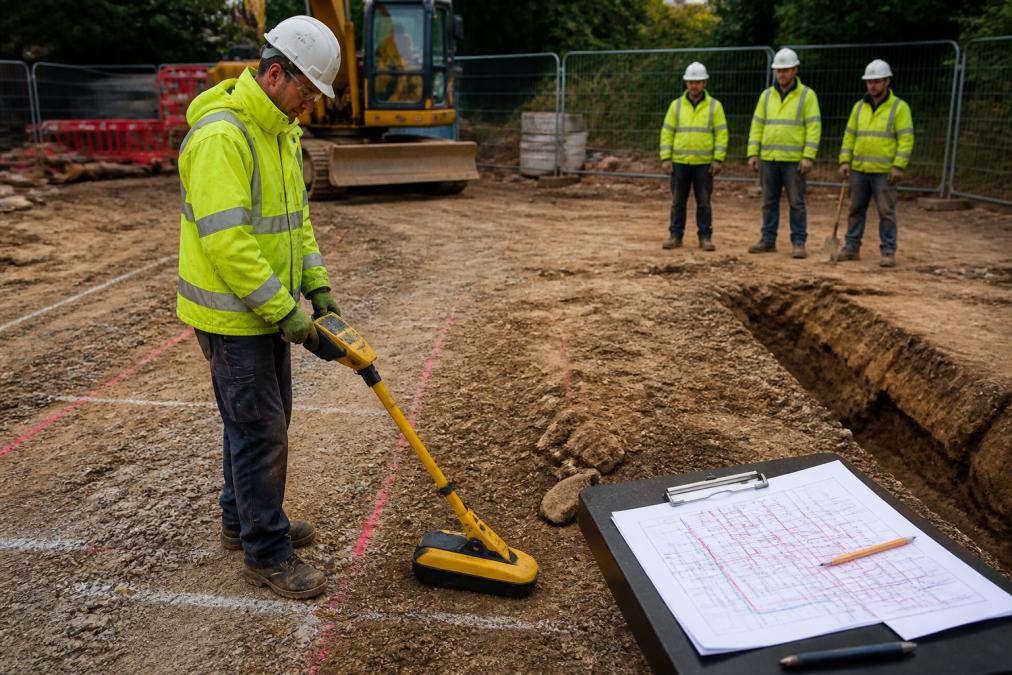
Site supervisor using a cable avoidance tool for HSG47 and GS6 compliance before beginning excavation works.
Before You Break Ground: Planning, Plans and Permits
Planning starts with service plans from every utility provider in the area, requested well before the dig date. These plans show approximate routes only, so they inform the survey rather than replace it. A permit to work should be raised for any excavation near services, and the safe system of work must name the competent person responsible for the locator survey.
Locating and Marking Services with Cable Avoidance Tools
Locating means sweeping the ground with a cable avoidance tool and signal generator, then marking every detected service with paint or pegs. A common mistake is treating a single sweep as final. Locators have known limitations, and the guidance is to use them alongside service plans, not instead of them.
Watch Out Never assume a service runs in a straight line between two marked points. Bends, T-junctions, and depth changes are common, and a strike on an unmarked spur is one of the most frequent causes of cable damage on site.
Building a GS6 Risk Assessment Template That Works
A GS6 risk assessment template should capture four things for every overhead line: its voltage level, its height, the plant that will pass beneath it, and the exclusion zone you will enforce. Generic templates fail because they treat all overhead lines the same.
Structure your assessment around these fields:
Line location and voltage – confirmed with the network operator, not estimated
Safe clearance distance – based on voltage and the tallest plant on site
Goalposts or barriers – physical markers at the exclusion zone boundary
Permit to work – required before any plant crosses beneath the line
Emergency contact – the network operator’s incident line, displayed on site
Safe Clearance Distances for Overhead Power Lines
Safe clearance distances for overhead power lines depend on voltage, and getting them wrong is an electrocution risk, not a paperwork problem. The guidance sets minimum distances that increase with voltage, and these apply to people, plant, and anything that could be lifted or extended.
Voltage Level
Typical Minimum Clearance
Key Control
Low voltage (up to 1kV)
1 metre
Warning signs, tool box talk
11kV to 33kV
3 metres
Goalposts, exclusion zone
132kV
6 metres
Permit to work, banksman
275kV to 400kV
7 metres or more
Network operator involvement
How to Set the Distance, Not Just Read It Off a Table
A clearance figure on its own is useless until it is converted into a physical control on the ground. Work through this sequence every time:
Confirm the voltage with the network operator. Do not estimate from the size of the pylon or the number of cables. Voltage determines the distance, and only the operator can confirm it in writing.
Identify the tallest plant and its maximum reach. A telehandler with its boom raised, an excavator with its arm extended, or a crane at full jib height all present a different envelope to the resting machine.
Add the clearance figure to the maximum reach, not to the machine’s footprint. This gives you the true exclusion zone boundary.
Mark the boundary physically. Goalposts, height restriction barriers, or bunting at the exclusion zone edge, not a painted line that fades or a cone that gets moved.
Brief the banksman and the operator on the boundary before the first movement, and confirm the permit to work names the line and the control.
Goalposts, Barriers and the Exclusion Zone
Goalposts are the standard control where plant must pass beneath a line. They are two vertical posts with a horizontal member set at the safe clearance height, positioned so that any machine that would breach the distance physically cannot pass. The HSE guidance on avoiding danger from overhead power lines sets out the goalpost and barrier expectations in detail.
Watch Out Never rely on a banksman alone to enforce an overhead line exclusion zone. A banksman cannot see the top of a raised boom or a crane jib from ground level, and the operator often cannot see the line. Physical barriers and goalposts are the control; the banksman is the backup.
When the Plant Changes Mid-Project
What most guides miss is that the clearance assessment must be revisited if the plant changes mid-project. A new crane with a longer jib, a larger excavator brought in for a deeper dig, or a delivery vehicle with a taller load all invalidate yesterday’s assessment. The safe system of work should name who is responsible for re-assessing when plant changes, and the permit to work should be re-raised rather than amended in the margin.
Key Takeaway Treat the clearance distance as a live figure, not a fixed one. Confirm the voltage, measure the tallest reach, add the clearance, mark the boundary physically, and re-assess every time the plant changes.
Electrical Safety Training for Contractors and Subcontractor Management
Electrical safety training for contractors only sticks when it changes behaviour on the ground, not just test scores. Subcontractors are the hardest group to manage because they arrive with varying competence levels and their own habits.
Vetting Subcontractors Before They Arrive
Most guides tell you to check training certificates at the gate. That is too late. A subcontractor who cannot evidence HSG47 and GS6 competence should not be on the programme in the first place. Build the check into procurement, not induction.
Evidence of HSG47 and GS6 training for every operative who will break ground or work near overhead lines, with a date that shows it is current.
A named competent person within the subcontractor’s team who owns the locator survey and the permit to work for their scope.
Their own cable avoidance equipment, or a written agreement on who provides it and who calibrates it.
A method statement that names the specific services and overhead lines on this site, not a generic excavation procedure.
Their incident and near-miss history for the last twelve months, and how they reported it.
Making Training Stick on Site
What works, in our experience:
Site induction that names the specific services and overhead lines on that site, not generic hazards
Tool box talks before each phase of excavation, not once at project start
A named competent person who owns the permit to work and can stop the job
Evidence of training currency checked at the gate, not after an incident
Pro Tip Ask subcontractors to walk the route with you before they start. Pointing at the actual overhead line and the actual marked service does more for retention than any classroom module.
Managing the Interface Between Trades
The highest-risk moment on a shared site is the handover between trades. A groundworker marks a service, then a different subcontractor’s machine operator arrives the next day and does not know the marks are there. The permit to work should name every trade working in the excavation, and the competent person should brief each incoming crew on the marks and the exclusion zones before they start.
Key Takeaway Vet subcontractors at procurement, not at the gate. Name the competent person, confirm the equipment, and brief every trade that enters the excavation.
Digital Mapping, Compliance Audits and Incident Reporting Protocols
Digital mapping tools have changed how sites plan around utility infrastructure, but they have not replaced the physical locator survey. The two work together: digital plans narrow the search area, and the locator confirms what is actually buried.
When Things Go Wrong: Emergency Procedures and Legal Duties
Emergency procedures must be displayed, rehearsed, and specific to the site. If a cable is struck, the immediate actions are: stop work, keep everyone back, do not touch anything, and call the network operator’s emergency line. Attempting to move a damaged cable or a machine in contact with one is how electrocution happens.
Conclusion: Making HSG47 and GS6 Compliance Stick
The hardest part of HSG47 and GS6 compliance is not learning the rules; it is making them survive contact with a busy site and a tight programme. Compliance that lives in a folder does nothing for the groundworker standing next to an unmarked service.
Frequently Asked Questions
What is the difference between HSG47 and GS6?
HSG47 covers avoiding danger from underground services, focusing on planning, locating cables with service plans and cable avoidance tools, and safe digging practices. GS6 deals with avoiding danger from overhead power lines, setting out exclusion zones and safe clearance distances based on voltage levels. Together they form the core of excavation safety and electrical hazards management on site, and a combined HSG47 and GS6 compliance guide should treat them as one operational system rather than two separate documents.
Who is responsible for ensuring HSG47 and GS6 compliance on site?
The duty holder, typically the principal contractor or site manager, carries overall responsibility under CDM 2015 and the Electricity at Work Regulations 1989. That duty of care extends to everyone on site, including subcontractors. In practice this means providing service plans, enforcing permit to work systems, delivering site inductions and toolbox talks, and appointing a competent person to oversee hazard identification and safe systems of work.
What are the key steps for safe excavation under HSG47?
Follow a clear sequence: obtain and review utility service plans, scan with cable avoidance tools, mark the ground, use safe digging practices such as hand tools near services, and maintain safe working distances. Never assume a service plan is accurate. Treat every cable as live until proven otherwise, and stop work immediately if you strike or expose anything unexpected, then follow your emergency contact and incident reporting protocols.
How do you maintain safe clearance distances under GS6?
Identify the voltage levels of overhead power lines from the utility infrastructure operator, then establish exclusion zones with barriers and goalposts that keep plant and people at the correct safe working distance for that voltage. Where plant cannot maintain clearance, use permit to work controls, banksmen and, where required, isolation. Site induction and toolbox talks should reinforce these limits daily, especially for tipper lorries, excavators and scaffold towers.
What training is required for HSG47 and GS6 compliance?
Anyone supervising or undertaking excavation near services, or working near overhead power lines, needs a level of competence matched to their role. That usually means a recognised HSG47 and GS6 course, plus a valid cable avoidance tool qualification. Electrical safety training for contractors should also cover emergency procedures, permit to work systems and how to read service plans. Refresher training keeps knowledge current when regulations, equipment or site conditions change.
What are the legal implications of failing to follow HSE guidance on power lines?
Failing to follow HSE guidance such as HSG47 and GS6 can breach the Health and Safety at Work etc. Act 1974, the Electricity at Work Regulations 1989 and CDM 2015. Consequences include prohibition notices, unlimited fines, prosecution of duty holders and, in the worst cases, custodial sentences. Beyond enforcement, a cable strike or overhead line contact can cause electrocution, burns and site shutdowns, so compliance is both a legal and a commercial necessity.
We use necessary cookies to keep this website secure and working. With your permission, we also use optional cookies to understand site performance and improve our services. Choose Accept All, Reject All or Preferences. You can change your choice at any time.
Cookie Policy
Necessary cookies support security and functions you request. Optional analytics and functional cookies are used only after consent. Some optional cookies may be set by service providers used on our pages. See the Cookie Policy for details.
Necessary cookies help make a website usable by enabling basic functions like page navigation and access to secure areas of the website. The website cannot function properly without these cookies.
Marketing cookies are used to track visitors across websites. The intention is to display ads that are relevant and engaging for the individual user and thereby more valuable for publishers and third party advertisers.
Preference cookies enable a website to remember information that changes the way the website behaves or looks, like your preferred language or the region that you are in.