Pass Training vs Specialized Providers: What’s the Real Difference?
The choice between generic pass training and specialised electrical safety providers comes down to one question: are you buying a certificate, or are you buying competence? For duty holders managing live electrical risks, that distinction carries real safety and legal weight.
Generic safety courses serve an important purpose for awareness-level induction. Specialist electrical training exists for a different outcome entirely: changing how people behave around energised equipment and buried cables.
Below, we show you how to evaluate which approach your organisation needs and how to calculate the true cost of getting that decision wrong.
Quick Comparison: Generalist vs Specialist Electrical Training
The core distinction is straightforward. Pass training in a generalist context refers to basic safety awareness and compliance tick-box exercises, while specialist providers deliver role-specific, competency-based programmes tied to regulatory frameworks.
Factor
Generalist Provider
Specialist Provider
Course content
Broad safety awareness
Role-specific, regulatory depth
Regulatory focus
Generic compliance
HSG47, GS6, BS7671 specifics
Delivery method
Often online modules
Hands-on, site-based practice
Trainer background
General safety instructors
Electrical engineering specialists
Knowledge retention
Lower without practical context
Higher through applied scenarios
Best suited for
Induction, basic awareness
Duty holders, maintenance teams
The table reveals the real trade-off. Generalist courses are cheaper per delegate and easier to schedule. Specialist training costs more upfront but targets the specific competencies your team actually needs to demonstrate. Health and Safety Executive guidance on electrical safety competence makes clear that employers must ensure workers have the appropriate level of knowledge and skill for the tasks they perform, which often exceeds what a generic awareness course provides.
When HSG47 Compliance Training Needs More Than a Box-Tick Exercise
HSG47 compliance training becomes a genuine liability issue when groundworkers, utility locators, or site supervisors are expected to interpret the guidance and apply it under pressure. The Health and Safety Executive’s HSG47 document sets out legal duties for avoiding danger from underground services, and a half-day awareness module rarely builds the judgement needed to assess risk on a live excavation.
Many organisations discover this the hard way. Workers complete an online module, receive a certificate, and then face a real cable strike scenario months later without the practical recall to respond correctly. The box-tick approach satisfies an audit trail but does nothing for safety outcomes on site.
Specialist HSG47 compliance training addresses this by using realistic scenarios: reading utility maps, identifying service markers, and making decisions about safe digging practices. When training includes these applied elements, knowledge retention improves significantly because learners connect the regulation to their actual work environment.
Watch Out Treating HSG47 as a box-tick exercise creates a false sense of security. A certificate does not prevent a cable strike; competent risk assessment does. If your training cannot be recalled months later on a live site, it has failed its purpose.
Why Bespoke Electrical Training for Maintenance Teams Beats Off-the-Shelf Courses
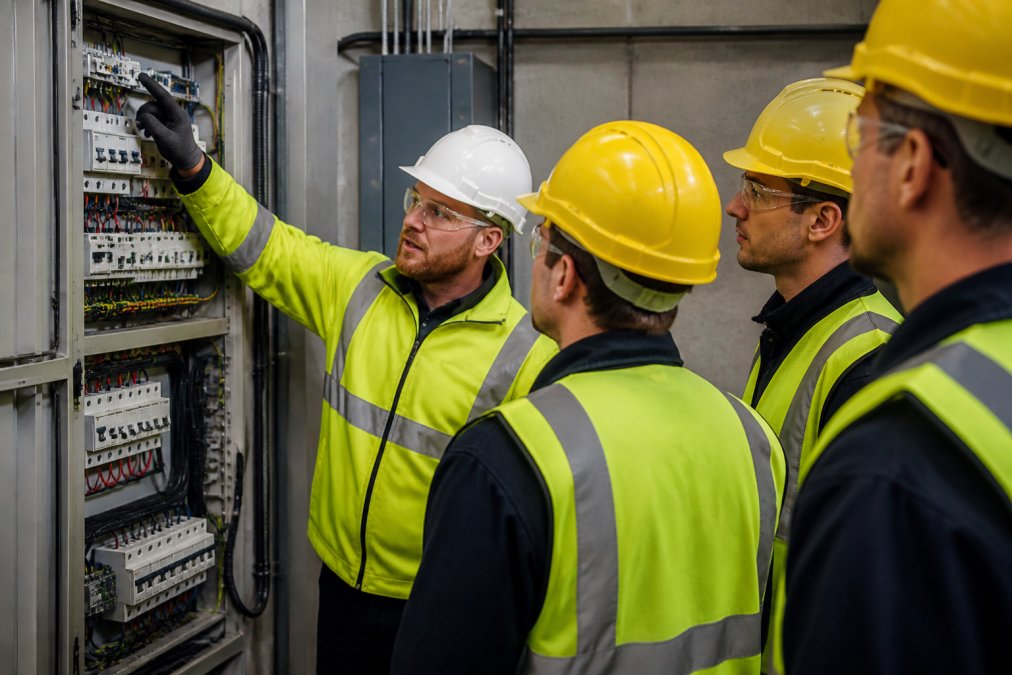
An electrical trainer in high-visibility clothing pointing at a live distribution board while a small group of maintenance engineers in hard hats observe during a hands-on site session
Bespoke electrical training for maintenance teams wins because it starts from the actual tasks your people perform, not from a generic syllabus designed for every industry at once. A hospital facilities team faces different risks than an airport lighting engineer, and off-the-shelf courses rarely accommodate that range.
The most effective programmes begin with a skill gap analysis of your specific workforce. A specialist provider assesses what your team already knows, identifies gaps relevant to your equipment and site conditions, then designs training around those findings, so course time is spent on what your people genuinely need, not on generic content they will never use.
Practical, hands-on training also drives better outcomes than passive classroom delivery. When maintenance engineers physically practise isolation procedures on equipment similar to what they encounter daily, the learning sticks, particularly for teams that are not electricians but must work safely around electrical systems.
Pro Tip Ask any provider whether they will visit your site before designing the course. A specialist willing to assess your actual equipment, switchgear, and working practices will deliver dramatically more relevant training than one working from a standard template.
How to Choose an Electrical Training Provider: A Decision Framework
Most procurement guidance stops at a checklist of credentials. The harder question is matching training depth to the actual risk profile of your workforce. A structured framework helps weigh trade-offs that rarely appear in a provider’s brochure.
Step 1: Map your workforce to a risk tier, not a job title.
The same job title can sit at different risk levels depending on the site. Before evaluating any provider, segment your teams into three tiers:
Tier 1 – Awareness only: Staff who work near electrical equipment but never interact with it directly. Generalist pass training may be sufficient here.
Tier 2 – Task-based competence: Workers who perform defined tasks like switching, isolation, or cable avoidance. They need role-specific training tied to regulations such as HSG47 or GS6.
Tier 3 – Authorised duty holders: Individuals who take legal responsibility for safety decisions, such as authorised persons or senior authorised persons. This tier demands the deepest specialist intervention, often with assessment and revalidation cycles.
This tiering prevents two common mistakes: over-training Tier 1 staff on content they will never use, and under-training Tier 3 staff with awareness-level material that creates a false sense of security.
Step 2: Apply the ‘worst credible failure’ test to each provider.
For each shortlisted provider, ask: if your worker faces the worst credible failure scenario for their role, would this training have changed the outcome? For a groundworker, that scenario is a cable strike; for a maintenance engineer, it is unintended live contact during isolation. If the provider cannot articulate how their course content would influence behaviour in that scenario, the training is unlikely to deliver the competence you need.
Step 3: Compare scalability against customisation, they pull in opposite directions.
This is the trade-off most comparison guides ignore. A generalist provider with a fixed syllabus can scale across hundreds of delegates with consistent quality and predictable pricing. A specialist provider offering bespoke, site-specific training delivers higher relevance but often at the cost of slower rollout and higher per-delegate pricing for small cohorts.
The decision hinges on cohort size and risk uniformity. Training 200 groundworkers across 20 sites with identical risk profiles may suit a standardised specialist programme; 12 maintenance engineers each working on unique equipment justifies a fully bespoke programme. The mistake is assuming one approach fits both scenarios.
Step 4: Verify the assessment method, not just the certificate.
Many providers advertise ‘competency-based training’ but assess through a multiple-choice questionnaire at the end of the day. That measures recall, not competence. Ask specifically how practical skills are assessed: is there a observed demonstration, a simulated fault-finding exercise, or a workplace-based assessment after the course? Providers that offer post-course workplace validation demonstrate greater confidence in their training outcomes.
Step 5: Check the revalidation cycle.
Competence decays. HSG47 awareness fades within months if not reinforced, and isolation procedures need regular practice. Ask each provider what their recommended refresher interval is and whether they offer structured revalidation. A provider that sells a one-off course with no revalidation pathway is not supporting long-term competence.
‘What is your maximum cohort for practical assessment?’
Customisation
Low, fixed syllabus
High, site-specific
‘Will you conduct a pre-training site visit?’
Assessment depth
Knowledge recall
Observed competence
‘How is practical skill assessed?’
Revalidation
Often absent
Structured refreshers
‘What is your recommended refresher interval?’
The framework above does not produce a single ‘right answer’. It forces the trade-offs into the open so the decision reflects your actual risk profile rather than the provider’s marketing materials.
Calculating ROI: What Specialist Training Actually Costs vs What It Saves
The standard argument, ‘one incident pays for the training’, is true but useless without numbers. Below is a direct ROI calculation model comparing generalist pass training against a specialist provider for a defined cohort.
Step 1: Define the training cohort and cost basis.
Assume a utility contractor needs to train 20 groundworkers and site supervisors in HSG47 compliance. The generalist option costs £45 per delegate for a half-day online module, totalling £900. A specialist provider offering a one-day, practical HSG47 course with a site-based assessment component might charge £185 per delegate, totalling £3,700. The upfront difference is £2,800.
Step 2: Estimate the probability-weighted cost of failure.
Cable strikes occur regularly across the UK, and a single strike on a live distribution network can easily generate costs far beyond the immediate repair. Use a conservative scenario:
Direct repair cost: £1,500-£5,000 depending on cable type and depth
Project delay penalties: £500-£2,000 per day of standstill
Investigation and reporting time: £800-£2,500 in internal resource
HSE enforcement action: potential prohibition notices or prosecution, with legal costs starting in the thousands
Reputational impact on future tenders: unquantifiable but often the largest long-term cost
A single moderate cable strike incident typically lands between £8,000 and £25,000 in direct and immediate costs. Even at the lower end, that single incident outweighs the £2,800 training premium by a factor of three.
Step 3: Factor in the probability of failure reduction.
Generalist awareness training reduces risk by improving basic knowledge but does little to change behaviour under pressure. Specialist practical training, with scenario-based exercises and assessment, produces measurably better retention and application. If specialist training reduces the probability of a cable strike by even 10 percentage points, the expected value calculation shifts dramatically.
For a contractor undertaking 50 excavation projects per year with a baseline strike probability of 2% per project, the expected annual cost of strikes is:
With generalist training: 1 expected strike × £15,000 average cost = £15,000 per year
With specialist training (strike probability reduced to 1%): 0.5 expected strikes × £15,000 = £7,500 per year
Annual expected saving: £7,500. Against the £2,800 training premium, the ROI is approximately 168% in the first year alone.
Step 4: Add the productivity and logistics variables.
Specialist providers often deliver on-site, eliminating travel time and accommodation costs. If sending 20 delegates to a central location costs £60 per delegate in travel and lost productive time, that is £1,200 in hidden costs for the generalist option. On-site specialist delivery removes this entirely, narrowing the upfront cost gap to £1,600.
Step 5: Apply the framework to your own context.
The numbers above are illustrative, not universal. The framework, however, transfers directly. Populate it with your own cohort size, incident probability, average incident cost, and training quotes. The calculation forces a comparison based on expected value rather than sticker price.
Key Takeaway A training budget is not an expense line, it is a risk mitigation investment. When the probability-weighted cost of a single incident exceeds the training premium, the specialist option is not more expensive; it is the cheaper choice with better safety outcomes. Run the calculation with your own figures before defaulting to the lowest per-delegate quote.
This framework also addresses the scalability question that most ROI discussions ignore. For large cohorts across multiple sites, the per-delegate premium for specialist training shrinks as on-site delivery eliminates logistics costs. The break-even point often arrives sooner than procurement teams expect.
Conclusion: Matching Training Depth to Your Team’s Real Risks
The choice between pass training and specialised providers ultimately depends on the level of risk your team faces and the regulatory duties you hold. Awareness-level training suits low-risk environments and induction purposes. Specialist, competency-based training is essential where workers make decisions near live electrical systems, buried cables, or energised equipment.
For organisations that need more than a certificate, SJB Electrical Training delivers hands-on electrical safety and compliance programmes across the UK, including HSG47 and GS6 training, authorised person courses, and bespoke programmes for maintenance teams. Our focus on duty holder competence and practical application ensures your workforce achieves genuine compliance with wiring regulations and safety standards.
Get started with SJB Electrical Training and give your team the practical competence to manage electrical risks with confidence.
Frequently Asked Questions
What is the difference between pass training and specialized provider training?
Pass training typically refers to standardised, often generic courses that meet basic compliance requirements. Specialized provider training, such as that offered by SJB Electrical Training, goes further by tailoring content to your specific work environments, equipment, and regulatory obligations like HSG47 and GS6. While pass training confirms understanding, specialized training focuses on practical application, changing behaviours on site, and reducing incidents. The right choice depends on your risk profile and whether your team needs to manage complex electrical hazards.
How do I ensure my electrical safety training meets HSG47 and GS6 requirements?
Verify that the provider explicitly references HSG47 and GS6 in their course design and that trainers hold relevant industry qualifications and hands-on experience. Ask how they assess competence: written tests alone rarely prove practical ability. A credible provider will incorporate site-specific scenarios, live demonstrations, and practical assessments. Request details on their quality assurance processes and accreditation bodies. If they cannot articulate how their training maps to Health and Safety Executive guidance, treat that as a warning sign.
Does my team require bespoke training or a standardised course?
Consider your team’s actual duties and the environments where they work. Standardised courses suit general awareness or induction-level needs, such as basic electrical safety for office staff. Bespoke electrical training for maintenance teams becomes necessary when staff face specific hazards: underground cables, overhead lines, temporary supplies, or complex isolation procedures. If your team has previously completed training but still shows unsafe behaviours on site, that strongly indicates a need for tailored, scenario-based instruction rather than another generic course.
What should I look for when vetting an electrical safety training provider?
Start with accreditation: confirm the provider works to recognised industry standards and that their trainers hold current, verifiable qualifications. Ask about class sizes, trainer-to-delegate ratios, and whether assessments are practical or theory-only. Request references from organisations in your sector and check their incident or near-miss follow-up processes. Confirm whether they offer post-training support, such as refresher materials or site audits. Finally, compare how they handle HSG47 compliance training specifically, because generic providers often lack the depth that specialist consultancies provide.
How does hands-on, specialist training improve long-term electrical risk management?
Hands-on training embeds correct behaviours through muscle memory and real-world problem solving, which classroom theory cannot replicate. When delegates physically practice safe isolation, cable avoidance, and emergency procedures, knowledge retention improves significantly. Specialist providers also tailor scenarios to your equipment and site conditions, meaning staff practise exactly what they will encounter. Over time, this reduces incidents, lowers downtime from cable strikes or electrical faults, and strengthens your safety culture. It shifts training from a compliance exercise to an operational risk management tool.
We use necessary cookies to keep this website secure and working. With your permission, we also use optional cookies to understand site performance and improve our services. Choose Accept All, Reject All or Preferences. You can change your choice at any time.
Cookie Policy
Necessary cookies support security and functions you request. Optional analytics and functional cookies are used only after consent. Some optional cookies may be set by service providers used on our pages. See the Cookie Policy for details.
Necessary cookies help make a website usable by enabling basic functions like page navigation and access to secure areas of the website. The website cannot function properly without these cookies.
Marketing cookies are used to track visitors across websites. The intention is to display ads that are relevant and engaging for the individual user and thereby more valuable for publishers and third party advertisers.
Preference cookies enable a website to remember information that changes the way the website behaves or looks, like your preferred language or the region that you are in.