To safely isolate electrical equipment, first identify every energy source feeding it, including backfeeds, control circuits and stored energy. Then open and lock each isolation point, follow the sequence in order, and prove the circuit dead with a tester checked before and after use. Electrical isolation is only complete once all supplies are secured and proven.
Map every supply, including dual feeds, drives, UPS units and control circuits, before work begins.
Switch off at the load, then open, secure and lock each isolation device, in that order.
Use the prove-test-prove method, checking your tester on a known live source before and after testing.
Use group lockout with a lock box so each worker’s personal lock protects the isolation.
Verify every isolation point and removed lock at each shift handover before work restarts.
Electrical isolation is the process of cutting off every source of electrical energy to a piece of equipment so that you can safely isolate electrical equipment before work begins, without the risk of shock, burns or unexpected start-up.
This guide walks through the full approach, from identifying the equipment to restoring supply safely. It is written for the people who carry this work out and the managers who sign it off. The steps below reflect principles behind HSG47 and GS6 guidance.
Why Safe Isolation Matters on Industrial Sites
To safely isolate electrical equipment, you must treat isolation as the single most important control for preventing electric shock and arc flash injuries on site.
Many accidents happen not because workers ignore the rules, but because they assume a circuit is off.
Good isolation also protects the wider operation. A clear procedure means fewer unplanned shutdowns, fewer near misses and a workforce that trusts the system.
Identifying the Circuit, Equipment and Every Energy Source
Before anything is switched off, the person in charge needs to know exactly what they are isolating. Start with the drawings, single-line diagrams and the equipment’s own nameplate. Confirm the circuit on site, not just on paper, because drawings are often out of date and a panel may have been modified since the last revision.
On industrial plant, the hard part is rarely the main supply. It is the second, third and fourth source that nobody remembered. Work through the following for every item of equipment:
Identify the equipment by its tag number, location and function, and match it to the drawing before you touch anything
Trace every supply, including standby generators, UPS units, dual-fed distribution boards and interlocks from other plant
Find the point of isolation for each supply, a circuit breaker, disconnect switch, isolator or removable link, and confirm it actually isolates the section you are working on
Check control circuits, which may run at a lower voltage but can still be fed from a separate source and remain live when the power circuit is dead
Look for backfeeds from motor drives, regenerative loads, parallel panels, neighbouring equipment and temporary supplies
Note stored energy, such as capacitors, springs, hydraulic pressure, pneumatic pressure or elevated machinery
Accounting for multiple feeds and complex equipment
A single item of equipment can be fed from more than one direction. Common patterns include:
Dual-fed boards and changeover arrangements, where either of two supplies can energise the same busbar
Motor drives and inverters, which can feed energy back into the circuit even after the supply is switched off
UPS and battery systems, which maintain voltage on circuits that appear dead
Generators and embedded generation, which may run independently of the mains supply
Interconnected machinery, where one line can back-feed another through shared services or control wiring
The practical approach is to build a source map for the equipment before work begins. List every supply, every isolation point and every stored-energy source on one sheet, then walk the route on site and tick each one off. If you cannot account for a source, stop and investigate, do not assume it is dead.
Watch OutA common mistake is isolating the main supply and forgetting a second feed from a motor drive, a parallel panel or a control circuit. Mapping every source before work begins is the only reliable way to prevent this.
Multiple feeds are the usual reason isolation goes wrong, so check each one against the sources below.
Feed source
Why it matters
What to check
Dual-fed boards
Either supply can energise the busbar
Every changeover supply
Motor drives and inverters
Can feed energy back after switch-off
Regenerative or back-feed paths
UPS and battery systems
Keep voltage on apparently dead circuits
Battery and UPS output
Generators
May run independently of mains
Standby and embedded generation
Interconnected machinery
One line can back-feed another
Shared services and control wiring
Obtaining Permission, Risk Assessment and Coordinating the Work
No isolation should start without authority. On most sites, an authorised person issues a permit or safe system of work that sets out the scope, the isolation points and who is responsible at each stage.
Before the permit is issued, carry out a short risk assessment. It should cover:
The voltage and fault level of the equipment
Whether any part of the system must stay live, and how that is controlled
Access, lighting and the working environment
The people involved and their competence
What happens if the isolation fails or the work overruns
Coordinate with operations, other trades and the shift team. Tell everyone affected that the equipment will be down, and agree how the work will be handed back. Clear communication stops someone restarting plant while another person is still inside it.
Electrical Safe Isolation Procedure: Switching Off and Isolating
This is the core of the process. Follow the steps in order every time, and never skip one because the job looks simple.
Notify everyone affected that isolation is about to begin
Switch off the load at its normal control point
Open the isolation device at each point of isolation
Secure each device so it cannot be closed by accident
Prove the circuit is dead using the method described below
Apply your personal lock and warning tag
The electrical safe isolation procedure is only complete when every point of supply has been opened, secured and proven. If any single source is missed, the whole isolation is unsafe.
Watch out: Switching off at the control panel is not isolation. A stop button or software command only stops the load.
Lock Off and Tag Out Procedure
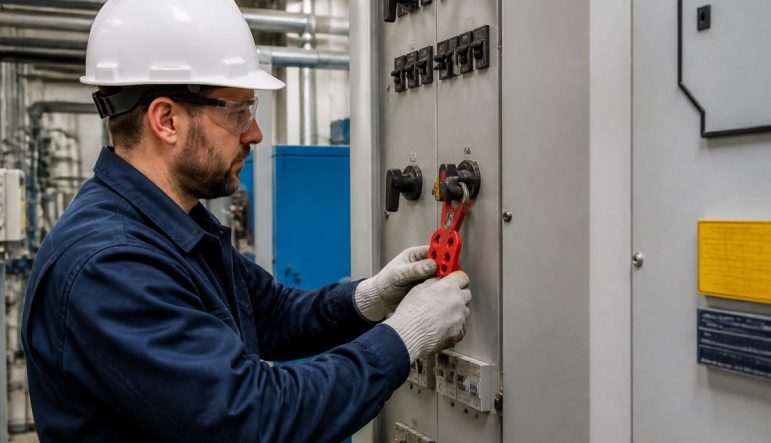
Locking off physically prevents anyone from reconnecting the supply while work is underway. Tagging out gives a written warning of why the isolation is in place. On a single-worker job this is straightforward; on an industrial site with multiple trades, contractors and shift changes, the procedure has to be designed to survive people coming and going.
Worker in high-visibility gear using a padlock to safely isolate electrical equipment in an industrial switchroom
A proper lock off and tag out procedure normally includes:
A personal padlock for each person working on the circuit
A lock-off device (a hasp or multi-lock clamp) where more than one padlock fits a single point
A warning tag stating who applied it, the reason, the date and the expected duration
A lock register or lock box so the team can see who holds each lock and why
Group lockout and lock boxes
Where several people work on the same isolation, use a group lockout arrangement rather than a chain of personal locks on the device itself:
The authorised person applies the primary lock and tag to the isolation device.
A lock box is attached to that primary lock, and the key to the isolation device goes inside the box.
Each worker then applies their own personal lock to the lock box and keeps the key.
The box cannot be opened, and the isolation cannot be removed, until every personal lock has been taken off.
This gives each worker ownership of the isolation without requiring every padlock to fit the device itself. It also makes it obvious at a glance how many people are protected by the isolation.
Shift handover and changing crews
Isolation ownership must transfer cleanly when a shift ends or a crew changes:
The outgoing worker removes their personal lock only after the incoming worker has applied theirs and confirmed the isolation is still in place.
The handover is recorded, who holds which lock, what work remains, and any changes to the isolation.
The incoming worker re-proves the circuit dead before starting work, even if the isolation appears undisturbed.
Never leave a lock on a device that nobody is actively working under, and never remove another person’s lock. If a worker leaves site without removing their lock, follow the site’s formal lock-removal authority procedure, usually requiring management authorisation, a check that the equipment is clear, and a written record, rather than cutting the lock off informally.
Pro TipA lock register that shows every lock, its holder and its purpose turns a tangle of padlocks into a clear picture of who is protected and where. Review it at every handover.
Prove Dead Procedure: Testing Before You Touch
Opening a switch does not prove that a circuit is dead. Faulty equipment, back-feeds and incorrect labelling can all leave a conductor live. The prove dead procedure is the only reliable check.
Use the prove-test-prove method:
Prove your voltage tester works on a known live source
Test the circuit to confirm it is dead, at every conductor and phase
Prove the tester again on a known live source
Use a tester rated for the voltage involved and check its test leads before each use.
Never rely on indicator lamps, panel meters or a colleague’s word. Test at the point of work, and test every phase.
Industrial Electrical Isolation Checklist and Restoring Supply
Before any work is signed off, run through a final check. This industrial electrical isolation checklist is a useful starting point for your site:
Every energy source is identified on the drawings and on site
Permit issued and risk assessment completed
All isolation devices opened and secured
Circuit proven dead at each phase, with the tester proven before and after
Personal locks and warning tags fitted
Stored energy released or controlled
Everyone affected has been told
Restoring supply needs the same care as isolating it. Confirm that all work is complete and everyone is clear of the equipment. Each person removes their own lock, the permit is closed, and the supply is reconnected in the reverse order. Tell the operations team before any equipment is restarted.
Booking Your Isolation Procedure Training
Written procedures only work when people can apply them under pressure. Practical, hands-on training can help teams understand what to do when they are near live equipment.
SJB Electrical Training offers HSG47 and GS6 training, and AP / Authorised Person and Competent Person courses.
Book your isolation procedure training today, and make safe isolation part of how your team works every day.
Frequently Asked Questions
What are the steps for safely isolating electrical equipment?
Safe isolation follows a fixed sequence: identify every source of supply, obtain permission to work, switch off at the correct point of isolation, secure the device against reconnection with a personal lock and warning tag, and then prove the circuit dead with a tested voltage indicator before any work starts.
How do you prove electrical equipment is dead before work begins?
Use the prove-test-prove method. First test a known live source with your voltage tester to confirm it works, then test the isolated equipment to confirm absence of voltage across all conductors and phases, and then re-test the known live source to confirm the tester still functions. Check for residual voltage, backfeed from other sources and stored energy, such as capacitors, before touching anything. The tester must be fit for the voltage level and suitable for the environment, and it should be checked for damage before each use.
Who is authorised to isolate electrical equipment on an industrial site?
Only persons who have been formally deemed competent and authorised by the site employer may carry out isolation. Authorisation usually follows training on the site’s safe systems of work, the specific equipment involved and the test instruments used. The authorised person should understand the isolation procedure, the permit to work system and how to handle multiple energy sources. Authorisation should be reviewed when equipment, procedures or site arrangements change.
What should you do if an electrical isolation point is unclear?
Stop work and do not assume the equipment is isolated. Trace the circuit from the load back to its supply, check drawings and single-line diagrams, and confirm with the site electrical engineer or responsible person. If the isolation point cannot be verified, treat the equipment as live and do not begin work until the position is clarified and recorded on the permit.
Frequently asked questions about electrical isolation are answered in the sections above. For tailored advice on your site, speak to our team.
We use necessary cookies to keep this website secure and working. With your permission, we also use optional cookies to understand site performance and improve our services. Choose Accept All, Reject All or Preferences. You can change your choice at any time.
Cookie Policy
Necessary cookies support security and functions you request. Optional analytics and functional cookies are used only after consent. Some optional cookies may be set by service providers used on our pages. See the Cookie Policy for details.
Necessary cookies help make a website usable by enabling basic functions like page navigation and access to secure areas of the website. The website cannot function properly without these cookies.
Marketing cookies are used to track visitors across websites. The intention is to display ads that are relevant and engaging for the individual user and thereby more valuable for publishers and third party advertisers.
Preference cookies enable a website to remember information that changes the way the website behaves or looks, like your preferred language or the region that you are in.