AGL 1-3 Certification and Standard Electrical Training: Key Differences
The difference between AGL 1-3 certification electrical training and standard electrical training comes down to specialisation. AGL 1-3 certification is a focused qualification designed specifically for maintaining airfield ground lighting systems at airports. Standard electrical training, such as City & Guilds 2365, provides broad foundational knowledge across general installation, design, and fault-finding. One prepares you for a niche but critical role; the other opens doors across the entire electrical industry.
For airport operations managers and maintenance teams, this distinction matters enormously. You need to know which pathway serves your workforce’s actual role and regulatory obligations.
Below, we’ll break down exactly what each qualification covers, who needs which, and how they stack up against real workplace requirements.
Key Takeaway AGL 1-3 is specialist and narrow, it teaches only airfield ground lighting. Standard electrical training is broad and transferable but doesn’t cover airport-specific systems. Choose based on your actual job function, not generic “more training is better” thinking.
What AGL 1-3 Certification Covers
AGL 1-3 certification addresses installation, maintenance, and testing of airfield ground lighting systems, including runway lights, taxiway markings, approach lighting, and their electrical infrastructure. The curriculum focuses on systems unique to aviation infrastructure: electrical circuits specific to airfield lighting, how these systems interface with airport operations, and safety protocols that prevent failures affecting aircraft movements. The “1-3” designation reflects three levels of competency.
Airfield ground lighting systems and components
Airfield lighting systems operate under strict regulatory requirements. The training covers physical infrastructure, aviation-rated light fixtures, airport-grade electrical cabling, and control systems managing lighting sequences. You’ll learn voltage drop calculations for long runway circuits, how ambient temperature affects component performance, and how grouping factors influence circuit design, practical constraints that determine system reliability.
Safe isolation and testing procedures specific to AGL
Testing and isolation procedures for airfield lighting differ from standard electrical testing. You’ll learn to safely isolate circuits whilst maintaining airport operations, a challenge unique to aviation environments. Procedures follow CAA (Civil Aviation Authority) guidance and international standards. Assessment verifies your ability to verify circuit integrity, check voltage compliance across long cable runs, and confirm control system responses.
Standard Electrical Training: Scope and Application
Standard electrical training typically follows the City & Guilds 2365 framework or equivalent qualifications, teaching installation, design, fault-finding, and safety across building types and industrial settings. The breadth is the defining feature: residential wiring, commercial installations, industrial systems, and underlying theory. A City & Guilds-qualified electrician can work on hospitals, factories, offices, or domestic properties.
City & Guilds 2365 and industry-recognised qualifications
City & Guilds 2365 is the apprenticeship standard for electrical installation in the UK. It combines on-the-job training with formal assessment covering electrical science, installation practices, wiring regulations (BS 7671), health and safety, circuit design, fault diagnosis, and testing procedures. The qualification is widely recognised by UK employers and often serves as a foundation before pursuing specialist certifications in areas like airfield systems.
General installation, design, and fault-finding skills
Standard training teaches circuit design for typical buildings, systematic fault diagnosis, and safe installation across diverse environments. The focus is adaptability and broad competence rather than depth in specialist areas like airport operations.
Qualification
Focus
Scope
Best For
AGL 1-3
Airfield lighting systems only
Narrow, aviation-specific
Airport maintenance teams
City & Guilds 2365
General electrical installation
Broad, multi-sector
Electricians seeking foundational qualification
Standard electrical training
Installation, design, fault-finding
General building and industrial
Career entry and broad competency
Electrical Safety for Airport Maintenance Staff
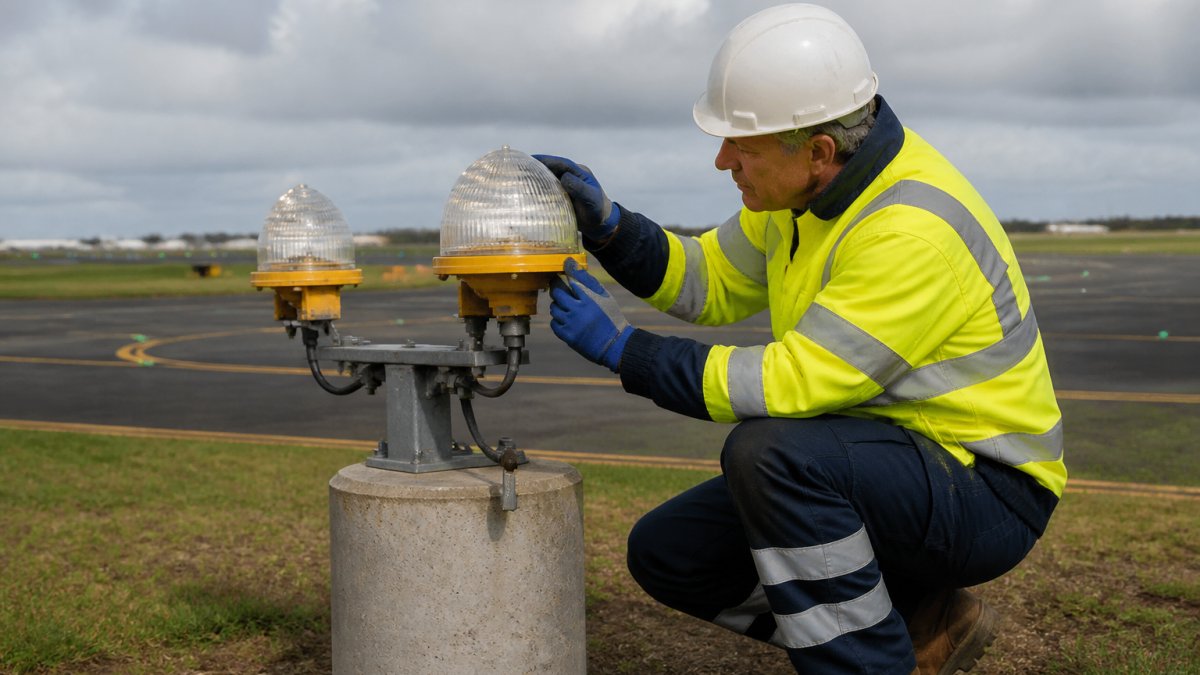
Professional maintenance technician in high-visibility safety clothing inspecting airfield ground lighting fixtures mounted on a concrete pole at an airport runway, with runway lights and taxiway markings visible in the background during daytime
Electrical safety at airports operates under heightened regulatory scrutiny from the Civil Aviation Authority (CAA) and Health and Safety Executive (HSE).
Watch Out Many maintenance teams attempt to apply general electrical safety practices to airfield systems and discover gaps during compliance audits. The specific training exists because airports are not typical electrical environments, and generic training doesn’t account for that reality.
CAA Airfield Lighting Regulations and Compliance
The Civil Aviation Authority sets the technical and safety standards for airfield lighting in the UK. These are not guidelines, they are regulatory requirements that airports must demonstrate compliance with.
AGL Maintenance Training Duration and Delivery
Understanding the time investment required for each qualification is critical when planning workforce development. The headline numbers are straightforward, but the real-world picture, how long until someone is actually competent and independently deployable, is more nuanced.
AGL 1-3: Intensive specialist training
AGL 1-3 certification requires formal training, plus supervised on-site experience before independent competency. This compressed timeline allows you to upskill existing maintenance teams relatively quickly.
Standard electrical training: Extended apprenticeship model
Standard electrical training (City & Guilds 2365 apprenticeship) requires 3 to 4 years combining on-the-job experience (2,500-3,000 hours), formal instruction (400-600 hours, typically 1 day per week), and ongoing assessment. The extended timeline reflects the breadth required: competency across residential, commercial, and industrial installations.
AGL 1-3 training is delivered as off-site block, on-site, or blended. Standard electrical training is delivered through apprenticeship providers as day-release (one day per week at college) or block-release (two weeks at college), with the apprentice remaining employed and contributing to operations.
Competency assessment and sign-off
AGL 1-3 assessment is completed within days of formal training; certification follows practical assessment, though employers typically require supervised practice before independent sign-off on live systems. Standard electrical assessment is ongoing throughout the apprenticeship, with formal assessment at the end.
Planning your training timeline
For upskilling existing maintenance staff on airfield lighting, AGL 1-3 certification electrical training is efficient, competency within weeks. For recruiting new staff into the electrical trade, standard training is essential foundational knowledge. For long-term airport maintenance capability, recruit apprentices into standard training, then add AGL 1-3 certification after qualification to create broadly competent electricians who are also aviation-system specialists.
Watch Out Do not underestimate the on-site experience component of AGL 1-3 training. Formal training teaches the theory and principles; on-site experience teaches you how those principles apply to your specific airfield infrastructure.
Career Progression and ROI: Which Qualification Suits Your Role
Career value depends on your immediate role and long-term goals. Organisations often invest in broad qualifications that don’t match the specific value their employer recognises.
Employer perspective: What hiring managers look for
Airport maintenance teams prioritise evidence of competency in their specific environment. AGL 1-3 certification signals safe work within CAA-regulated systems and understanding of airfield hazards, a compliance requirement auditors verify. City & Guilds 2365 is valuable as foundation but doesn’t demonstrate aviation-specific competency. An airport manager reviewing two candidates will prioritise the one with both qualifications; the first would require additional training before independent sign-off, creating cost and timeline burden.
Job security and specialisation trade-offs
AGL 1-3 creates a narrower but more defensible position: airports cannot replace you with a general electrician, creating job security but limiting options in other sectors. Standard training creates broader optionality, City & Guilds-qualified electricians can work in airports, hospitals, factories, commercial buildings, or domestic settings. The trade-off: specialisation = security in a narrow field; generalisation = flexibility across many fields.
Progression routes and further qualifications
If you hold AGL 1-3 certification, your next step is typically moving into supervisory or management roles within airport maintenance, or pursuing additional specialist certifications in related areas (for example, advanced airfield systems or airport operations management). Your progression is constrained by the aviation sector.
Pro Tip If your current role is airport maintenance, AGL 1-3 is the qualification that directly increases your value to your employer and meets regulatory requirements. If you’re early in your electrical career, standard training first, then specialist certifications later, gives you the most flexibility and earning potential.
Practical Assessment and Competency Requirements
Both AGL 1-3 and standard electrical qualifications include practical assessment, but the focus differs significantly.
Test and inspect airfield lighting circuits to CAA standards
Diagnose faults in airfield-specific systems
Understand and apply voltage drop calculations in long-run circuits
Demonstrate knowledge of safe working practices in aviation environments
Standard electrical assessment covers:
General circuit design and installation
Fault diagnosis across diverse system types
Testing and inspection using standard procedures
Health and safety awareness
Knowledge of wiring regulations (BS 7671)
Frequently Asked Questions
What is AGL 1-3 certification and who needs it?
AGL 1-3 certification is a specialist qualification for professionals maintaining airfield ground lighting systems at airports. It covers the safe operation, testing, and isolation of airport lighting infrastructure. Airport maintenance teams, contractors working on airfield projects, and authorised persons responsible for lighting safety require this certification to comply with CAA regulations and HSG47 guidance. Standard electrical training does not cover the specific technical and safety requirements of airfield lighting systems.
How does AGL maintenance training duration compare to standard electrical qualifications?
AGL 1-3 training is typically delivered as a focused, intensive programme lasting days rather than months, targeting the specific competencies needed for airport lighting work. Standard electrical training such as City & Guilds 2365 Level 2 or 3 spans 12-36 months as part of apprenticeships or full-time courses, covering broad electrical installation theory and practice. AGL training prioritises depth in a narrow specialism, while standard training builds a foundation across the entire electrical trade. Your delivery model, on-site or classroom-based, affects scheduling flexibility for both.
What specific CAA airfield lighting regulations does AGL training address?
AGL training ensures compliance with Civil Aviation Authority standards for airfield ground lighting safety and performance. It covers safe isolation procedures, voltage drop calculations, ambient temperature correction, and grouping factors specific to airport infrastructure. Trainees learn how to interpret and apply airfield lighting specifications, conduct fault-finding on lighting circuits, and maintain compliance with HSG47 (Health and Safety Executive guidance on electrical safety) and GS6 (guidance on safety in confined spaces and underground services). Standard electrical training does not address these aviation-sector-specific regulatory requirements.
Is AGL 1-3 certification suitable if I’m not working in aviation?
No. AGL 1-3 is designed exclusively for airport and airfield maintenance environments. If you work in industrial, commercial, or domestic settings, standard electrical training such as City & Guilds 2365 or an Authorised Person qualification is more appropriate. AGL training assumes working knowledge of airfield systems and regulatory frameworks unique to aviation. Choosing the right qualification ensures your training matches your actual role and industry requirements, avoiding wasted investment in irrelevant specialist content.
We use necessary cookies to keep this website secure and working. With your permission, we also use optional cookies to understand site performance and improve our services. Choose Accept All, Reject All or Preferences. You can change your choice at any time.
Cookie Policy
Necessary cookies support security and functions you request. Optional analytics and functional cookies are used only after consent. Some optional cookies may be set by service providers used on our pages. See the Cookie Policy for details.
Necessary cookies help make a website usable by enabling basic functions like page navigation and access to secure areas of the website. The website cannot function properly without these cookies.
Marketing cookies are used to track visitors across websites. The intention is to display ads that are relevant and engaging for the individual user and thereby more valuable for publishers and third party advertisers.
Preference cookies enable a website to remember information that changes the way the website behaves or looks, like your preferred language or the region that you are in.