Every year, workers across construction and maintenance are seriously injured or killed by preventable electrical incidents. Live buried cables, overhead lines, and faulty temporary supplies can turn a routine task into a life-threatening event. Understanding how to prevent site electrical accidents is the difference between going home safely and becoming a statistic.
At SJB Electrical Training, we deliver hands-on safety and compliance training that translates regulations like HSG47 and GS6 into practical, daily habits. A site electrical accident is an event caused by contact with, or failure of, live electrical systems, often resulting in electric shock, burns, or arc flash injuries. The financial and human toll makes proactive prevention the only sensible strategy.
Below, we walk through a five-step framework for preventing site electrical accidents, covering risk assessment, underground cable avoidance, overhead line safety, and duty holder competence, plus common mistakes that undermine safety programmes.
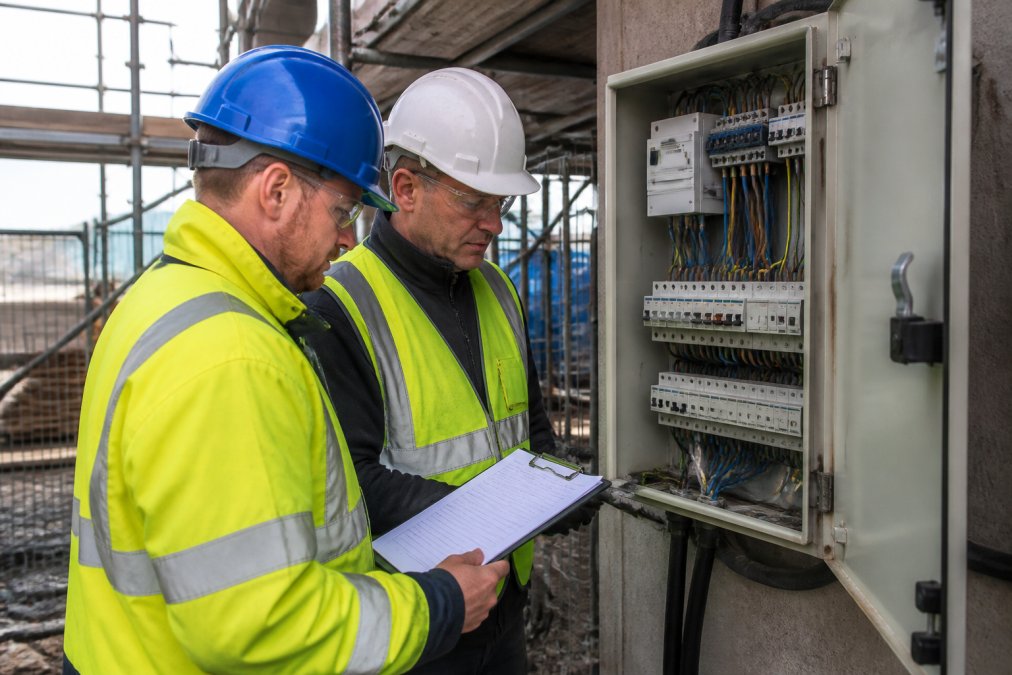
A site manager in a high-visibility vest and hard hat reviewing a clipboard checklist with a colleague in front of an electrical distribution board on a construction site
Step 1: Conduct a Site-Specific Electrical Risk Assessment
The foundation of any prevention strategy is a thorough, site-specific electrical risk assessment. Generic templates fail when they don’t account for your location’s unique hazards: wiring age, buried services, or temporary power supplies. The HSE expects this assessment to be ‘suitable and sufficient’, specific to the tasks, environment, and people on site.
An effective electrical risk assessment template must identify every potential electricity source, the voltage and current involved, and tasks that could bring a worker into contact with it. For each hazard, document the likelihood and severity of an incident. This informs control measures, from isolation procedures to PPE.
A practical framework for the assessment follows a five-step model:
Identify the electrical hazards: Walk the site and systematically list all sources, including the permanent mains supply, site distribution board, temporary generators, portable transformers, extension leads, and any buried or overhead services. Don’t forget less obvious sources like cathodic protection systems or static build-up.
Decide who might be harmed and how: Go beyond the operative doing the task. Consider the banksman guiding a crane, the visitor walking through a work area, or the maintenance worker who might later work on a system you’ve installed. Consider how they could be harmed: direct contact, electric shock, arc flash burns, fire, or explosion.
Evaluate the risk and decide on precautions: For each hazard, determine the risk level (likelihood x severity) and apply the hierarchy of control. Can you eliminate the risk by isolating the supply? If not, can you substitute a lower voltage (e.g., 110V for portable tools)? If not, can you engineer controls like RCDs or physical barriers? Only as a last resort rely on administrative controls (signs, permits) and PPE.
Record your findings: The record must be clear and accessible to all workers, not a dense document locked in the site office. A visual risk assessment board at the site entrance or a laminated card for each task is often more effective. The record should detail the hazard, the risk rating, and the specific control measure.
Review and update: The assessment is a living document. It must be reviewed whenever site conditions change, new equipment arrives, ground is excavated, or a different contractor starts work. A static document is a liability.
A common failure is treating the risk assessment as a one-off event. Effective sites conduct a short ‘dynamic risk assessment’ at the start of each task or shift, asking: ‘Has anything changed since this plan was written? Is the isolation point still accessible? Is the RCD tested?’ This bridges the gap between the formal document and reality.
Watch Out A risk assessment that identifies a hazard but does not specify a clear, actionable control measure is not compliant. For example, writing ‘be careful of overhead lines’ is insufficient. A compliant entry would state: ‘Exclusion zone established with physical barriers at 6m from line. Banksman to supervise all crane movements. Line owner (National Grid) contacted and isolation confirmed for work within the zone.’
Step 2: Apply HSG47 Underground Cable Avoidance
Many serious incidents occur when workers strike buried cables during excavation. The Health and Safety Executive’s guidance document HSG47 outlines the legal and practical steps required to avoid underground services. Following this guidance is a core element of how to prevent site electrical accidents involving excavation work.
The process begins with planning: obtain accurate utility drawings and use cable avoidance tools (CAT scanners) before any ground is broken. This requires ongoing verification as you dig, since cable depths and positions can vary from drawings. A common approach combines scanning, hand-digging near suspected services, and clear communication with the utility owner.
HSG47 training must go beyond theory. Workers need to practice interpreting signals and responding when a cable is unexpectedly found. Striking a live cable can cause explosions, electric shock, and fatal burns.
Step 3: Follow GS6 Overhead Power Line Safety
Working near overhead power lines presents a different challenge: the hazard is visible, yet workers become complacent about its reach. GS6 provides the regulatory framework for keeping people, plant, and materials at a safe distance.
The first rule is to establish an exclusion zone around the lines, marked with physical barriers and warning signs. For work that could encroach, consult the line owner to arrange isolation or goalposts and other protective measures. Never assume a line is dead or clearance is sufficient; voltage dictates the minimum distance.
Effective GS6 overhead power line safety relies on planning the site layout so cranes, excavators, and tall loads never enter the danger area, often meaning redesigning access routes and storage. When risk cannot be eliminated, a dedicated banksman should supervise every movement of plant near the lines.
Step 4: Meet Electrical Duty Holder Training Requirements
Prevention ultimately depends on people knowing what they are doing. The electrical duty holder training requirements ensure those responsible for managing electrical systems have the competence to do so safely, extending beyond electricians to site managers, supervisors, and permit issuers.
A duty holder is anyone responsible for the safety of others in relation to electrical systems. Their training must cover hazard identification, isolation and lockout tagout principles, and protective devices. Depth varies by role, but the standard is consistent: no one must perform a task they are not competent to undertake.
For many organisations, the gap lies in translating knowledge into behaviour. Training focused on assessment and compliance can leave workers unprepared for a busy site. Practical, scenario-based instruction reinforces safe systems until they become habitual.
Step 5: Build a Daily Prevention Checklist
A strong prevention strategy is only as good as its daily execution. A simple, repeatable checklist ensures critical checks are performed every day, by every team. This checklist should be a practical tool for preventing site electrical accidents, not a box-ticking form. The most effective checklists are short, specific, and tied to a named individual accountable for sign-off.
The checklist should cover the key areas of risk:
Verify portable tools and leads: Before any power tool is used, it must have a valid Portable Appliance Testing (PAT) sticker. The daily check goes further: look for damage to the outer sheath of the cable, check that the plug is not cracked and the pins are not bent, and ensure the tool’s casing is intact. A common failure is using a 240V tool when the policy requires 110V; check the transformer is rated correctly for the tool’s wattage.
Test residual current devices (RCDs): The daily check confirms an RCD functions, not just that it is present. Press the ‘T’ or ‘Test’ button before power is applied; this should trip the device instantly. If it doesn’t trip, the RCD is faulty and must be taken out of service immediately. For fixed RCDs in the distribution board, test weekly; for portable RCDs used with extension leads, test daily.
Inspect cables, plugs, and sockets: Look for signs of overheating (brown scorch marks on plugs or sockets), cuts or abrasions on cable sheaths, and loose connections where the cable enters the plug. A cable that feels warm to the touch is a sign of overloading or a poor connection. Any damaged item must be taken out of use and labelled ‘FAULTY – DO NOT USE’.
Re-check underground services: Before any excavation begins that day, re-verify the location of underground services. The CAT scanner should be used to sweep the area again, even if it was done yesterday. Ground conditions can change, and marker paint can be obscured. The daily check confirms that the exclusion zone for hand-digging is still correctly marked.
Confirm overhead line exclusion zones: Check that physical barriers, goalposts, and warning signs under overhead power lines are still intact and clearly visible. Look for any new plant or equipment brought onto site that might have a taller reach than previously planned. Confirm the banksman is on duty and knows the safe clearance distances.
Ensure correct PPE is available: The daily check confirms that insulated gloves, matting, and arc flash protection are available at the point of use, not just stored in a locked cabinet. Check for cuts, punctures, or signs of perishing on rubber insulating gloves. Insulated matting should be clean and dry.
Prevention Step
Key Action
Common Failure Point
Risk Assessment
Identify all live supply sources and tasks
Using generic, outdated templates
Cable Avoidance
Use CAT scanners and hand-dig near services
Trusting drawings over live detection
Overhead Lines
Establish and maintain exclusion zones
Plant operators ignoring height limits
Duty Holder Training
Confirm competence for specific site roles
Confusing general knowledge with task readiness
Daily Checklist
Inspect tools, RCDs, and barriers every shift
Rushing checks to save time
A Unique Angle: Moving Beyond the Paper Checklist
While the paper checklist remains the legal minimum, leading sites supplement it with digital tools that provide higher assurance:
IoT-Enabled RCD Monitoring: Smart distribution boards can monitor RCD trip events remotely. If an RCD trips, the system logs the time, the circuit, and sends an alert to the site manager’s phone. This provides data on recurring faults that a daily manual test would miss. For example, if an RCD trips three times in a week on the same circuit, it indicates a persistent earth fault needing investigation, not just a simple reset.
Digital Permit-to-Work Systems: Instead of paper permits that can be lost or forgotten, digital systems on a tablet or phone require a supervisor to confirm each isolation point and test result before the permit is issued. The system can enforce a sequence of checks, ensuring that voltage testing is done before work is authorised. This creates an auditable trail far more robust than a signature on a form.
Thermographic Scanning: For permanent installations or long-running temporary supplies, a weekly thermal imaging scan of the distribution board can identify hot spots caused by loose connections or overloaded circuits before they fail. A loose connection can generate enough heat to melt insulation and cause a fire, but it won’t trip a breaker. Thermal scanning catches this hidden risk.
These digital tools do not replace the human check but add continuous monitoring a once-a-day paper check cannot provide. They also create a data trail that identifies systemic issues, moving the site from a reactive ‘check and fix’ culture to a proactive ‘predict and prevent’ culture.
Common Mistakes That Lead to Site Electrical Accidents
Even with procedures in place, incidents happen due to recurring human and organisational errors. One of the most common is assuming a circuit is dead because a switch is off. Without proper lockout tagout and voltage testing before work begins, this assumption can be fatal.
Another frequent mistake is misusing temporary power supplies. Overloading sockets with adaptors, using damaged extension leads, or failing to protect supplies with the correct fuse or breaker rating creates serious fire and shock risk. Workers also often neglect to check for ground fault circuit interrupters (GFCIs), essential for protecting against shock in damp conditions.
Psychological factors also play a role. Time pressure and a culture prioritising productivity over safety lead workers to take shortcuts. Combating this requires visible leadership and a willingness to stop work when a hazard is unclear. All personnel, including maintenance teams, must understand the specific electrical hazards they face and how to respond.
Conclusion: Start Preventing Site Electrical Accidents Today
Preventing site electrical accidents is a continuous commitment requiring strong systems, the right equipment, and above all, competent people. Regulations provide the framework, but true safety comes from embedding these principles into your site’s daily culture. From the first risk assessment to final checks, every action contributes to a safer working environment.
SJB Electrical Training specialises in equipping duty holders and their teams with the practical skills needed to manage these risks confidently. Our expert-led programmes cover critical areas like HSG47 and GS6, ensuring your workforce understands not just the rules, but how to apply them in real-world conditions.
Get started with SJB Electrical Training and give your team the competence to work safely around electrical systems.
Frequently Asked Questions
What are the 5 main electrical hazards on a construction site?
The five main hazards are contact with overhead power lines, striking underground cables, using faulty or damaged equipment, overloading circuits, and working in wet conditions. Each requires specific controls. For example, overhead lines need exclusion zones per GS6, while underground cables demand cable avoidance tools and safe digging practices per HSG47. A proper site-specific risk assessment should identify which of these hazards apply to your work areas.
What is the difference between HSG47 and GS6 guidance?
HSG47 focuses on avoiding underground services. It covers planning, using cable locating tools, and safe digging practices before you break ground. GS6 applies to work near overhead power lines, setting out exclusion zones, and using goalposts or barriers to keep plant and materials clear. Both are published by the Health and Safety Executive. Site managers should apply the relevant guidance to the specific hazards present on their site.
Who is responsible for electrical safety on a construction site?
The principal contractor and the client share responsibility under the Construction (Design and Management) Regulations. They must appoint a competent electrical duty holder to manage the fixed installation and temporary supplies. That duty holder is responsible for ensuring systems are designed, installed, and maintained safely. Every worker also has a duty under the Health and Safety at Work Act to follow training and report hazards they identify.
Book Training with our specialists to build a safer, more compliant site.
We use necessary cookies to keep this website secure and working. With your permission, we also use optional cookies to understand site performance and improve our services. Choose Accept All, Reject All or Preferences. You can change your choice at any time.
Cookie Policy
Necessary cookies support security and functions you request. Optional analytics and functional cookies are used only after consent. Some optional cookies may be set by service providers used on our pages. See the Cookie Policy for details.
Necessary cookies help make a website usable by enabling basic functions like page navigation and access to secure areas of the website. The website cannot function properly without these cookies.
Marketing cookies are used to track visitors across websites. The intention is to display ads that are relevant and engaging for the individual user and thereby more valuable for publishers and third party advertisers.
Preference cookies enable a website to remember information that changes the way the website behaves or looks, like your preferred language or the region that you are in.