Understanding Electrical Hazards and Risk Assessment
Electrical safety power lines and other electrical hazards pose serious risks in any workplace, yet many teams underestimate the danger until something goes wrong. The real challenge is recognising subtle risks that sit dormant until conditions align dangerously.
Electrical hazards fall into several categories: contact with live conductors, arc flash, thermal burns, and electrocution. Each requires different control measures. The first step in any risk assessment is identifying where these hazards exist: electrical equipment, distribution boards, cables overhead or underground, and temporary installations. Document everything.
Risk assessment isn’t a one-time box-tick exercise. Conditions change: new equipment arrives, contractors work in unfamiliar areas. A proactive assessment reviews these changes and adjusts controls accordingly.
At SJB Electrical Training, we’ve found that teams with strong risk assessment processes feel more confident on site: they know what they’re looking for, understand why zones are restricted, and can explain the reasoning to their crew.
Electrical Duty Holder Training Requirements
Your organisation has a legal duty to ensure anyone working near electrical systems understands the risks, a direct requirement under the Electricity at Work Regulations 1989. The person responsible for ensuring this training happens is the duty holder, often a site manager, maintenance lead, or facilities director.
The duty holder must ensure anyone who may encounter electrical hazards receives training tailored to their role. A groundworker digging near underground cables needs different training than an electrical technician testing equipment, and a caravan park manager must ensure seasonal staff understand overhead line hazards.
Training must cover hazard identification, safe work practices, and what to do if something goes wrong. It must be delivered by someone competent, documented, and refreshed when conditions change or staff aren’t following what they learned.
Many organisations assume a single session covers everyone for years, but people forget, new staff arrive, and complacency sets in. The duty holder must check training actually sticks, through observation, questioning, and incident review.
Workplace Electrical Safety Training Duration and Delivery
How long should electrical safety training take? Duration is the wrong first question. The right one is: what must this person be able to do, unaided, on your site? Duration follows from the competency standard.
Separate three tiers of worker, because each needs a different depth and a different way of proving it.
Tier 1, Informed persons. Office staff, cleaners, warehouse operatives, and anyone who might reset a breaker, plug in equipment, or notice a damaged cable.
Tier 2, Instructed persons. Groundworkers, maintenance assistants, plant operators, and contractors working near but not on electrical systems. This is where HSG47 and GS6 awareness sits.
Tier 3, Authorised and competent persons. People who isolate, test, or work on or near live systems under a permit.
Delivery method matters as much as duration. Classroom theory alone doesn’t build confidence.
Refresher triggers are worth building into your compliance calendar rather than relying on a fixed annual date. Common triggers include:
A change in role, site, or the equipment the person works on
A new or altered electrical installation, or a change in supply arrangements
An incident, near-miss, or a finding from an audit or inspection
A gap in practice observed during supervision or a toolbox talk
A lapse in the person’s authorisation or their underlying qualification
To test whether training has landed rather than just been attended, run short competency checks at the point of work.
The HSE publishes guidance on electrical safety in the workplace, and the Electricity at Work Regulations 1989 set the duty to prevent danger.
HSE electrical safety in the workplace guidance
Key Takeaway Duration is an output, not a target. Define the competency standard first, then choose the shortest delivery that reliably gets someone there, and record how you checked it.
HSG47 Compliance Best Practices for Excavation and Underground Work
HSG47, the HSE guidance on avoiding danger from underground services, is essential reading for anyone managing excavation work. It isn’t a regulation itself, but reflects what the HSE expects organisations to do to comply with health and safety law.
The core principle is simple: before you dig, know what’s below. Underground cables, gas pipes, water mains, and drainage all create hazards.
HSG47 compliance starts with service location: contact the utility companies, use cable and pipe locating services, mark the ground, and brief your team on what’s been found.
Many teams treat HSG47 as a paperwork exercise: request a locate report, file it, move on. Genuine compliance means your team understands the risks, knows how to identify services in the ground, and has a clear process for stopping work if something looks wrong.
Documentation matters. Keep records of service location requests, the reports received, and how you managed the risks. If an incident occurs, the HSE will ask what you knew and when. Strong records show you took the duty seriously.
GS6 Overhead Power Line Safety: Establishing Safe Zones
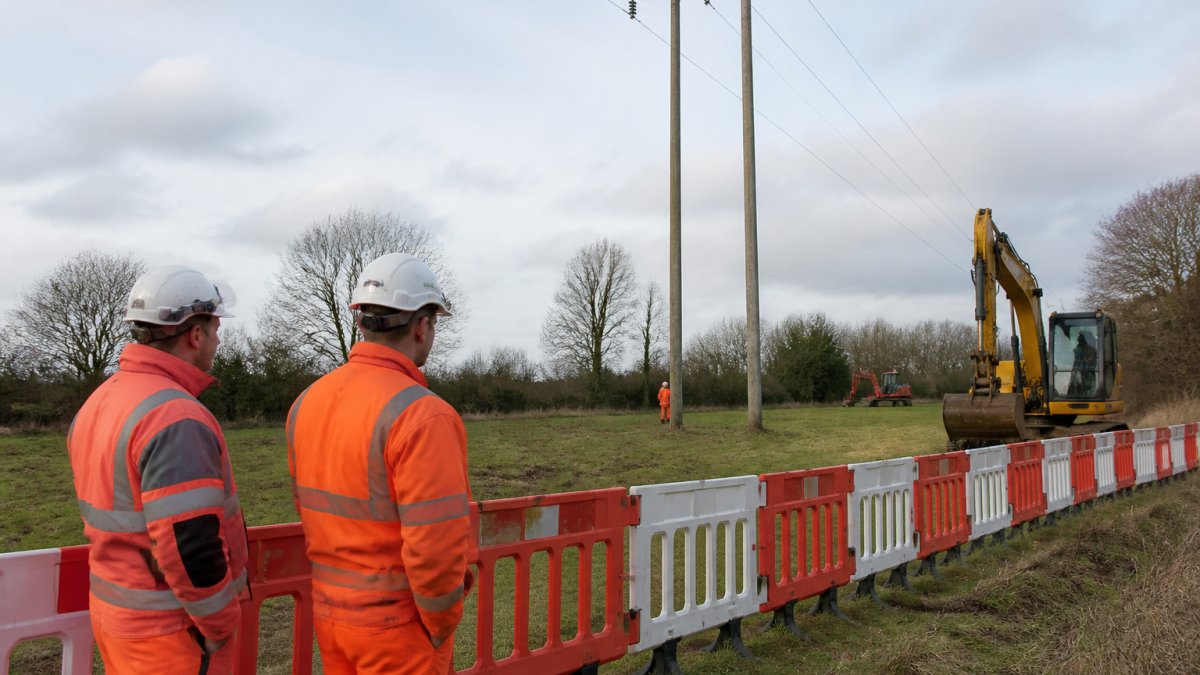
Construction team working at a safe distance from overhead power lines with visible safety barriers and warning signs on a typical UK work site
Overhead power lines are invisible killers. A crane, a ladder, or even a person standing on a vehicle can contact a line carrying thousands of volts. GS6, the HSE guidance on electrical safety power lines, sets out how to manage this hazard.
The starting point is establishing safe clearance zones. For most overhead lines, the safe distance is at least 5.2 metres horizontally and 3.3 metres vertically, depending on voltage.
GS6 compliance requires you to identify all overhead lines on or near your site, mark them, and brief your team.
Many caravan parks, construction sites, and industrial facilities have overhead lines posing constant risk. Seasonal staff, contractors, and new employees may not recognise the hazard.
Documenting GS6 compliance matters. Record where lines are, what voltage they carry, what work is planned near them, and what controls are in place, this shows the HSE you’ve thought through the risk.
Electrical Inspections, Testing and Compliance Documentation
Most articles stop at ‘inspect regularly and keep records’. The harder question is how you turn inspection, testing, isolation, and recordkeeping into a single repeatable workflow a manager can run, audit, and defend.
Start by separating the things that are often lumped together under ‘testing’:
Fixed installation inspection and testing, carried out under BS 7671, the wiring regulations. The output is an Electrical Installation Condition Report (EICR) with a schedule of inspections and test results, coded for the action required. Intervals are set by the duty holder based on use, environment, and risk, commonly a few years for routine commercial premises, shorter for harsher environments.
In-service inspection of equipment and installations, looking for damage, deterioration, and misuse between formal tests, a routine, often weekly or monthly, visual check recorded against the asset.
Portable appliance testing, which is not a blanket legal requirement. The legal duty is to maintain equipment so it doesn’t cause danger; PAT is one way to demonstrate that for portable equipment, and frequency depends on the equipment and how it’s used.
The workflow that holds this together has five stages, and each one produces a record:
Register the assets. You cannot manage what you haven’t listed. A simple asset register, location, description, supply details, responsible person, is the foundation for every inspection, test, and isolation decision.
Set the intervals and the criteria. Decide, on risk, how often each asset is inspected and tested, and what ‘acceptable’ looks like. Record the reasoning, that’s what an inspector or the HSE will want to see.
Plan and schedule the work. Build due dates into a calendar so inspections are proactive rather than reactive. A spreadsheet is often enough for small sites; dedicated compliance software earns its place on larger or multi-site estates.
Control the work itself. Before anyone works on or near a system, apply permit-to-work and isolation discipline: identify the circuit, isolate it, prove dead, lock and tag, and record who applied and removed the isolation. The Electricity at Work Regulations 1989 require live work only where it is unreasonable to work dead and suitable precautions are taken, the default is dead working.
Close the loop. Every inspection, test, or isolation produces a finding. Findings need an owner, an action, a deadline, and a sign-off. A finding logged but never closed is worse than no record at all, because it shows you knew and did nothing.
Documentation is where this either becomes a managed process or a filing cabinet. The records that matter most are:
Asset register and inspection/test schedule
EICRs and any remedial action plans, with completion evidence
In-service inspection records and defect logs
Permit-to-work and isolation records, including who held the lock and key
Training and authorisation records for each named person
Incident, near-miss, and audit findings, with corrective actions and dates closed
A common failure pattern is disconnected records, a test certificate in one folder, a permit in another, a training matrix in a third. When something goes wrong, the investigation must reconstruct the picture from fragments. A single indexed compliance file per site, or a shared system with consistent naming, removes that risk.
Build in a periodic self-audit. Once a quarter, pick a sample of assets and trace them end to end: is the asset on the register, is the inspection in date, was the last finding closed, is the responsible person still authorised? This is the technique an external auditor or the HSE would use, and running it yourself first turns a potential enforcement finding into an internal improvement.
Watch Out A finding that is recorded but not closed is a liability, not a control. Always assign an owner and a deadline, and verify closure.
HSE guidance on maintaining portable and transportable electrical equipment
Building a Safety Culture Through Competence and Accountability
Confidence at work comes from knowing your team can handle electrical hazards safely, resting on two foundations: competence and accountability.
Competence means your people have the knowledge and skills to do the job safely, built through training, mentoring, and experience.
Accountability means people take responsibility for safety decisions. When a worker spots a hazard, they must feel safe reporting it. When someone cuts corners, there are consequences. When an incident happens, you investigate and learn, not blame.
Many organisations claim a strong safety culture but don’t invest in the fundamentals. They skip training to save time, don’t investigate incidents properly, and promote people on production speed rather than safety judgment.
Building confidence when working around electrical systems and power lines isn’t about a false sense of security. It’s about genuine competence through proper training, clear processes, and a culture where safety decisions are valued.
Frequently Asked Questions
What are the key responsibilities of an electrical duty holder under UK law?
An electrical duty holder is responsible for ensuring that electrical systems are safe, properly maintained, and that work is carried out by competent persons. Under the Electricity at Work Regulations 1989, duty holders must assess electrical risks, implement control measures, ensure workers receive appropriate training, and maintain records of inspections and tests. This includes establishing safe systems of work, providing personal protective equipment where needed, and ensuring compliance with standards such as BS 7671.
How does HSG47 influence safe excavation and work near underground cables?
HSG47 (Avoiding Danger from Underground Services) provides guidance on identifying and managing risks when working near buried electrical cables and other services. It requires a proactive risk assessment before excavation, use of cable-locating services, safe digging techniques, and establishing exclusion zones. HSG47 compliance means planning work carefully, using qualified personnel to locate services, and maintaining safe distances. This approach prevents cable strikes that could cause serious injury or death.
What is the role of GS6 in managing risks near overhead power lines?
GS6 (Avoidance of Danger from Overhead Electric Lines) sets out how to work safely near overhead power lines. It requires risk assessment to identify line locations and voltages, establishing safe clearance zones (typically 4.5 metres for lines under 11 kV), selecting appropriate control measures such as banksmen or insulated tools, and emergency response procedures. GS6 compliance ensures workers understand the hazards and follow safe systems of work to prevent electrocution or arc flash incidents.
How can organisations measure whether electrical safety training has actually changed worker behaviour?
Effective measurement goes beyond test scores. Track near-miss reporting rates, observe safe work practices during site audits, review incident records, and gather feedback from supervisors on worker confidence and decision-making. Competent workers should demonstrate correct hazard identification, appropriate use of control measures, and proper documentation. Regular refresher training, on-site coaching, and leadership commitment to safety culture reinforce learning and ensure training translates into genuine behavioural change on the ground.
We use necessary cookies to keep this website secure and working. With your permission, we also use optional cookies to understand site performance and improve our services. Choose Accept All, Reject All or Preferences. You can change your choice at any time.
Cookie Policy
Necessary cookies support security and functions you request. Optional analytics and functional cookies are used only after consent. Some optional cookies may be set by service providers used on our pages. See the Cookie Policy for details.
Necessary cookies help make a website usable by enabling basic functions like page navigation and access to secure areas of the website. The website cannot function properly without these cookies.
Marketing cookies are used to track visitors across websites. The intention is to display ads that are relevant and engaging for the individual user and thereby more valuable for publishers and third party advertisers.
Preference cookies enable a website to remember information that changes the way the website behaves or looks, like your preferred language or the region that you are in.