Why Electrical Risk Assessment Matters in Warehouses
Electrical hazards cause serious injuries and deaths in warehouse environments every year. Conducting an electrical risk assessment warehouses need isn’t just a compliance box to tick, it’s the foundation of keeping your team safe and your operation running without costly shutdowns or incidents.
Warehouses present unique electrical challenges. You’ve got distribution boards, portable appliances, temporary lighting rigs, and often staff who aren’t electricians working near live systems. One faulty cable or overlooked hazard can trigger a fire, electrocution, or arc flash. The legal duty sits with you as the employer or duty holder.
This guide walks you through conducting a proper electrical risk assessment for warehouses step by step. We’ll cover what you need to identify, how to evaluate risk, and what control measures actually work in a warehouse setting.
Key Takeaway An electrical risk assessment for warehouses identifies what could go wrong with your electrical systems, who might be harmed, and what you need to do to prevent incidents.
Legal Requirements and Employer Responsibilities
Under the Health and Safety at Work Act and the Electricity at Work Regulations, you have a duty to assess electrical risks and manage them. That’s not optional, it’s a legal requirement.
Your responsibility as an employer or duty holder includes:
Identifying all electrical hazards on your premises
Assessing the risk each hazard poses to your workforce
Implementing control measures to reduce or eliminate that risk
Keeping records of your assessment
Reviewing and updating your assessment regularly
Ensuring staff are trained to work safely around electrical systems
The Electricity at Work Regulations require that electrical systems are maintained in a safe condition. That means testing, inspection, and preventative maintenance on a schedule that matches the risk level.
Many warehouse operators assume that having an electrician on speed dial is enough. It isn’t. You need a documented assessment that shows you’ve thought through the risks systematically, not just reacted to breakdowns.
Watch Out Failing to conduct a proper electrical risk assessment for warehouses leaves you liable for prosecution if an incident occurs. Fines can reach tens of thousands of pounds, plus potential criminal charges for gross negligence.
Identifying Electrical Hazards in Your Warehouse
Before you can assess risk, you need to spot what could go wrong. Electrical hazards in warehouses fall into several categories.
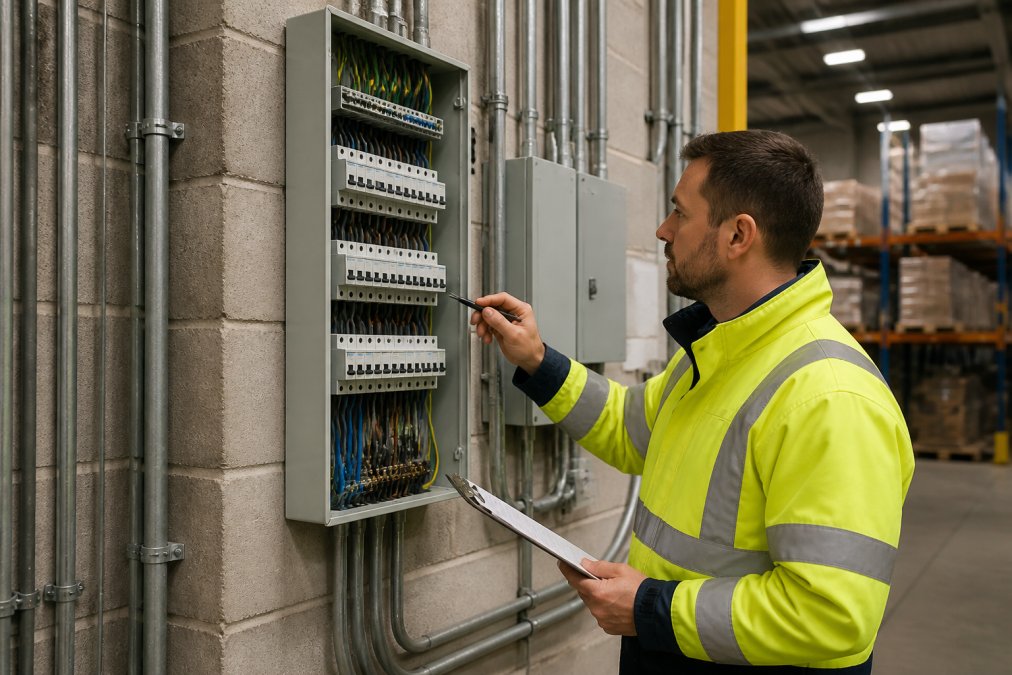
Warehouse worker inspecting a circuit breaker panel for an electrical risk assessment in a warehouse.
Fixed electrical installations include your main distribution board, sub-boards, wiring, lighting circuits, and emergency lighting.
Common electrical hazards in warehouses:
Damaged or frayed cables and leads
Overloaded circuits and extension leads
Poor earthing and bonding of equipment
Lack of residual current devices (RCDs) on circuits
Inadequate maintenance of fixed wiring
Staff without training working near live systems
Temporary electrical supplies not properly installed
Faulty or missing circuit breakers
Insulation resistance below safe levels
Step-by-Step Risk Assessment Process
A structured approach keeps you from missing anything. This is the framework that satisfies legal requirements and actually protects your team.
Step 1: Gather Information and Map Electrical Systems
Start by documenting what electrical infrastructure you have. Walk your warehouse with a clipboard and list every fixed installation, distribution board, circuit, portable appliance category, and temporary supply.
Map out:
Location of all distribution boards and sub-boards
Not everyone in your warehouse faces the same electrical risk. A forklift driver charging equipment faces different hazards than an office staff member, who faces different hazards than your maintenance team.
Maintenance and technical staff
Forklift and equipment operators
General warehouse operatives
Temporary or agency workers
Visitors and contractors
Cleaning staff (especially if they’re working near electrical equipment)
Step 3: Evaluate Existing Control Measures
You likely already have some controls in place. Your job here is to assess whether they’re adequate.
Existing controls might include:
RCDs on circuits (these trip if there’s a fault, cutting power in milliseconds)
Insulation and earthing of equipment
Maintenance schedules and records
Staff training and competence checks
Labelling and warning signs
Lockout/tagout procedures for maintenance work
PAT testing records for portable appliances
Step 4: Determine Risk Levels and Prioritise Actions
Risk = likelihood × severity. A hazard that’s very likely to cause serious harm is high risk. A hazard that’s unlikely and would cause minor harm is low risk.
Your team needs to understand electrical risks and how to work safely. The level of training depends on their role and exposure.
Pro Tip Training sticks better when it’s delivered on-site and tied to real hazards in your warehouse. Staff see the distribution board they work near, the cables they step over, the equipment they use, and understand why the safety rules matter.
Warehouse Electrical Inspection Checklist
A systematic checklist ensures you don’t miss anything during your assessment. Use this as a template and adapt it to your warehouse.
Fixed electrical installation:
EICR completed within the last 5 years (1 year if high-risk environment)
All distribution boards accessible and labelled
Circuit breakers and RCDs tested and working
Earthing and bonding in place and tested
Cables protected from damage, moisture, and heat
Emergency lighting functional and tested
No signs of scorch marks, burns, or overheating on equipment
Adequate ventilation around electrical equipment
Portable appliances:
PAT testing records up to date
No damaged cables or plugs in use
Leads stored safely, not tangled or kinked
Sockets not overloaded
Chargers for forklifts and equipment in good condition
Extension leads rated for the load they carry
Environmental conditions:
No standing water near electrical equipment
Dust and debris cleared from around boards and equipment
Temperature and humidity within safe ranges for equipment
No vibration damage to cables or connections
Staff and procedures:
Training records show all relevant staff are competent
Lockout/tagout procedures documented and followed
Incident reporting system in place
Electrical faults reported and logged
Contractors vetted for electrical competence before work begins
Portable Appliance Testing Frequency and Schedule
PAT testing checks that portable appliances are safe to use. The frequency depends on the environment and how heavily the equipment is used.
General warehouse environment:
Hand tools: annually
Extension leads: annually
Chargers for forklifts and equipment: every 6 months
Portable heaters: annually
Kitchen appliances: annually
High-risk environments (wet, dusty, or with heavy vibration):
All portable appliances: every 6 months
Extension leads: every 3 months
Visual inspection between tests:
Damaged cable or plug
Scorch marks or burn damage
Loose connections
Signs of water damage
Key Takeaway Portable appliance testing schedules should be based on environment and use. High-risk warehouses need more frequent testing. Visual inspections between tests catch obvious damage early.
Control Measures and Preventative Actions
Once you’ve identified risks, you need control measures that actually reduce them. The hierarchy of controls applies: eliminate the hazard if you can, then engineer controls, then administrative controls, then PPE.
Engineering controls:
Install RCDs on circuits to cut power if there’s a fault
Upgrade to modern distribution boards with better protection
Use cable conduit or ducting to protect leads from damage
Install proper earthing and bonding throughout
Fit circuit breakers sized correctly for the load
Administrative controls:
Maintenance schedules and records
Staff training and competence checks
Lockout/tagout procedures for maintenance work
Incident reporting and investigation
Regular review and update of the risk assessment
PPE:
Insulating gloves for staff working near live systems
Safety footwear with electrical insulation properties
Hard hats with chin straps (to prevent contact with overhead cables)
Frequently Asked Questions
How do you perform an electrical risk assessment in a warehouse?
Begin by mapping all electrical systems and identifying who could be harmed. Evaluate existing control measures like circuit breakers, earthing and bonding, and residual current devices. Determine risk levels using a risk matrix, then document findings and implement preventative maintenance schedules. Record all actions and review annually or when systems change. This structured approach ensures compliance with the Electricity at Work Regulations 1989.
What electrical duty holder training requirements apply to warehouse managers?
Duty holders must understand their legal obligations under the Health and Safety at Work Act and the Electricity at Work Regulations. Training should cover hazard identification, control measures, risk evaluation, and competent person requirements. Managers need practical knowledge of fixed wire testing, portable appliance testing schedules, and when to engage specialists. Hands-on training ensures staff can recognise electrical faults and follow safe systems of work in real warehouse conditions.
What should a warehouse electrical inspection checklist include?
A comprehensive checklist covers visual inspection of distribution boards, circuit breakers, and cable routes; verification of earthing and bonding integrity; assessment of emergency lighting and fire safety systems; portable appliance condition; and documentation of any electrical faults. Include checks for moisture or corrosion in high-humidity areas, overhead hazards, and underground service locations. Document findings with photographs and assign responsibility for remedial action within specified timeframes.
How often should portable appliance testing be performed in warehouses?
Portable appliance testing frequency depends on equipment type and use intensity. High-risk items like extension leads and power tools in warehouses typically require testing every 6-12 months. Lower-risk fixed appliances may be tested annually. The assessment process should establish your warehouse’s specific schedule based on equipment condition, manufacturer guidance, and statutory requirements. Maintain a testing register with dates and results to demonstrate compliance with the Electricity at Work Regulations.
We use necessary cookies to keep this website secure and working. With your permission, we also use optional cookies to understand site performance and improve our services. Choose Accept All, Reject All or Preferences. You can change your choice at any time.
Cookie Policy
Necessary cookies support security and functions you request. Optional analytics and functional cookies are used only after consent. Some optional cookies may be set by service providers used on our pages. See the Cookie Policy for details.
Necessary cookies help make a website usable by enabling basic functions like page navigation and access to secure areas of the website. The website cannot function properly without these cookies.
Marketing cookies are used to track visitors across websites. The intention is to display ads that are relevant and engaging for the individual user and thereby more valuable for publishers and third party advertisers.
Preference cookies enable a website to remember information that changes the way the website behaves or looks, like your preferred language or the region that you are in.