Why Electrical Safety Training for Hospitals Is Different From Other Sites
Electrical safety training for hospitals answers to a stricter rulebook than training on a construction site or in a warehouse. The stakes are higher because the people at risk include patients on life-support equipment, and the estate itself carries HTM 06-01 obligations that general site induction never touches.
At SJB Electrical Training, we build hospital programmes around that distinction. A maintenance assistant changing a lamp in a ward corridor needs a different level of competence from an Authorised Person signing off isolation permits on a theatre suite’s supply.
The core difference comes down to three things:
Duty of care extends to non-staff. Patients and visitors cannot be expected to avoid electrical hazards, so control measures must be absolute rather than advisory.
Continuity of supply is clinical, not commercial. Losing power to a theatre or ICU is a patient safety event, so isolation and testing procedures carry extra layers of verification.
The estate is mixed-age and mixed-standard. A hospital campus often runs new build alongside Victorian-era infrastructure, all governed by the same wiring regulations.
Most generic electrical safety courses treat hospitals as just another commercial premises. That framing is where the compliance gaps start.
HTM 06-01 Compliance Training: The Framework Your Programme Must Follow
HTM 06-01 is the Department of Health guidance that sets out how electrical safety should be managed in healthcare premises, and it is the document your training programme should be built around. It sits alongside BS 7671 wiring regulations guidance rather than replacing them.
HTM 06-01 guidance from NHS England covers the management structure, the appointment of Authorised and Competent Persons, and the documentation expected for every isolation and permit-to-work. Training that does not reference this framework will leave gaps an inspector will find.
Key Takeaway HTM 06-01 is a management framework, not a course syllabus. Your training should map each role to the specific duties that framework assigns it.
Electrical Risk Assessment for Healthcare Facilities: Step by Step
A hospital electrical risk assessment follows the same logic as any other risk assessment, with clinical continuity added as a scoring factor. What separates a defensible assessment from a tick-box one is that every risk is scored against the consequence of losing supply to a clinical area, not just the likelihood of a shock.
Work through these steps in order.
List every electrical installation and its criticality category. Theatre suites, ICU, imaging, mortuary, kitchens and plant rooms all carry different consequences if supply is lost. Group them into three tiers: life-critical (theatre, ICU, neonatal, renal), clinical-support (imaging, pathology, pharmacy cold storage, mortuary) and non-clinical (offices, catering, grounds).
Identify who works near each installation. Include estates staff, portering, catering and clinical staff who operate equipment. A ward nurse plugging in a syringe driver is exposed to a different risk from an electrician working on a distribution board.
Score likelihood and severity separately. Use a simple 1-5 scale for each. Severity for any life-critical tier installation should be scored at 5 regardless of likelihood, because the consequence of failure is a patient safety event, not a maintenance inconvenience.
Record existing controls against each risk. RCD protection, barriers, labelling, permit-to-work systems, and the presence of a trained Authorised Person on shift. Note whether each control is verified or assumed.
Set actions with owners and dates. Assign each gap to a named person, not a department. “Estates team” is not an owner.
Review on a fixed cycle and after every change. A common mistake is treating the assessment as a one-off document. It should be revisited after any new installation, any change of use of a room, and after any near-miss.
HSE guidance on risk assessment sets out the five-step principle this method follows, adapted here for clinical continuity.
Key Takeaway An assessment that scores likelihood but not clinical consequence will rank a faulty socket in an office above a degraded supply to a theatre. Tier the installation first, then score.
The output of the assessment should feed directly into the training matrix. If a risk is controlled by a permit-to-work system, the people issuing and receiving those permits need the matching competence recorded against their name. That link between assessment and training record is what an inspector will look for.
Authorised Person Electrical Training: Who Needs It and What It Covers
Authorised Person electrical training is for the named individual who controls high-voltage and low-voltage isolation on site, and it is not the same qualification as general electrical safety awareness. In a hospital setting, that person typically sits within the estates team and holds formal appointment under HTM 06-01.
The course covers safe isolation procedure, permit-to-work issue and cancellation, lock-off and tagging, testing before and after isolation, and the documentation trail an audit will expect to see.
Competent Person training is the tier below. It suits technicians who carry out work under an Authorised Person’s permit but do not authorise isolation themselves. Getting the tier wrong is one of the most common findings in a safety audit, because a Competent Person signing off an isolation is outside their remit.
Watch Out Appointing someone as Authorised Person without the matching training record creates a paper trail that works against you in an incident investigation, not for you.
Electrical Safety Training Duration for Hospitals: How Long Each Role Needs
Electrical safety training duration for hospitals depends on the role, not a single fixed number. Awareness-level training for non-electrical staff typically runs half a day, while Authorised Person courses run across several days with practical assessment.
Role
Typical Duration
Refresher Cycle
Non-electrical maintenance staff
Half day
Every 3 years
Competent Person
1-2 days
Every 3 years
Authorised Person (LV)
3-4 days
Every 3 years
Authorised Person (HV)
4-5 days
Every 3 years
Refresher intervals should also trigger on a change of role, a change of site, or after any near-miss involving electrical work. Training that only runs to the calendar and ignores those triggers will not keep competence current.
Building the Training Programme: A Step-by-Step Rollout
Rolling out a hospital training programme works best when it is staged by role rather than delivered as one all-staff event. A single mass session usually means the Authorised Person and the porter sit through the same content, and neither gets what they need.
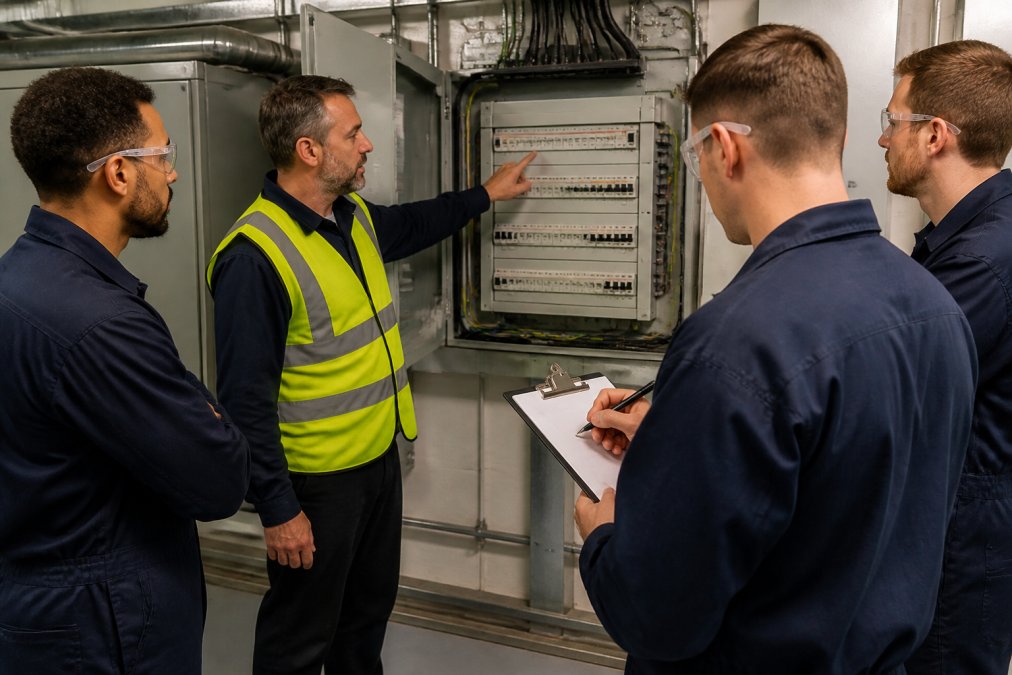
A hospital estates supervisor in a high-vis vest briefing a small group of maintenance staff in a plant room, pointing at a distribution board while one technician takes notes on a clipboard
Map roles to training tiers. Separate awareness, Competent Person and Authorised Person groups before booking anything.
Sequence by risk. Train Authorised Persons first so they can supervise the rest of the rollout.
Deliver on-site where possible. Plant room and switchroom context makes the practical assessment meaningful.
Assess practically, not just by written test. Isolation and permit procedures need to be demonstrated.
Record completion against each named individual. Digital records make audit retrieval straightforward.
Schedule refreshers at booking. Diarise the next cycle before the first course finishes.
Pro Tip Running the practical assessment in the actual switchroom your staff use, rather than a training centre mock-up, is the single biggest driver of retention. People remember the board they will actually isolate.
Emergency Response Protocols, Record Keeping and What to Avoid
Emergency response protocols should be written before an incident, not after. Every hospital electrical safety programme needs a clear procedure for electrical shock, arc flash, and unexpected loss of supply to a critical area, with named first responders and a defined escalation route to the on-call estates manager. Most training content stops at the installation and testing stage and never covers what staff should actually do in the first five minutes of an electrical incident, that gap is where serious harm happens.
Electrical shock
The priority is to break contact safely without becoming a second casualty. Staff should be trained to isolate at the nearest distribution board or use the emergency stop where fitted, never to pull a casualty clear by hand. Once isolated, call for clinical help through the standard crash call route, begin first aid if trained, and preserve the scene for investigation. The Authorised Person or on-call estates manager must be notified immediately, and the incident logged the same day.
Arc flash
Arc flash incidents produce burns, blinding light and a pressure wave. Staff should not approach a panel that has flashed until it has been isolated and confirmed dead.
Loss of supply to a critical area
Watch Out A protocol that names a department rather than a person fails at 3am on a Sunday. Every escalation step needs a named individual and a named deputy.
Digital record keeping for compliance
Common pitfalls in insurance claims
Conclusion
Frequently Asked Questions
What are the electrical safety requirements for hospital maintenance staff?
Non-electrical maintenance staff need awareness-level electrical safety training covering hazard identification, safe isolation awareness, permit-to-work rules and when to escalate to an Authorised Person. Staff carrying out electrical work need competence-based training mapped to HTM 06-01 and BS 7671, plus a clear appointment letter defining their duties. Everyone should understand the limits of their role and the reporting route for defects.
How does HTM 06-01 influence electrical training in healthcare settings?
HTM 06-01 sets the framework for electrical infrastructure in healthcare premises, including safety, availability and resilience of supplies. It drives training by defining the duty holder structure, the appointment of Authorised and Competent Persons, and the documentation expected for safe systems of work. Your training programme should reference HTM 06-01 directly so staff understand how their daily tasks fit the required management structure.
How long does electrical safety training for hospitals take?
Duration depends on role. Awareness sessions for non-electrical staff usually run half a day, while Competent Person courses typically take one to three days plus assessment. Authorised Person training often runs several days because it includes appointment-level responsibilities and practical assessment. Refresher training is commonly needed every three years or sooner if responsibilities change.
How often should hospital electrical systems be inspected and tested?
Fixed installations are typically inspected and tested on a five-year cycle, though HTM 06-01 and risk assessment can shorten this for critical care areas or high-demand equipment. Portable appliances follow a risk-based schedule, with higher-risk items checked more often. Emergency lighting, generators and uninterruptible supplies need their own periodic testing regime, and all results should feed into a live maintenance schedule.
We use necessary cookies to keep this website secure and working. With your permission, we also use optional cookies to understand site performance and improve our services. Choose Accept All, Reject All or Preferences. You can change your choice at any time.
Cookie Policy
Necessary cookies support security and functions you request. Optional analytics and functional cookies are used only after consent. Some optional cookies may be set by service providers used on our pages. See the Cookie Policy for details.
Necessary cookies help make a website usable by enabling basic functions like page navigation and access to secure areas of the website. The website cannot function properly without these cookies.
Marketing cookies are used to track visitors across websites. The intention is to display ads that are relevant and engaging for the individual user and thereby more valuable for publishers and third party advertisers.
Preference cookies enable a website to remember information that changes the way the website behaves or looks, like your preferred language or the region that you are in.