
We use cookies to optimize your experience, analyze traffic, and personalize ads. Please choose whether you accept our use of non-essential cookies. Read More
York
08:00 AM - 05:00 PM
Last Updated: August 28, 2026
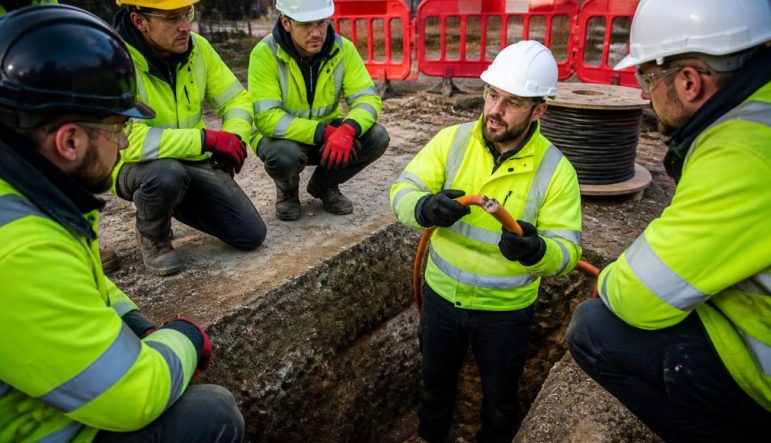
Electrical hazard training for groundworkers isn’t optional, it’s survival. Every year, groundworkers encounter buried cables, overhead power lines, and electrical systems they’re not trained to recognise. The consequences are stark: electrocution, severe burns, cardiac arrest, or death. Ground disturbance is one of the highest-risk activities on any construction or maintenance site. A single mistake, striking a cable you didn’t know was there, failing to isolate a live circuit, or working too close to overhead power lines, can change everything in a fraction of a second.
Many groundworkers have never received formal training on how to identify electrical hazards, use detection tools, or respond when something goes wrong. This guide covers electrical hazard training for groundworkers: what the hazards are, what the law requires, how to assess risk on your site, and how to embed safe practices that stick.
Beneath most UK construction and maintenance sites sits a network of services: electricity cables, gas pipelines, water mains, telecommunications ducts, and sometimes steam or district heating pipes. These are live, pressurised, or both. Strike one, and the results are immediate and often irreversible.
Underground electricity cables are the primary hazard for groundworkers. High-voltage cables (above 1,000 volts) can arc across gaps and ignite surrounding materials. Medium-voltage cables (400-1,000 volts) deliver enough energy to cause cardiac fibrillation. Low-voltage cables (below 400 volts) still kill. A cable buried just 600 mm below the surface isn’t protected by depth alone; a spade or pickaxe will breach it.
The real danger is that buried services don’t announce themselves. Service plans, the maps that show where cables and pipes run, are often incomplete, inaccurate, or decades old. Utility companies update them irregularly, and routes change when repairs happen. A groundworker relying on an outdated plan is working with incomplete information.
Cable strikes happen because the person with the spade didn’t know a cable was there. You need to know what types of cables are typically buried in your area, how deep they’re usually installed, what the warning signs are (colour-coded tape, marker posts, surface markings), how to use detection equipment correctly, and what to do if you suspect a cable is nearby. Weather adds another layer of risk. After heavy rain, soil shifts and cables can settle or become exposed.
HSG47 Avoidance of Danger from Underground Services is the Health and Safety Executive‘s guidance on avoiding danger from underground services. If you’re a duty holder, site manager, contractor, or organisation responsible for ground disturbance, you’re legally required to follow it. The Health and Safety at Work etc. Act 1974 and the Management of Health and Safety at Work Regulations 1999 make this explicit.
HSG47 sets out the steps you must take before, during, and after ground disturbance, built on a hierarchy of control:
Step 1: Plan and prepare. Obtain service plans from utility companies, consult with utility operators, identify all known underground services, mark out their routes on the ground, and assess the risks specific to your site.
Step 2: Use detection equipment. Before and during excavation, use a Cable Avoidance Tool (CAT) and, where appropriate, a Genny (signal generator) to locate cables and pipes that aren’t marked on plans or that might have shifted.
Step 3: Excavate safely. Hand-dig near identified cables and pipes (no mechanical diggers), use appropriate tools (spades, not pickaxes, near electrical services), have a competent person on site to oversee the work, and stop immediately if you strike a cable or suspect you’re near one.
Step 4: Isolate and protect. If you must work near live electrical services, they must be isolated or protected. This might mean de-energising a cable, installing protective ducting, or establishing exclusion zones.
Step 5: Report and record. If you strike a cable or damage a service, isolate the area immediately, notify the utility operator, report the incident (it’s notifiable under RIDDOR if there’s a risk of serious injury), and document what happened and what was learned.
Failure to follow HSG47 is a breach of health and safety law. The HSE has prosecuted contractors, site managers, and organisations for cable strikes that could have been prevented. Penalties include fines and, in cases of gross negligence causing death, unlimited fines and prison sentences.
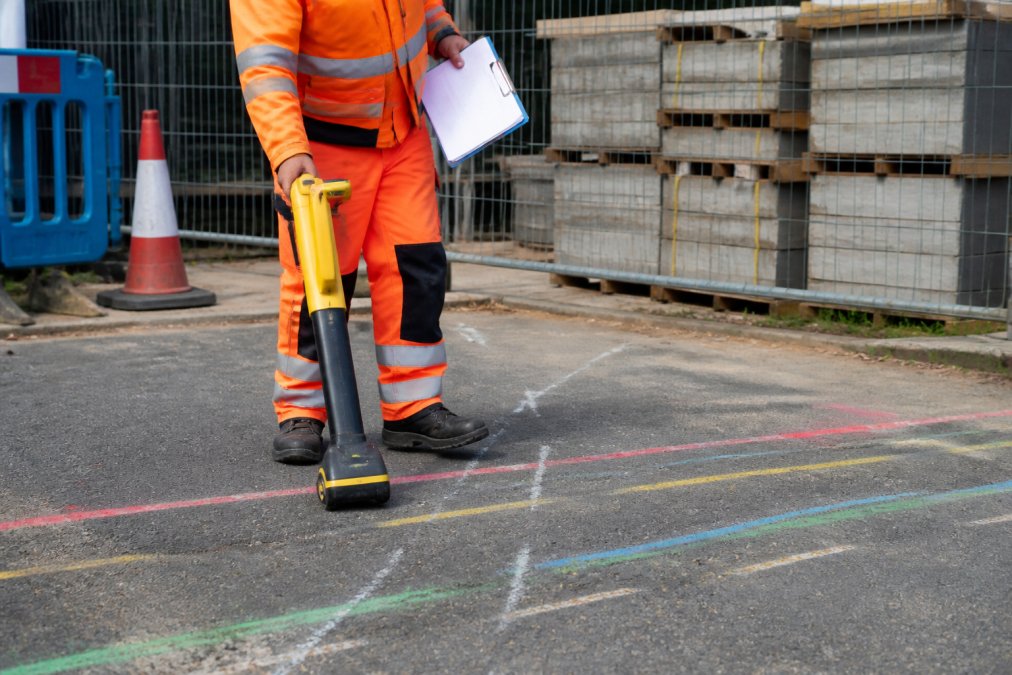
A Cable Avoidance Tool (CAT) is a handheld device that detects electrical cables, pipes, and other metallic services buried underground. A Genny (signal generator) is a companion device that transmits a signal along a cable, making it easier to trace. Together, they’re your primary defence against striking a live cable.
But a CAT and Genny are only as good as the person using them. Misuse them, and you get false negatives, you think there’s no cable when there is. You get false positives, you think there’s a cable when there isn’t. Worse, you develop false confidence and dig without proper precautions.
CAT and Genny training duration typically ranges from 4 to 8 hours for initial competency. A half-day course covers the basics: how to hold the device, what the signals mean, common failure modes, and when to hand-dig instead of relying on the tool. A full-day course adds practical site work, troubleshooting, and decision-making under realistic conditions. Training for a competent person should include how the devices work, how to set up and calibrate the equipment, how to scan systematically, how to interpret signals, when CAT and Genny will fail, and what to do if you strike something. Electrical Training providers can tailor this to your team’s needs and your site’s specific conditions.
Safe digging starts long before the spade hits the ground. It starts with a plan, continues through marking and detection, and doesn’t end until the work is complete and the site is made safe.
Before any work begins, request service plans from all utility operators: electricity distributor, gas supplier, water company, telecommunications provider, and any others relevant to your site. In the UK, you can request plans from your local electricity distributor (DNO), the gas network operator (typically Cadent, Northern Gas Networks, SGN, or Wales & West Utilities), your water company, Openreach or other telecommunications operators, and your local authority.
Service plans show the recorded routes of cables and pipes. Review them carefully and note the depth at which each service is buried, the cable voltage, the route, and any notes about hazards or special conditions. Mark the plan locations on your site using paint, chalk, or tape.
Once you have service plans, mark the routes on the ground using colour-coded tape or paint: yellow for electricity cables, red for gas, blue for water, green for telecommunications, and orange or white for other services. Mark a buffer zone, typically 1 metre either side of the recorded route, to account for inaccuracy in the plans. This is your exclusion zone. No mechanical digging within this zone. Hand-digging only, and only after detection equipment has confirmed no cables are present. Place marker posts at regular intervals so the marked route is visible from a distance.
Mechanical digging is acceptable in areas where you’ve confirmed (using service plans, CAT scanning, and visual inspection) that no services are present. Hand-digging is mandatory within marked exclusion zones and within 1 metre of any identified cable, pipe, or service. Use a spade, not a pickaxe. Dig carefully, removing soil in layers, exposing the service as you go.
Stop work immediately if you strike anything hard, see any cable or pipe, suspect you’re close to a service, or encounter unexpected markings or evidence of services.
If you strike a cable: stop immediately and don’t pull the spade out. Isolate the area and move everyone at least 5 metres away. Don’t touch the cable, it might be live. Call the utility operator and give them your location and a description of what happened. Document the incident and report it. If there’s a risk of serious injury, it’s a notifiable incident under RIDDOR.
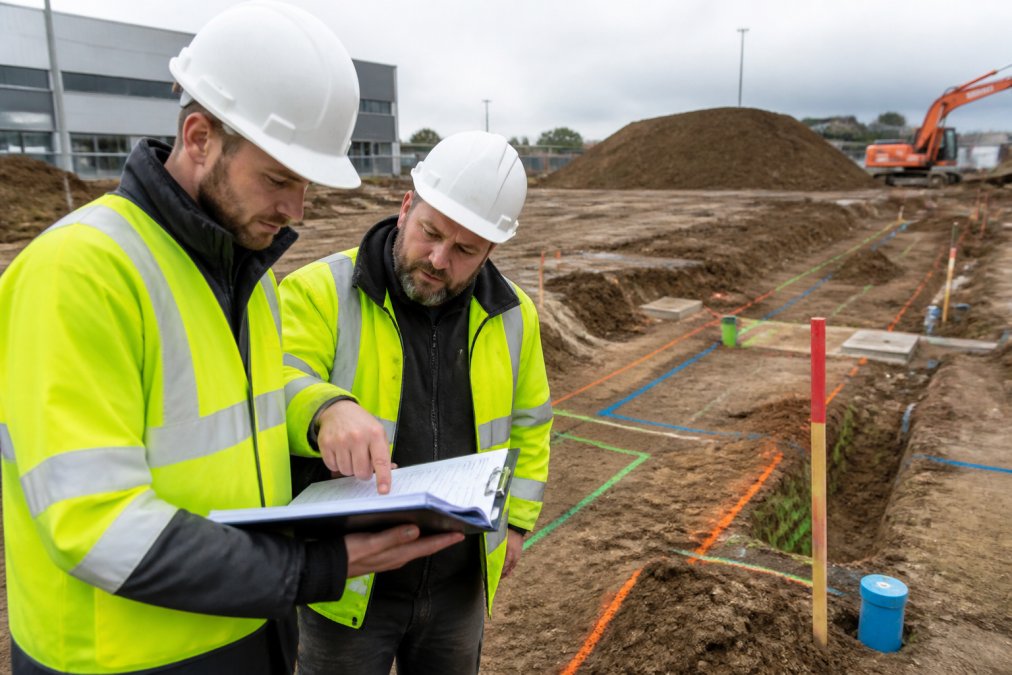
A risk assessment for ground disturbance identifies the specific hazards on your site and the controls needed to manage them. It’s specific to your location, your work, your team, and your circumstances.
A proper risk assessment includes hazard identification (what electrical and other utilities are present, what’s the voltage, what’s the depth, what’s the ground condition), risk evaluation (how likely is a cable strike, how serious would the consequences be, who’s at risk), control selection (service plan review, CAT scanning, hand-digging, exclusion zones, competent person oversight, permit-to-work system, emergency procedures), and competency confirmation (who’s in charge and do they have the training and experience to make decisions on site).
A permit-to-work system is a formal process for authorising and controlling high-risk work. For ground disturbance near electrical services, it typically includes a written permit that describes the work, the hazards, and the controls; sign-off by a competent person before work starts; confirmation that all necessary precautions are in place; and a clear stop-work procedure if conditions change or hazards emerge. The permit-to-work system forces you to think through what could go wrong and how you’ll prevent it.
If you must work on or near live electrical equipment, isolation is the primary control. Isolation means disconnecting the equipment from its power source so it can’t suddenly energise and cause harm. This is typically done by opening a circuit breaker or isolator switch, removing a fuse, unplugging the equipment, or de-energising a cable in coordination with the utility operator.
Once isolated, the equipment should be locked and tagged (lockout/tagout, or LOTO). A lock prevents someone else from re-energising the equipment. A tag explains why it’s locked and who locked it. LOTO is mandatory for maintenance work on electrical equipment and is good practice for any work near live circuits.
If you’re working near a buried cable that you can’t isolate, your controls are protective ducting, exclusion zones, competent person supervision, and emergency procedures.
Emergency response for electrical incidents: If someone is electrocuted, do not touch the casualty while they’re in contact with the electrical source. Break the contact by switching off the power at the source. If you can’t do that safely, use a non-conductive object to move the casualty away from the source. Call emergency services immediately (dial 999). Provide first aid. If the casualty is unconscious and not breathing, start CPR. If they’re conscious, place them in the recovery position and monitor breathing. Electrical injuries can cause internal burns and cardiac arrhythmias that aren’t immediately obvious. Always call 999.
Training courses teach knowledge, but knowledge doesn’t change behaviour on site. Making training stick requires reinforcement through toolbox talks, site inductions, near-miss reviews, and refresher courses. Many organisations require electrical hazard training refresher every 2-3 years.
Every new team member on site should receive a site-specific induction that covers the specific electrical hazards on that site: where the cables are, what the detection procedures are, what the stop-work rules are, and what to do if something goes wrong. A competent person should be present during high-risk work to spot hazards, stop unsafe work, and make decisions when things don’t go as planned.
Near-misses are goldmines for learning. When a near-miss happens, investigate it, understand why it happened, and change the system to prevent it next time. Share the learning across your organisation so a cable strike on one site teaches a lesson that could prevent a strike on another site.
At SJB Smart Electricals Training & Consultancy, we deliver electrical hazard training for groundworkers that goes beyond the classroom. Our on-site delivery means your team learns in the actual environment where they’ll be working. We emphasise practical decision-making, not just knowledge recall, and work with you to embed safe practices into your site systems and culture.
Electrical hazards on construction and maintenance sites are real and often invisible. Your groundworkers are the last line of defence against a cable strike. Training them to recognise hazards, use detection equipment correctly, and follow safe digging procedures is essential. SJB Smart Electricals Training & Consultancy offers on-site electrical hazard training for groundworkers tailored to your specific site conditions, combined with GS6 & HSG47 Training that ensures your team understands both the legal requirements and the practical steps to stay safe. Book training with us and give your workforce the confidence to work safely near electrical services.
The main hazards are striking buried power cables during excavation, contact with overhead power lines, and electrical shock from live services. Underground cables may carry voltages from 400V to 33kV or higher. Cable strikes can cause fatal injuries, electrocution, or arc flash. Overhead lines pose risk during work with tall equipment or cranes. Groundworkers must identify these hazards through service plans, utility mapping, and site-specific risk assessment before any ground disturbance begins.
HSG47 (Avoidance of Danger from Underground Services) is the primary regulation governing buried utility safety. It requires duty holders to identify all underground services before work begins, obtain service plans from utility companies, use Cable Avoidance Tools to locate cables, and establish safe working practices near live services. HSG47 mandates competency training, site induction, and permit-to-work systems. Non-compliance can result in enforcement action and criminal liability. Every groundworker must understand their organisation's HSG47 compliance procedures.
CAT (Cable Avoidance Tool) training teaches operators to detect buried cables and pipes using electromagnetic signals. Genny (signal generator) training covers how to inject signals into known cables to trace their route. Both are essential for utility avoidance. CAT and Genny training duration typically covers hands-on operation, signal interpretation, and limitations of the equipment. Groundworkers must understand that CAT cannot detect all cables, particularly plastic-sheathed or non-metallic services, so it must always be combined with service plans and safe hand-digging practices.
Stop work immediately and do not touch the cable or equipment. Warn others and establish an exclusion zone. If the cable is damaged or live, do not attempt to move it. Contact the utility company and your site supervisor at once. Never assume a cable is dead, treat all struck cables as live until confirmed safe by a qualified electrician. Document the incident as a near-miss or accident. Your organisation should have an emergency procedure in place; ensure you know it before starting work on any site with buried utilities.
This article was written using GrandRanker

Learn what an 18th edition course for electricians covers, who needs i
Understand competent person electrical training, who needs it, what it