
We use cookies to optimize your experience, analyze traffic, and personalize ads. Please choose whether you accept our use of non-essential cookies. Read More
York
08:00 AM - 05:00 PM
Last Updated: August 26, 2026
Electrical incidents remain one of the most preventable causes of serious workplace injury, yet many teams receive compliance-focused training that fails to change behaviour on the ground. At SJB Smart Electricals Training & Consultancy, we understand this gap: workers who can pass a written test but struggle when they encounter a suspect cable on a live site.
According to Health and Safety Executive electrical safety guidance, electrical contact and arc flash incidents cause fatalities and major injuries across construction, maintenance, and facilities sectors every year. The overwhelming majority are preventable with proper hazard identification and safe systems of work.
Practical electrical safety training is the difference between a workforce that knows the rules and one that follows them under pressure. That distinction matters enormously when a groundworker is three metres from an overhead line, or a facilities technician is isolating a circuit in a live hospital environment.
Electrical safety training requirements for employees are legal obligations rooted in primary legislation. Duty holders who cannot demonstrate competence face enforcement action.
The Electricity at Work Regulations 1989 (EAWR) form the legal backbone of electrical safety management. Regulation 16 is critical: no person shall work on electrical systems unless they possess the technical knowledge or experience to prevent danger, or are under appropriate supervision. This applies to every member of your team who works near or with electrical systems, not just qualified electricians.
Electricity at Work Regulations 1989 full text defines the duty of care that sits with employers, employees, and self-employed contractors alike.
HSG47 provides practical guidance on avoiding danger from underground services, and GS6 covers the avoidance of danger from overhead electricity lines. Both are published by the HSE and carry significant weight in enforcement proceedings. For construction and groundworks teams, competence against HSG47 and GS6 is a site requirement.
A duty holder is any person with legal responsibility for an electrical system or for work carried out on or near it. Competence certification demonstrates that individuals have received structured training and can apply safe systems of work in practice.
Regulations require ongoing competence, which means refresher training, documented supervision, and regular review of safe working procedures. A certificate issued five years ago does not prove current competence.
Workplace risk assessment is not a form-filling exercise. Done properly, it connects legislation to daily behaviour on site.
Electrical hazard identification varies by sector, but several hazards appear consistently:
Use this checklist as a starting point for your own workplace safety audit.
| Audit Item | Check | Action if Failed |
|---|---|---|
| Overhead line proximity markers in place | Yes / No | Install goal posts or barriers; brief team |
| Underground service drawings available before excavation | Yes / No | Obtain CAT scan and drawings before work starts |
| All portable appliances in-date for PAT testing | Yes / No | Remove from service; arrange PAT inspection |
| Isolation procedures documented and accessible | Yes / No | Create and brief site-specific isolation procedure |
| PPE appropriate for voltage levels available | Yes / No | Review PPE against task risk assessment |
| Staff competence records current and filed | Yes / No | Arrange refresher training; update records |
| Emergency response procedure posted and understood | Yes / No | Brief team; conduct walkthrough |
| Insulation resistance testing records up to date | Yes / No | Schedule inspection with competent person |
Safe isolation is the single most important practical skill for anyone working on or near electrical systems.
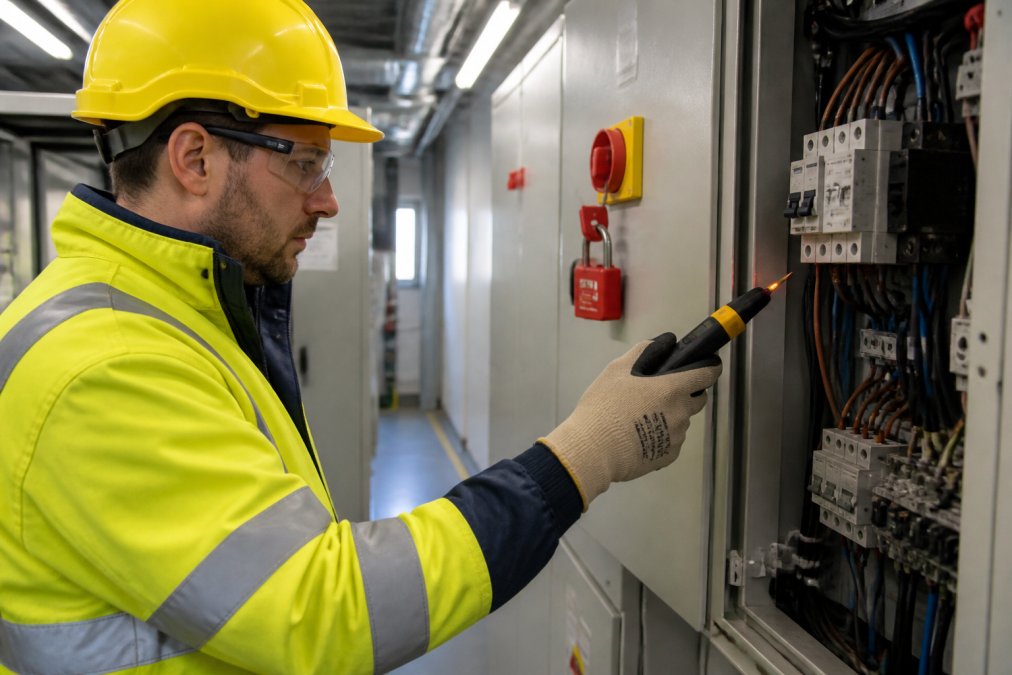
Safe isolation procedure training teaches workers to confirm that a circuit is de-energised and cannot be re-energised before work begins. The procedure applies to qualified electricians and non-electricians alike, wherever there is a risk of contact with a live conductor.
This sequence follows the principles set out in HSE guidance on safe isolation of electrical equipment.
Voltage testing is not optional. Proving dead is the step that prevents fatalities.
Electrical safety awareness course duration varies depending on competence level required and audience. For non-electricians who need general awareness, a one-day course covers hazard identification, basic safe systems of work, and regulatory standards. This suits maintenance staff, facilities operatives, and site labourers.
The combined HSG47 and GS6 two-day course covers both underground service avoidance and overhead line safety in a structured format. The two-day structure avoids duplication and reduces time off site.
Authorised Person and duty holder programmes typically span two to three days and include technical competence assessment, documentation requirements, and permit-to-work systems. Specialist programmes such as AGL 1-3 for airport lighting engineers are structured around sector-specific regulatory standards.
The key question is not "how long is the course?" but "does the course develop competence that holds up in practice?"
The format of your training programme matters as much as the content, particularly for multi-site organisations.
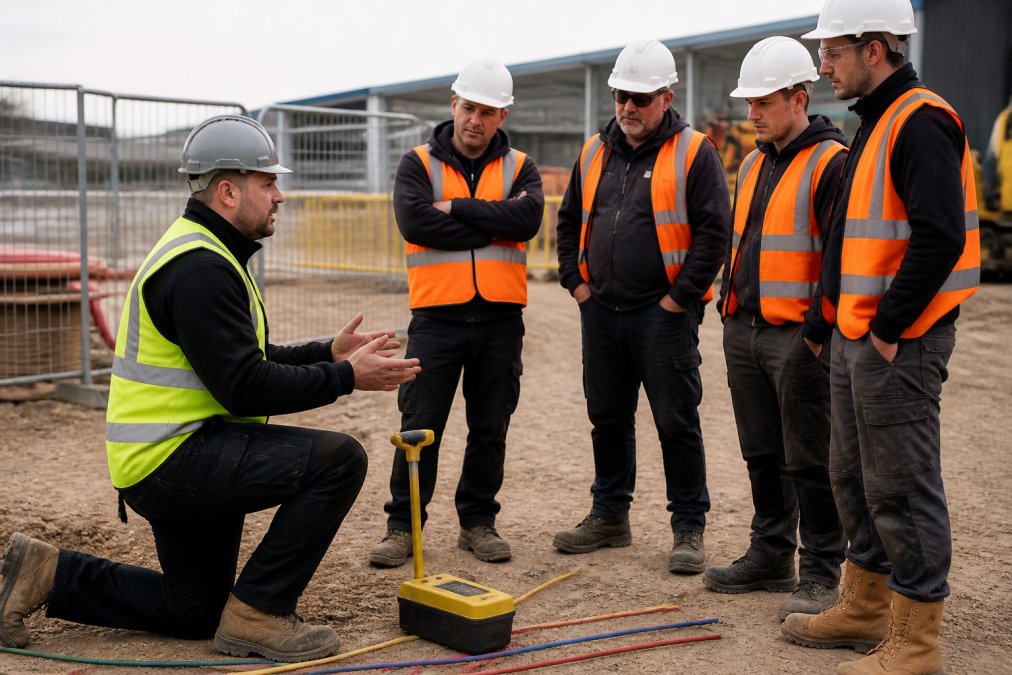
On-site delivery is typically superior for operational teams. Getting 40 groundworkers off three active sites simultaneously is not realistic. On-site delivery brings training to the workforce and allows training to reference site-specific hazards, existing isolation procedures, and the actual equipment your team uses. That specificity produces better knowledge retention and more immediate behaviour change.
Classroom-based training remains appropriate for smaller groups, programmes requiring specialist equipment, and technical content that benefits from a controlled learning environment. Hybrid approaches, where theoretical content is delivered remotely and practical assessment is conducted on-site, work well for dispersed teams.
Generic electrical awareness training is not sufficient for all roles. Specialist programmes address specific hazard profiles and regulatory standards:
Matching the programme to the role is what the EAWR requires when it specifies that competence must be appropriate to the work being carried out.
Training that changes behaviour for three weeks and then fades is not effective training. It is compliance theatre.
Most knowledge loss occurs in the first 72 hours after training. Structured reinforcement converts short-term learning into long-term practice:
Remote and hybrid working arrangements create specific challenges for electrical safety training. Many remote workers are in domestic environments where electrical hazard identification and reporting responsibilities are less clearly defined, yet real hazards exist.
For facilities managers with hybrid teams, key obligations relate to portable appliance testing of equipment used at home, display screen equipment assessments, and ensuring remote workers can identify and report electrical faults. Remote training delivery can address awareness-level content effectively, but practical competence assessment requires in-person delivery.
The business case for practical electrical safety training is straightforward. The direct cost of training is visible and easy to challenge. The cost of an electrical incident is not on the budget until it happens.
According to HSE cost of workplace injuries and ill health statistics, the total cost of workplace injury to employers runs into billions annually when lost productivity, investigation, legal costs, and reputational damage are included. Electrical incidents sit at the severe end of that spectrum.
For management, the relevant comparison is not "training cost versus no training cost." It is "training cost versus the combined cost of an incident, enforcement action, civil liability, and operational disruption."
A structured approach to electrical safety management also has commercial value. Many procurement frameworks, particularly in construction, healthcare, and utilities, require evidence of workforce competence certification as a condition of contract award.
SJB Smart Electricals Training & Consultancy offers on-site delivery and can accommodate multi-site organisations with dispersed teams. Contact the team directly for a tailored quote based on your specific requirements.
Electrical incidents do not announce themselves. The team that encounters a live conductor without proper training, documented isolation procedures, or current competence certification will not have time to consult a policy document. SJB Smart Electricals Training & Consultancy delivers hands-on electrical safety training that builds genuine competence, from combined HSG47 and GS6 programmes for groundworks teams to Authorised Person courses and specialist AGL training for airport lighting engineers. Book training with SJB Smart Electricals Training & Consultancy and give your team the practical skills and regulatory compliance that actually hold up on site.
There is no single fixed interval set by law, but the Electricity at Work Regulations 1989 require that competence is maintained at all times. Most duty holders schedule refresher training every one to three years, depending on the risk level of the work, staff turnover, and any changes to site conditions or regulations. Higher-risk roles, such as those working near overhead power lines or live systems, warrant more frequent review. A workplace safety audit can help you identify where knowledge has drifted and when refreshers are due.
Under the Electricity at Work Regulations 1989, employers must ensure that no person carries out electrical work unless they are technically competent to do so. The Health and Safety at Work etc. Act 1974 adds a broader duty of care to provide adequate training, information and supervision. For work near buried services, HSG47 sets specific competence expectations. Failing to meet these standards can result in HSE enforcement action, prosecution, and unlimited fines, as well as serious risk to workers.
Classroom theory alone does not prepare workers for the decisions they face on site. Practical electrical safety training builds muscle memory for safe isolation procedures, voltage testing, and PPE use, so that correct behaviour becomes automatic under pressure. Teams that only complete online modules often struggle to apply knowledge when they encounter a real hazard. Hands-on training, delivered where the work actually happens, closes the gap between what people can recite in a test and what they do when it matters.
HSG47 (Avoiding Danger from Underground Services) sets out the precautions that anyone working near buried cables and pipes must follow. It establishes competence requirements for those planning, supervising, and carrying out excavation work. Training aligned with HSG47 covers cable avoidance tools, permit-to-dig systems, and emergency response procedures. For construction and groundworks teams, HSG47-compliant training is a key part of demonstrating regulatory compliance and protecting workers from electrocution risks during excavation.
This article was written using GrandRanker

Learn what an 18th edition course for electricians covers, who needs i

Understand competent person electrical training, who needs it, what it