
We use cookies to optimize your experience, analyze traffic, and personalize ads. Please choose whether you accept our use of non-essential cookies. Read More
York
08:00 AM - 05:00 PM
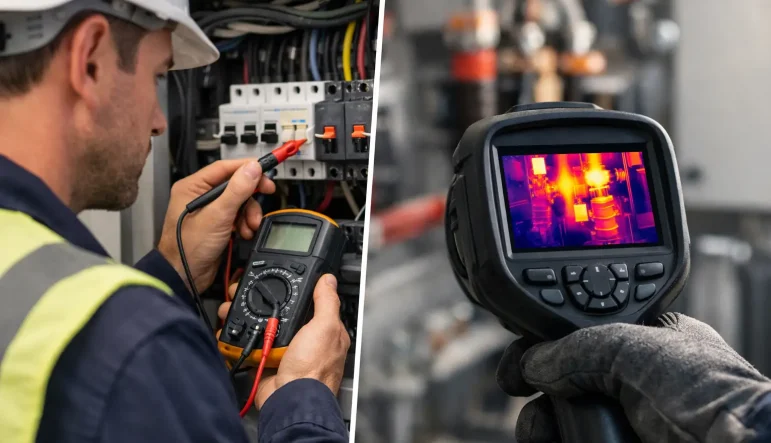
A distribution board can look orderly, be correctly labelled and still contain a connection that is heating under load. Equally, a thermal image can show a warm component without confirming whether the wider installation is safe, compliant or fit for its intended use. That is why the electrical survey vs thermal imaging decision should not be treated as a choice between two interchangeable services.
Both assessments provide valuable evidence, but they answer different questions. The right approach depends on the age and use of the installation, the type of premises, operational risk, previous test history and whether there is a planned change to the electrical system.
An electrical survey is a structured assessment of an installation, its condition, capacity, suitability and requirements. Its scope can range from a pre-installation survey for a new circuit, EV charger or lighting upgrade to a more detailed assessment of an existing commercial or industrial installation. It may include visual inspection, review of drawings and records, assessment of routes and containment, load considerations, earthing arrangements, access constraints and the condition of equipment.
Thermal imaging, also called thermographic inspection, uses an infrared camera to identify differences in surface temperature. In electrical work, it is commonly used to find abnormal heat patterns in switchgear, distribution boards, cables, terminations, motors and control equipment. A hot spot can indicate loose connections, overload, phase imbalance, failing components or deteriorating contacts.
The distinction matters. An electrical survey establishes the broader technical picture and supports planning, design, remedial work or compliance decisions. Thermal imaging provides a non-invasive view of operating temperature at a particular moment. It is highly useful for identifying developing faults, but it cannot see every electrical defect and should not be presented as a replacement for inspection and testing.
The term “electrical survey” covers several types of work, so the agreed scope is critical. For a homeowner, the survey may focus on the existing consumer unit, cable routes, earthing and capacity before an extension, heat pump or electric vehicle charge point is installed. For a facilities manager, it may examine the condition and suitability of electrical assets across a building, identify infrastructure constraints and prioritise remedial works.
In industrial, transport or high-demand commercial environments, a survey often needs to consider much more than the visible installation. Load profiles, resilience requirements, shutdown opportunities, segregation of supplies, access to plant rooms, environmental conditions and the consequences of equipment failure can all affect the recommended solution.
A properly planned survey can help establish whether equipment has the capacity for proposed additional load, whether protective devices and distribution arrangements are appropriate, and whether installation work can be completed safely with minimal disruption. It also creates a reliable basis for quotations, project planning and communication between contractors, facilities teams and duty holders.
Where the purpose is to assess the safety of an existing installation against the relevant requirements, formal inspection and testing may be required. An Electrical Installation Condition Report, or EICR, is not simply a visual survey. It involves defined inspection and testing procedures, with observations recorded where applicable. A client should be clear on whether they need a feasibility survey, a condition assessment, an EICR, or a combination of these services.
Thermal imaging is most valuable when equipment is energised and carrying a meaningful load. It allows an experienced operative to inspect panels and equipment with less disruption than intrusive investigation, subject to safe access and appropriate control measures. This makes it particularly useful in premises where electrical downtime carries a high cost or operational impact.
Common findings include overheating at cable lugs, busbar joints and circuit breakers; unbalanced loading between phases; overloaded circuits; abnormal heat at contactors, fuses or isolators; and temperature differences between comparable components. The image is not the diagnosis on its own. It is evidence that must be interpreted alongside the equipment type, operating load, ambient temperature, emissivity of the surface and the condition of comparable components.
For example, a component that appears warm may be operating normally because it is carrying a higher load. Conversely, a connection can be failing without looking dramatically hot if the system is lightly loaded during the inspection. A sound thermographic report should therefore record relevant conditions, identify the location and severity of observations, and recommend proportionate follow-up action.
Start with an electrical survey where the question is about what can be installed, what condition the infrastructure is in, or how a site should be upgraded. This is usually the right route before planned works such as new machinery connections, altered layouts, additional distribution, emergency lighting improvements, EV charging infrastructure or refurbishment.
It is also the stronger starting point when documentation is incomplete, equipment is poorly labelled, there are visible concerns with containment or accessories, or site users report recurring trips and operational limitations. Thermal imaging may later support the investigation, but it cannot establish cable routes, confirm design suitability or assess all the factors needed for safe installation planning.
For property owners and managers, a survey gives practical clarity before money is committed. It can identify access issues, disruption risks and potential enabling works early, rather than allowing these to emerge after an installation programme has begun.
Thermal imaging is particularly effective as part of planned preventative maintenance for operational electrical assets. Commercial buildings, manufacturing sites, warehouses, schools, data-sensitive environments and transport-related facilities can all benefit where equipment reliability matters and avoidable downtime is unacceptable.
It can be scheduled around peak or representative load conditions to inspect main switchboards, sub-main distribution, motor control centres and critical connections. Used periodically, it can help a facilities team compare findings over time and target remedial work before heat damage results in failure.
However, timing is everything. A thermal survey performed while a building is quiet, machinery is idle or circuits are lightly loaded may have limited diagnostic value. The survey plan should reflect how the site actually operates. In some cases, safe access, appropriate permits, panel design and the presence of live exposed parts will determine whether the inspection can proceed and what method is suitable.
For higher-risk or complex premises, the strongest maintenance strategy is not electrical survey or thermal imaging, but a coordinated programme that uses each method for its proper purpose. The electrical survey establishes asset condition, installation suitability and planned work requirements. Thermal imaging then provides operational evidence about heat-related defects while systems are in use.
Consider a commercial kitchen experiencing intermittent loss of power. A survey may identify ageing distribution equipment, inadequate circuit separation or unsuitable protective arrangements. Thermal imaging during a busy service period may then reveal a high-resistance termination overheating under real load. One assessment gives context; the other helps locate an active weakness.
The same principle applies to industrial sites. A survey may identify limited spare capacity and poor labelling in an older panel, while thermal inspection may detect an overloaded phase or deteriorating connection. The resulting remedial plan can be prioritised according to risk, operational consequence and the practical opportunity to isolate equipment.
The most useful question is not “Which service is better?” but “What decision do we need to make?” If the requirement is a new installation, upgrade, compliance assessment or investigation of wider infrastructure, request a clearly scoped electrical survey. If the aim is to detect heat-related faults in live, critical equipment, thermal imaging may be appropriate. If reliability, compliance and future works are all concerns, combine them.
Before work begins, confirm the assets to be included, operating conditions, access arrangements, required records and reporting format. For larger sites, agree how urgent findings will be communicated and whether remedial work can be undertaken promptly. This avoids a report becoming a list of observations without a workable path to resolution.
Competence is central to both services. The contractor must understand electrical risk, safe systems of work, relevant standards, the limitations of the assessment method and the operational demands of the environment. SJB Smart Electricals applies this practical, sector-aware approach across domestic, commercial, industrial and infrastructure-led electrical work.
A well-scoped assessment does more than identify faults. It gives the responsible person clearer evidence for maintenance decisions, investment planning and safer day-to-day operation. The most valuable next step is usually the one that answers the actual site risk, rather than the one that appears quickest on paper.

Learn what an 18th edition course for electricians covers, who needs i

Understand competent person electrical training, who needs it, what it