
We use cookies to optimize your experience, analyze traffic, and personalize ads. Please choose whether you accept our use of non-essential cookies. Read More
York
08:00 AM - 05:00 PM
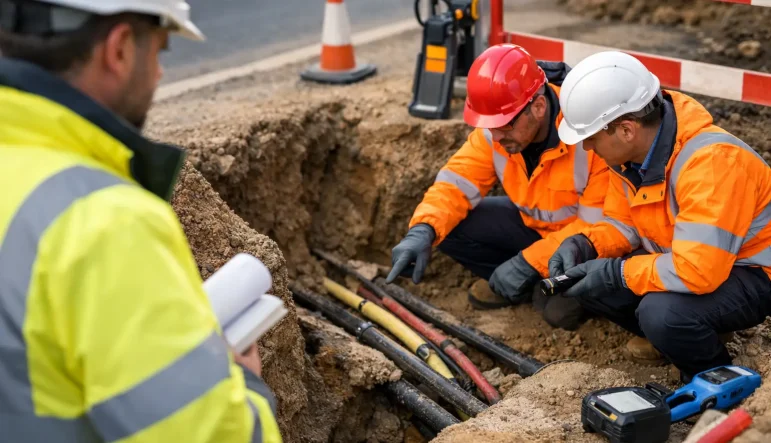
People searching “what is Health & Safety Executive HSG47” are usually preparing to break ground near an existing building, road, yard or service route. That work can appear routine, whether it involves a trench for new cables, an EV charger base, a lighting column or drainage. However, a strike on a live cable, gas main or water pipe can cause serious injury, service interruption, damage and significant project delay.
HSG47 is Health and Safety Executive guidance titled Avoiding danger from underground services. It sets out the practical precautions required to reduce the risk of hitting buried services during excavation and similar ground-disturbing work.
The guidance applies to far more than large construction sites. It is relevant wherever the ground may be disturbed, including commercial refurbishments, industrial upgrades, domestic external works, highway-adjacent projects and infrastructure maintenance. Installing new electrical supplies, ducting, earthing systems, signage or external lighting may all require an HSG47-led approach.
HSG47 is guidance rather than a piece of legislation in its own right. It does not replace the legal duties placed on clients, employers, designers and contractors under health and safety law. In practice, however, it is widely treated as the recognised standard for planning and controlling the risk from underground services. If an incident occurs, a failure to follow its principles may be difficult to justify.
The central message is straightforward: do not assume that drawings are complete, that a service runs where expected, or that a cable detector alone makes excavation safe. Information must be checked, the ground investigated and the work controlled by competent people.
Electricity is one of the most severe hazards associated with underground service strikes. A damaged cable can result in electric shock, arc flash, burns, fire, loss of power and damage to connected equipment. The danger is not limited to high-voltage networks. Low-voltage cables can still produce fatal consequences, particularly in wet ground or confined working conditions.
For electrical contractors, HSG47 affects the project before installation begins. The location of existing cables and other utilities can determine the route, depth and method used for a new supply. It may also influence the position of a feeder pillar, distribution board, charging point, lighting column or plant connection.
A sensible survey is therefore not simply a way to avoid an obstruction. It supports safe design, accurate pricing and fewer changes once work is under way. On occupied commercial sites, airports, rail environments and industrial facilities, it also protects continuity of operations where an unplanned outage could have wider consequences.
HSG47 is often understood through three connected stages: planning the work, locating and identifying services, then excavating safely. Each stage depends on the one before it. Skipping directly to a cable avoidance tool and starting the excavation is not a sufficient control measure.
Planning begins with obtaining available utility records and site information. This can include statutory undertaker plans, client drawings, previous survey data, records for private electrical systems and knowledge held by the facilities team. Service plans should be reviewed by somebody who understands their limitations.
Records are an indication, not proof of the exact position or depth of a service. They may be old, scaled inaccurately, incomplete or unable to show privately installed cables. On a developed site, previous alterations may have created routes that are not shown anywhere. Assumptions based on visible cabinets, lamp columns or meter positions are equally unsafe.
The work should be assessed before an excavation permit or authority to dig is issued. The assessment needs to consider the proposed route, plant to be used, ground conditions, access arrangements, known services and the competence of the workforce. The client and principal contractor should also ensure that responsibilities are clear, particularly where several trades are working in the same area.
The next stage is to transfer available information to the ground and investigate it using suitable detection methods. A competent operative should use a cable avoidance tool, often referred to as a CAT, with a signal generator where required. The area should be scanned methodically in the relevant operating modes, following the manufacturer’s instructions and the site procedure.
Detection equipment is valuable, but it has limitations. Some cables may not produce a detectable signal, their depth or orientation can affect the reading, and congestion can make interpretation difficult. A buried service may also be masked by other metallic items or reinforced concrete. Equipment must be maintained, function checked and used by someone who has been properly trained.
Detected routes should be marked clearly and protected from disturbance. Where the route remains uncertain, further investigation is required. This may involve trial holes or other agreed methods that expose the service without placing operatives at unnecessary risk.
Once services are expected in the work area, excavation needs to proceed with appropriate controls. Mechanical excavation should be kept away from identified or suspected services until their location has been confirmed by safe means. The precise safe distances and methods should reflect the type of utility, site rules, service-owner requirements and the risk assessment.
Hand digging is not automatically safe if it is carried out carelessly. Picks, forks, sharp-edged tools and aggressive techniques can damage a cable or pipe. Suitable insulated hand tools and careful excavation methods may be necessary, but the correct approach depends on the service and conditions. Services should be supported where needed and protected from damage throughout the work.
If the findings on site do not match the plans, the work must stop and be reassessed. This is not lost time. Continuing on the basis of an unexpected cable, altered route or unclear detector reading is how manageable work turns into an incident.
Safe excavation is a shared responsibility. Clients need to provide relevant information and allow sufficient time and resource for proper investigation. Designers should consider underground hazards when selecting routes and specifications, rather than passing an impractical design problem to the installation team.
Principal contractors and site managers need systems for permits, coordination and supervision. Contractors must provide competent operatives, suitable equipment, task-specific risk assessments and safe methods of work. Individual workers must follow the agreed controls and report anything that differs from the information provided.
This matters particularly on multi-contractor projects. One team may be installing ducts while another is carrying out electrical works and a third is responsible for civil engineering. A marked service route can be lost through resurfacing, spoil movement or changes to the work area. Communication and documented checks remain necessary throughout the project, not just at the start.
The most frequent failure is relying on a single source of information. Plans, detector surveys and visible site features all help, but none should be treated as definitive in isolation. A second common mistake is assuming a shallow excavation cannot reach a service. Cable depths vary, ground levels change and services may have been installed incorrectly in the past.
Another issue is treating a utility search as a substitute for an on-site survey. Records identify what may be present, while a competent survey helps establish what is actually present within the proposed work area. Both are needed for a reliable decision.
Training is also often underestimated. An operative may have used a cable avoidance tool before without understanding signal modes, limitations, calibration checks or how to respond to an ambiguous reading. Competence should be demonstrated and refreshed, especially where staff undertake this work only occasionally.
The scale of the project changes the depth of planning, but not the need for control. A homeowner arranging external electrical works may require a simpler process than a major industrial development, yet the buried cable hazard remains real. Small jobs can be particularly vulnerable because records are less likely to exist for private installations and informal assumptions are more common.
On larger sites, the process may involve utility records, topographical information, ground-penetrating surveys, permit systems, marked exclusion zones and formal briefings. In high-risk or operational environments, the site owner may impose additional procedures. The right level of control depends on the task, the services present and the consequences of a strike.
For any installation involving excavation, early engagement with a competent electrical contractor helps ensure that survey findings, cable routes and installation methods are considered together. Before the first bucket enters the ground, the safest decision is usually the one made with reliable information, suitable equipment and a clear plan for stopping when the ground tells a different story.

Learn what an 18th edition course for electricians covers, who needs i

Understand competent person electrical training, who needs it, what it