Electrical Safety Training for Facilities: What Actually Matters
Electrical safety training for facilities equips maintenance, operational, and contract staff with the competence to work near, isolate, and maintain electrical systems without injury. Most training directories list courses by title and price, offering little insight into whether a hospital facilities technician requires the same content as an authorised person at a substation.
Below, we break down seven course options, detailing their coverage, suitability for different roles, applicable requirements, competence verification methods, and how to measure training effectiveness.
Key Takeaway The core distinction in facility electrical safety training lies between awareness (recognising hazards) and competence (the ability to safely isolate, test, and prove dead). A common compliance failure stems from treating the former as equivalent to the latter.
The table below summarises seven course options, detailing their delivery format, focus, and best-fit roles.
| Course |
| — | — | — | — |
| Industrial and Utilities Electrical Safety | AVO Training | Instructor-led | Industrial and utility teams |
| Electrical Safety Management (ESM) | The IET | 13.5-hour course | Graduate engineers, safety managers |
| Electrical Safety and Lockout/Tagout | ClickSafety | Online | Distributed general-industry teams |
| Electrical Safety Training for Maintenance Staff | ASHE | Overview resource | Healthcare contractors and electricians |
| Authorised Person Electrical Training | SJB Electrical Training | Hands-on, on-site | AP and Competent Persons |
| Electrical Safety Specialist (ESS) | NASP | Certificate course | Safety professionals |
| Electrical Safety for High-Risk Facilities | TCI Training | Event-based | High-risk and energetic sites |
The optimal choice hinges less on provider reputation and more on the specific role being trained.
What Electrical Safety Training Requirements Apply to Facilities?
Facility electrical safety training requirements originate from the Electricity at Work Regulations 1989, which mandate employers to ensure individuals working on or near electrical systems possess the necessary competence. A certificate alone does not fulfil this duty.
The Health and Safety Executive (HSE) provides the overarching framework through its guidance on electrical safety in the workplace. In practice, this necessitates a training programme that demonstrates each person’s understanding of the hazards they face, their ability to apply safe systems of work, and their awareness of their own competence limitations.
Three key requirements shape most facility electrical safety programmes:
Duty holder competence: An individual must be assigned responsibility for the electrical safety management system, extending beyond budgetary control.
Role-appropriate content: Instruction must differ for a cleaner isolating a socket for cleaning versus an authorised person operating a high-voltage switch.
Evidence of assessment: This requires written and practical assessments, not merely attendance records.
Watch Out Treating a training certificate as definitive proof of competence is a prevalent compliance gap. The regulations mandate competence for specific tasks, and a generic certificate does not establish this for high-risk isolation work.
Industrial and Utilities Electrical Safety: AVO Training
AVO Training’s industrial and utilities programme is designed for environments where downtime incurs significant costs, focusing on risk reduction and minimising unplanned outages. It is suitable for teams working on industrial distribution systems, switchgear, and motor control, assuming a baseline of technical knowledge rather than catering to general maintenance staff who only require awareness.
For a UK facility, a potential limitation is that the provided course information does not specify formats, durations, or prices, nor does it explicitly confirm alignment with UK-specific requirements. If your site operates under BS 7671 and the Electricity at Work Regulations 1989, it is crucial to verify that the syllabus maps to these standards before booking.
How to judge whether this course fits your site
Consider these four questions:
What is the highest-risk task your team performs? If it involves switching and isolation on industrial distribution, this type of course is relevant. For basic visual checks and reporting, it is likely over-specified.
What is the technical baseline of the audience? Industrial and utilities content assumes familiarity with switchgear, protection, and motor control. Enrolling a facilities assistant would be an inefficient use of their time and your budget.
Does the syllabus reference the standards your safe systems of work use? Your isolation procedures will cite BS 7671 and the Electricity at Work Regulations 1989. A course based on a different regulatory framework will create a mismatch between training content and required practice.
Is there a practical assessment on equipment comparable to yours? Classroom-only delivery cannot establish competence for isolation work, irrespective of the provider’s reputation.
A common strategy involves using a provider like AVO Training for technically experienced core staff, those holding or working towards an authorised person role, and supplementing this with shorter, site-specific training for other personnel, ensuring depth where the risk is highest.
Electrical Safety Management (ESM): The IET
The IET’s Electrical Safety Management course is a 13.5-hour programme. It is aimed at individuals responsible for managing electrical safety, such as graduate engineers transitioning into safety roles, rather than those performing hands-on electrical work. This course is advisable when the primary need is for designing a management system, rather than executing physical isolations. It is well-suited for a facilities manager who oversees safety policy but does not directly interact with electrical equipment.
A notable limitation is that the provided course information lacks details on the syllabus or delivery format, and it does not specify if the content is tailored for facilities teams. It is important to allocate sufficient time for this training, as its value lies in applying the learned framework to your specific site context afterwards.
Electrical Safety and Lockout/Tagout: ClickSafety
ClickSafety offers online electrical safety training that covers lockout/tagout procedures and NFPA 70E. The online format is advantageous for dispersed teams, and the focus on lockout/tagout addresses a critical control measure for maintenance operations.
The primary consideration for a UK facility is that NFPA 70E is a US standard. The provided course information does not confirm alignment with UK requirements. If your safe system of work references BS 7671 and the Electricity at Work Regulations 1989, an NFPA-based course may not provide a direct match.
This type of training is useful for general hazard awareness across a broad workforce. However, it should not be the sole basis for verifying the competence of individuals performing isolations on your site.
Translating lockout/tagout into a UK safe system of work
The fundamental principle – isolate, prove dead, secure against reconnection, verify – is universally applicable. Differences arise in terminology, regulatory references, and documentation. If you adopt an online lockout/tagout module, treat it as a foundation for hazard awareness and bridge any gaps with site-specific instruction covering:
Your isolation points and devices: Identify the isolators, the types of locks and tags used on your site, and who is responsible for their management.
Your permit and authorisation process: Clarify who issues permits, who is authorised to perform isolations, and how work boundaries are defined.
Your proving-dead procedure: Specify the approved voltage indicator used, how it is tested before and after use, and the method for recording these checks.
Your records: Establish how each isolation is logged and the required retention period for these records.
Delivery trade-offs for online lockout/tagout content
Online modules offer scalability and are suitable for refresher training. However, they cannot assess a person’s ability to physically apply a lock, select the correct proving unit, or identify a back-feed. It is recommended to supplement online modules with a brief, supervised practical session on your site’s equipment, delivered by a competent individual authorised to sign off on the task.
For employers, the decision involves determining which aspects of competence can be demonstrated digitally and which require hands-on assessment on actual equipment.
Electrical Safety Training for Maintenance Staff: ASHE Healthcare Module
The ASHE resource, developed in conjunction with Eaton, specifically addresses electrical safety for contractors and electricians within healthcare facilities. This specificity is a key strength, as healthcare sites have critical continuity-of-supply obligations that general industrial training may overlook.
This training is suitable for estates teams and contractors working in clinical environments where an unplanned supply interruption poses a patient safety risk, not merely a financial one. The limitation is its scope; the provided information describes an overview rather than a detailed course specification, with pricing and delivery formats not stated. It should be viewed as an initial reference for healthcare-specific considerations, with practical isolation training developed around it.
Authorised Person Electrical Training: AP and Competent Person Courses
Authorised Person training marks the transition from general awareness to demonstrable competence in facility electrical safety.
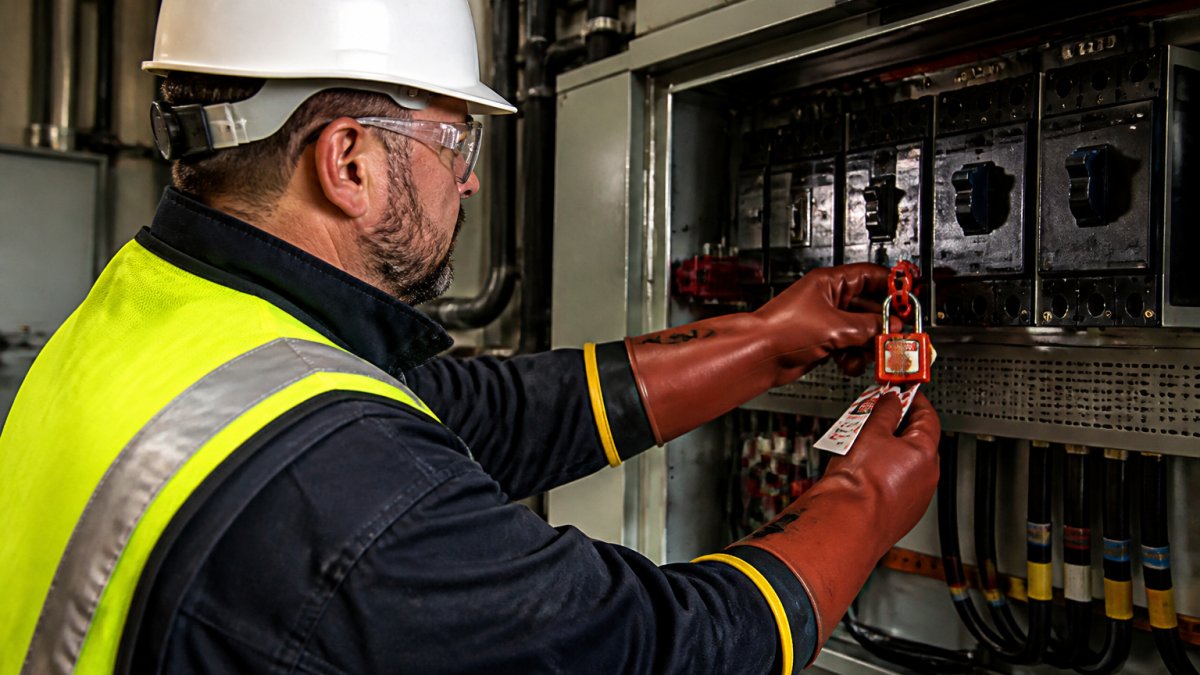
An engineer in full PPE, including insulated gloves and safety glasses, demonstrating lockout/tagout procedures on an industrial electrical panel inside a facility plant room
For employers, the practical considerations revolve around refresher frequency and competency verification. Supporting services often associated with AP training include GS6 and HSG47 training for teams working near underground services and overhead lines, respectively, and BS 7671 wiring regulations training for those requiring the foundational regulatory knowledge.
Pro Tip When selecting AP training, request that the provider assess competence against your site’s specific isolation procedures, rather than a generic scenario. An AP who has only practised on a training rig may hesitate when faced with your actual switchgear.
How often should AP authorisation be refreshed?
Most facilities reassess AP authorisation annually, or sooner if the individual has not performed an isolation for an extended period, the electrical system has been modified, or an incident has occurred. Refresher training should include practical reassessment, not solely a knowledge check.
Building a Training Programme That Sticks
Selection is only half the challenge; implementation is where many programmes falter.
Begin by mapping roles to risk. A hospital facilities team maintaining basic equipment differs significantly from an industrial maintenance crew working on switchgear. Subsequently, decide on the delivery method. Online training is effective for awareness among dispersed workforces, while hands-on, on-site delivery is crucial for competence, as isolation is a physical skill.
Finally, measure outcomes. Attendance is not a metric of success. Track the correct completion of isolation permits, observe trends in near-miss reports, and verify that individuals can still demonstrate the procedure months later.
| Problem |
| — | — | — |
| Staff pass tests but hesitate on site | Assess against your own isolation procedures | Practical confidence under real conditions |
| Dispersed teams cannot attend centrally | On-site or blended delivery | Coverage without halting operations |
| Competence drifts after certification | Annual reassessment tied to system changes | Maintained, not assumed, competence |
| Unclear who owns electrical safety | Named duty holder with defined authority | Accountability for the safety system |
Frequently Asked Questions
What should electrical safety training for facilities teams cover?
It should cover electrical hazards such as shock, electrocution, arc flash and arc blast, plus safe work practices, hazard identification, risk assessment and risk control. Lockout/tagout and energy isolation procedures are essential, as is the correct use of personal protective equipment. Training should also address emergency response, equipment inspection and preventive maintenance, and the difference between a qualified person and an unqualified person. For facilities teams, the content must be practical and specific to the environments they work in, whether that is a plant room, a hospital ward or a production floor.
Who needs electrical safety training in a facility?
Any operational personnel who work near or on electrical equipment needs some level of training. Maintenance personnel, building services staff, contractors and site supervisors typically need more detailed instruction, including safe work practices and energy isolation. Staff who do not perform electrical work but work in areas with electrical systems still benefit from awareness training covering hazard identification and emergency response. The depth of training should match the risk level of each role and the type of electrical systems present in the building installation.
How often should facilities staff receive electrical safety training?
Most facilities should refresh electrical safety training every one to three years, depending on the risk level and the pace of regulatory change. Staff working on high-voltage systems or in industrial facilities may need annual refresher sessions and periodic competency assessments. A practical approach is to align refresher frequency with your risk assessment cycle and any changes to the electrical systems, equipment or safe work practices on site. Competency verification through observation or practical assessment is more reliable than simply recording a completion certificate.
What is the difference between electrical awareness and authorised person training?
Electrical awareness training gives staff a general understanding of electrical hazards, safe work practices and when to escalate an issue. It suits operational personnel who do not perform electrical work but are near electrical equipment. Authorised person electrical training is far more detailed. It covers energy isolation, lockout/tagout, issuing and cancelling permits, risk assessment, and the responsibilities of a qualified person. It is intended for staff who control or supervise work on electrical systems and need to apply safe systems of work in practice.
How can facilities managers assess electrical training needs?
Start with a training needs analysis based on your risk assessment. Identify who works on or near electrical equipment, what tasks they perform, and what level of competence each task requires. Review your building installation, electrical systems and any recent incidents or near-misses. Then map roles to training objectives and course curriculum. An electrical safety training checklist can help you compare providers on content, delivery format, hands-on practice, competency assessment and completion certificate. Review the programme annually or after any significant change to operations.
We use necessary cookies to keep this website secure and working. With your permission, we also use optional cookies to understand site performance and improve our services. Choose Accept All, Reject All or Preferences. You can change your choice at any time.
Cookie Policy
Necessary cookies support security and functions you request. Optional analytics and functional cookies are used only after consent. Some optional cookies may be set by service providers used on our pages. See the Cookie Policy for details.
Necessary cookies help make a website usable by enabling basic functions like page navigation and access to secure areas of the website. The website cannot function properly without these cookies.
Marketing cookies are used to track visitors across websites. The intention is to display ads that are relevant and engaging for the individual user and thereby more valuable for publishers and third party advertisers.
Preference cookies enable a website to remember information that changes the way the website behaves or looks, like your preferred language or the region that you are in.