
We use cookies to optimize your experience, analyze traffic, and personalize ads. Please choose whether you accept our use of non-essential cookies. Read More
York
08:00 AM - 05:00 PM
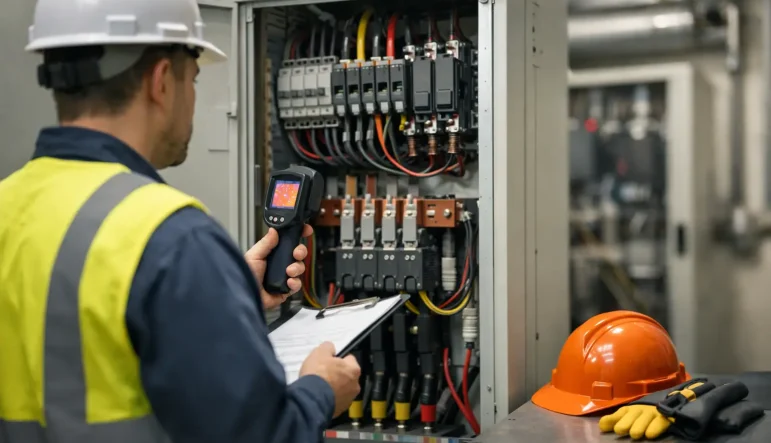
A distribution board with no current schedule, sockets added over several years, and an extension lead supplying fixed equipment are not minor facilities issues. Together, they can indicate a wider control problem. Knowing how to assess commercial electrical risks means looking beyond whether the lights work and establishing whether an installation remains safe, suitable, maintained and properly managed for the way the premises now operate.
For business owners, property managers and facilities teams, the objective is straightforward: identify electrical hazards before they lead to injury, fire, disruption or enforcement action, then deal with them in the right order. The assessment must reflect the building, the people using it and the operational demands placed on the electrical system.
A meaningful assessment begins with the environment, not the consumer unit or distribution board alone. A quiet office, a commercial kitchen, a warehouse, a workshop and a transport facility can all have very different electrical risk profiles, even where the nominal supply arrangement appears similar.
Consider who enters the area and what they do there. Employees, contractors, cleaners, visitors and members of the public may be exposed to different risks. Areas accessible to the public need particular attention, while plant rooms and restricted electrical spaces require effective access control, signage and competent working arrangements.
Usage patterns matter just as much. A circuit that was suitable for office desks may no longer be adequate if it now supplies portable heaters, servers, charging equipment or additional kitchen appliances. In industrial and infrastructure settings, vibration, moisture, dust, heat, vehicle movements and continuous operation can accelerate deterioration or increase the consequence of a fault.
The assessment should also establish whether the existing installation matches the current layout. Altered partitions, changed tenancy arrangements, new machinery or a refurbished workspace can leave circuits overloaded, inadequately protected or poorly documented.
A site assessment combines visual inspection, document review, discussion with those who use the building and, where necessary, formal testing by a competent person. It should not rely on a quick walk-round or a single maintenance record.
Start by gathering the records that show what has been installed, inspected and altered. Useful information includes electrical installation condition reports, installation certificates, minor works certificates, circuit schedules, test records, maintenance logs and details of previous defects.
Missing records do not automatically mean an installation is unsafe, but they do make safe management more difficult. If circuits are not clearly identified, for example, isolation during an emergency or maintenance task becomes slower and more hazardous. Out-of-date drawings can also conceal changes that were made without the right level of verification.
Check whether recommendations from previous reports have been closed out. A repeated observation about damaged accessories, inadequate labelling or poor earthing should not simply be carried forward at each inspection. It needs an owner, a target date and evidence that the remedial work has been completed.
Visual inspection can reveal issues requiring immediate action. Look for damaged plugs, cracked socket outlets, loose accessories, exposed cables, signs of overheating, scorch marks, water ingress and temporary wiring that has become permanent by default.
Extension leads and adaptors deserve careful scrutiny. They are useful for temporary, low-demand work, but they are often misused to compensate for too few fixed outlets. Daisy-chained extensions, cables routed across walkways, leads trapped in doors and overloaded multiway adaptors create risks of shock, fire and trips. The solution may be additional fixed wiring rather than another portable accessory.
Distribution boards and local isolators should be accessible, securely enclosed and suitably labelled. A locked electrical cupboard can be appropriate, but only if authorised staff can gain access without delay when isolation is needed. Obstructed boards, unlabelled circuits and improvised repairs are all indicators that electrical controls need closer review.
A visual check cannot confirm the condition of conductors, connections, earthing arrangements or protective devices. Formal inspection and testing is required to identify defects that are not apparent on the surface.
An Electrical Installation Condition Report, commonly called an EICR, is a key part of assessing fixed installation risk. It examines the condition of the installation against the relevant requirements and identifies observations by code. Findings that indicate danger or potential danger require prompt action, while other observations may call for planned improvement.
The appropriate inspection interval depends on the type of premises, the installation and the level of risk. A high-use workshop or harsh industrial environment may need more frequent attention than a low-risk office. The right approach is risk-based, supported by the condition of the installation, manufacturers’ guidance and the recommendations of a competent electrical contractor.
Portable electrical equipment also needs proportionate management. Portable appliance testing can be useful, but a pass label is not a complete safety system. Regular user checks, visual inspection, suitable equipment selection and controlled replacement are equally relevant. Equipment used outdoors, in damp areas or under heavy operational conditions will usually require closer control than an office desk lamp.
Electrical risk is not limited to a defect in wiring. It can arise from how people interact with an otherwise sound installation. Maintenance staff may need to isolate equipment; contractors may drill into walls containing concealed cables; cleaners may use equipment near water; and employees may bring personal chargers or heaters into the workplace.
Assess whether people have clear instructions and the competence required for their role. Staff do not need to be electricians to recognise damaged equipment, report a hot socket or avoid using a faulty lead. However, tasks involving isolation, alteration, fault-finding or work near live electrical parts must be controlled and undertaken by suitably competent persons.
Contractor management is especially significant in occupied commercial premises. Before works begin, confirm the location of services, isolation arrangements, permit requirements and responsibility for reinstatement and testing. Electrical changes made during a fit-out or maintenance project should be documented and certified where applicable, not left as an informal handover point.
Not every finding demands the same response. A sensible assessment ranks issues by the likelihood of harm and the potential consequence if something fails. A damaged faceplate in a low-traffic cupboard may need a planned repair. Evidence of overheating at a distribution board, exposed live parts or water entering electrical equipment may require immediate isolation and urgent remedial work.
Pay particular attention to these recurring commercial risks:
The assessment should record the location, nature and severity of each issue, along with photographs where helpful. Vague wording such as “electrics to be checked” is difficult to act on. Clear findings allow facilities teams to obtain the right scope of work and demonstrate that risks are being managed responsibly.
A risk assessment only adds value when it leads to controlled action. Separate urgent defects from planned maintenance and longer-term improvements. Immediate danger should be made safe without delay. For less urgent work, set priorities according to risk, operational impact, budget and access requirements.
Assign each action to a named person or provider, with a due date and a method for confirming completion. Where work affects a critical area, plan isolations carefully to avoid unnecessary disruption to operations, tenants or public access. There can be a trade-off between completing work quickly and arranging a controlled shutdown, but safety-critical defects should never be deferred solely for convenience.
Once remedial work is complete, update drawings, circuit schedules and maintenance records. This is particularly valuable in multi-occupancy buildings, industrial sites and premises with frequent layout changes. Good records reduce risk at the next inspection and give contractors the information needed to work safely.
Commercial electrical risk is not a one-off exercise. Equipment ages, occupancy changes, loads increase and premises are altered. Regular review helps identify when the original assessment no longer reflects actual conditions.
A competent electrical survey can provide the technical evidence needed to prioritise investment, plan remedial works and support compliance responsibilities. SJB Smart Electricals works across commercial, industrial and specialist environments, helping clients translate inspection findings into practical, properly managed electrical improvements.
The most useful question to keep asking is not simply whether an installation has power, but whether it can continue to serve the people and operations relying on it safely. That focus keeps electrical risk management practical, proportionate and ready for the next change in the building.

Learn what an 18th edition course for electricians covers, who needs i

Understand competent person electrical training, who needs it, what it