
We use cookies to optimize your experience, analyze traffic, and personalize ads. Please choose whether you accept our use of non-essential cookies. Read More
York
08:00 AM - 05:00 PM
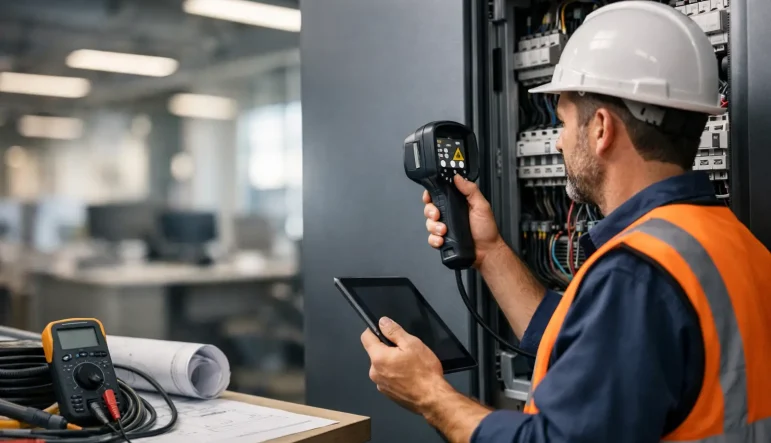
A commercial unit rarely gives much warning before electrical issues start affecting operations. A distribution board that has coped for years may suddenly be overloaded by new equipment. Lighting circuits may be carrying temporary alterations that were never properly documented. On paper, everything looks serviceable. In practice, that assumption can be expensive. That is why commercial electrical surveys matter – they establish what is actually in place, how well it performs, and whether it remains safe and suitable for the building’s current use.
For business owners, facilities managers and property professionals, the value of a survey is not just in spotting defects. It is in making informed decisions. Whether the issue is compliance, acquisition, refurbishment, change of tenancy or unexplained faults, a clear technical assessment gives you a basis for action rather than guesswork.
Commercial electrical surveys are structured assessments of an electrical installation within a non-domestic setting. The scope can vary depending on the building, the operational risks and the reason for the inspection, but the purpose is consistent: to understand condition, capacity, suitability and compliance.
That may involve reviewing switchgear, distribution boards, earthing and bonding, containment, wiring systems, protective devices, lighting, emergency systems and general installation standards. In many cases, survey work also considers whether previous modifications have been carried out correctly and whether the installation still aligns with the demands now placed on it.
A small office, a retail unit and a rail-related facility do not carry the same risk profile. The survey approach should reflect that. A competent contractor will not treat every site as though it can be assessed with the same checklist and the same assumptions.
The obvious time to commission a survey is when there is a known problem, but waiting for faults is not always the most sensible route. In commercial settings, electrical infrastructure often changes in stages. New equipment gets added, layouts are altered, and responsibilities pass between landlords, tenants and contractors. Over time, records become incomplete and confidence in the installation is based more on habit than evidence.
A survey is often justified before a lease begins, during a property purchase, ahead of refurbishment works or when a business changes how a space is used. It is also useful where there are recurring trips, unexplained outages, overheating concerns or visible signs of deterioration.
For landlords and managing agents, surveys can help clarify liability and prioritise works across multiple units. For owner-occupiers, they support budgeting and reduce the risk of discovering major electrical issues halfway through a project. In higher-demand environments such as industrial sites or transport facilities, the case is even stronger because electrical shortcomings can affect safety, uptime and contractor coordination.
Routine electrical maintenance has its place, but it does not always answer bigger questions about overall suitability. A system can be operational and still be poorly configured for the current load, poorly documented or non-compliant in key areas.
Commercial electrical surveys often identify a mismatch between the original installation and the way the building now functions. A workshop converted from storage may have insufficient power distribution. An office floor that has seen several fit-outs may contain layered alterations from different periods, with circuit identification that no longer reflects actual use. A site with regular contractor interventions may have safe individual additions but weak coordination across the wider installation.
These are not minor housekeeping issues. They can affect isolation procedures, emergency response, fault finding and future project costs. They also matter during audits, insurance discussions and legal responsibilities around workplace safety.
Not every survey delivers the same level of value. A very limited inspection may confirm that some components appear serviceable, but that is not the same as assessing the installation in enough detail to support business decisions.
A useful survey starts with purpose. If you need a condition assessment for a pre-acquisition review, the focus may be on age, defects, compliance risks and likely remedial costs. If you are planning an upgrade, the key question may be whether the existing infrastructure can support additional load, altered layouts or more complex controls. If faults are ongoing, the emphasis shifts towards tracing underlying causes rather than simply recording symptoms.
This is where experience matters. A contractor who works across commercial, industrial and regulated environments is more likely to recognise how electrical systems behave under operational pressure, not just how they appear in isolation.
One of the main reasons clients request commercial electrical surveys is compliance. That is sensible, but compliance should not be reduced to a pass-or-fail mindset. In practice, commercial properties sit within a wider framework of legal duty, maintenance responsibility, operational risk and project planning.
An installation may technically function while still presenting issues that need attention because of deterioration, inadequate protection, poor workmanship or unsuitable modifications. Equally, some observations are more urgent than others. The practical value of the survey lies in identifying priorities clearly so decision-makers know what requires immediate action, what should be programmed, and what should be monitored.
This avoids two common problems. The first is underreacting and leaving genuine risks unresolved. The second is overreacting and budgeting for unnecessary disruption when a more measured approach would be sufficient.
A professional survey process should be methodical and easy to follow. That means understanding the site, clarifying the purpose of the survey, reviewing available records and carrying out inspection and testing appropriate to the brief.
Good communication is part of technical competence. Clients should be told what will be inspected, whether there is likely to be any disruption, what limitations apply and how findings will be reported. In occupied premises, this is especially important because access, business continuity and health and safety controls can shape how survey work is carried out.
The report itself should be clear enough to support action. That does not mean oversimplifying technical findings. It means presenting them in a way that allows facilities teams, property managers and business owners to understand condition, risk and next steps without having to interpret vague language.
Commercial buildings are not all electrically straightforward. Even within the same broad category, one site may have relatively predictable loads while another includes specialist equipment, critical systems or infrastructure interfaces that demand closer scrutiny.
This is where sector breadth becomes useful. A contractor that understands domestic, commercial, industrial and transport-related work is often better placed to assess systems in context. That includes recognising how power quality, resilience, safe isolation, phased upgrades and documentation standards affect real-world operations.
For clients, the benefit is practical. Survey findings become more than a defect list. They become guidance shaped by how the building is actually used and what standards of reliability it needs to maintain. That is the difference between generic inspection work and a service that supports proper planning.
SJB Smart Electricals operates in that space – combining survey capability with installation knowledge and training awareness, which helps clients move from assessment to implementation with fewer gaps between diagnosis and delivery.
Approval status, competence and reporting quality should all carry weight when appointing a contractor. In commercial settings, price alone is a weak filter. A cheap survey that misses capacity issues, documentation problems or unsafe alterations can create far greater cost later.
It is worth asking whether the contractor regularly works in comparable environments, whether they understand current standards, and whether they can explain findings in operational terms. If remedial works are likely, it also helps to work with a provider capable of supporting the next stage rather than simply identifying problems and stepping away.
The best survey work is balanced. It is technically precise, commercially aware and realistic about disruption, urgency and cost. That balance is what gives decision-makers confidence.
Electrical systems tend to attract attention only when something fails or a project forces the issue. A well-timed survey shifts that position. It gives you visibility before small uncertainties become operational problems, and that is usually where the real value lies.

Learn what an 18th edition course for electricians covers, who needs i

Understand competent person electrical training, who needs it, what it