
We use cookies to optimize your experience, analyze traffic, and personalize ads. Please choose whether you accept our use of non-essential cookies. Read More
York
08:00 AM - 05:00 PM
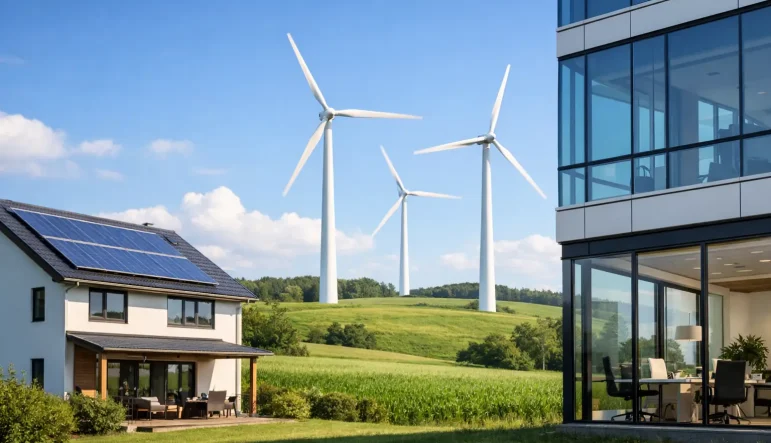
A small wind turbine can look like a straightforward route to lower-carbon electricity. In practice, wind turbines as green energy to support home or office premises only perform well where the location, electrical design and operational needs are properly assessed. A turbine in a clear, exposed position can make a worthwhile contribution to on-site consumption. The same equipment in a sheltered suburban garden or among turbulent rooflines may generate far less than expected.
For homeowners, facilities managers and commercial operators, the first question is not which turbine to buy. It is whether the site has a usable wind resource and a practical route from generation to the building’s electrical system. That decision should be based on a competent survey, not an annual wind-speed figure taken from a broad regional map.
Wind power is most effective where wind reaches the turbine cleanly and consistently. Open rural sites, elevated land, agricultural buildings, estates and larger commercial locations can be favourable, particularly where there is steady daytime electricity demand. Warehouses, workshops, offices with plant loads and mixed-use sites may be able to use a meaningful share of the power generated as it is produced.
A typical urban home is more challenging. Nearby houses, mature trees, chimneys and taller buildings create turbulence. Turbulent air reduces output and places irregular loading on turbine components. Mounting a turbine on a building does not automatically solve this issue; roof-mounted units can be exposed to vibration, noise transfer and highly disturbed airflow.
This does not mean wind is unsuitable for every home or office. It means the project needs to match the site. A standalone mast with adequate clearance from obstacles may be viable on a larger domestic plot or business premises, while solar generation or energy-efficiency improvements may be a better first investment elsewhere.
A pre-installation survey should establish far more than available space. It should review wind exposure, nearby obstructions, access for construction and maintenance, proposed turbine height, ground conditions, cable routes and the condition of the existing electrical installation.
For commercial and industrial clients, the survey should also consider the site load profile. A business that consumes electricity during the hours when wind generation is likely to occur can reduce imported electricity more effectively than a property with low daytime demand. Half-hourly consumption data can be particularly useful for larger sites, as it shows when loads are present rather than relying on annual bills alone.
The electrical assessment must establish the capacity of the distribution board, the location and rating of protective devices, earthing arrangements, isolation requirements and the proposed point of connection. A generating system must be designed so that it operates safely alongside the grid supply and existing equipment. This is particularly important where a site already has solar photovoltaic panels, battery storage, standby generation or sensitive machinery.
For grid-connected systems, the Distribution Network Operator must be involved under the relevant connection process. Smaller installations may fall within simplified notification arrangements, while larger or more complex systems require approval before connection. The route depends on the generation capacity and installation design, so it should be confirmed early rather than treated as paperwork after the work is complete.
Regional wind maps are useful as a starting point, but they cannot account for a line of trees, a neighbouring development or the shelter created by local terrain. For higher-value projects, site-specific analysis and, where appropriate, wind monitoring provide a much stronger basis for expected output.
The aim is to understand average wind speed at the turbine hub height, not at ground level or at a distant weather station. Wind energy rises sharply as wind speed increases, so a modest difference in actual conditions can have a major effect on annual generation. Honest estimates should include seasonal variation, downtime for maintenance and likely losses through electrical conversion and export.
Planning requirements vary with the type of turbine, its height, location and the characteristics of the site. Some domestic developments may qualify for permitted development rights, but this is not automatic. Conservation areas, listed buildings, protected landscapes, proximity to aviation infrastructure and local planning conditions can all alter what is possible.
Commercial projects are more likely to need a formal planning approach, especially where a mast, access works, foundations or visible structures are involved. Noise, visual impact, shadow flicker, ecology and effects on birds or bats may need assessment. For sites near airports, rail infrastructure or other transport assets, additional safeguarding and operational considerations can apply.
Early engagement is usually more efficient than redesigning a scheme after objections or planning feedback. A clear proposal should explain the turbine location, height, predicted sound levels where relevant, construction method, landscape impact and how the equipment will be maintained safely.
The turbine itself is only one part of the system. A reliable installation includes a suitable tower or mounting arrangement, foundations where required, cabling, inverter or controller equipment, isolation, circuit protection, metering, earthing and labelling. Each element must suit the site and be accessible for inspection, testing and future service.
For a building connected to the public network, the control system must prevent unsafe energisation of the network during an outage. Appropriate protection and commissioning prove that the generating equipment disconnects when required and reconnects only under acceptable conditions. This is a core safety requirement, not an optional extra.
Where resilience is a priority, battery storage can be considered alongside wind generation. However, a battery does not automatically provide power during a grid outage. Backup operation requires a designed changeover arrangement, suitable protection and a clear definition of which circuits will be supported. Offices may prioritise communications, emergency lighting and critical IT equipment; homes may choose heating controls, refrigeration and selected socket circuits.
The value of a turbine is not simply the number of kilowatt-hours it produces. It depends on how much electricity is used on site, how much is exported, the tariff structure, installation and maintenance costs, financing, and the expected service life of the equipment.
Using generated electricity directly often provides better value than exporting it, because it offsets electricity that would otherwise be purchased from the supplier. That makes load matching significant. A small office that is occupied during daytime hours may use wind output well, whereas a vacant weekend property may export a larger proportion of its generation.
Maintenance should be included in every financial appraisal. Turbines have moving parts and are exposed to weather, so planned inspections, servicing and access arrangements are part of responsible ownership. A lower initial price is not necessarily the lower whole-life cost if spare parts, technical support or safe maintenance access are limited.
Safe installation requires coordinated civil, mechanical and electrical work. The contractor must manage lifting operations where needed, cable protection, excavation risks, working at height, equipment positioning and safe isolation of electrical systems. Commissioning should include inspection, testing, verification of protective functions and clear handover information for the property owner or facilities team.
For commercial sites, the work should be planned around business continuity. Cable routes, switchboard outages, vehicle movements and access restrictions may need to be managed outside core operating hours. Industrial and infrastructure locations can require permit systems, task-specific risk controls and coordination with other contractors.
SJB Smart Electricals approaches renewable generation as part of the wider electrical installation: beginning with the survey, identifying connection and compliance requirements, and ensuring the finished system can be operated and maintained safely.
A wind turbine is not a universal answer to rising energy costs or sustainability targets. It is a site-dependent generating asset that can be highly effective in the right conditions and disappointing in the wrong ones. The strongest projects begin with measured expectations, a clear understanding of planning and grid requirements, and an installation designed around the way the property actually uses electricity.
Before committing, establish what the wind can realistically deliver at your site, what the network will permit and what the building can safely absorb. That groundwork turns a green-energy ambition into a system with a credible operational purpose.

Learn what an 18th edition course for electricians covers, who needs i

Understand competent person electrical training, who needs it, what it