
We use cookies to optimize your experience, analyze traffic, and personalize ads. Please choose whether you accept our use of non-essential cookies. Read More
York
08:00 AM - 05:00 PM

Last Updated: September 3, 2026
A safe system of work for electricity is a documented, systematic approach to managing electrical hazards by identifying risks, implementing control measures, and ensuring compliance with relevant regulations. It combines risk assessment, isolation procedures, permit-to-work systems, and competency requirements into a coordinated framework that protects workers from electrical shock, arc flash, and other hazards.
Before any electrical work happens, you need a plan that identifies what could go wrong, who’s qualified to do the work, what controls are in place, and what happens if something fails. Most organisations complete risk assessments but fail on implementation, reverting to old habits on site. A safe system of work only works when it actually changes what people do in front of live electrical installations.
The Electricity at Work Regulations 1989 forms the legal backbone of electrical safety in the UK. The regulations place a duty on employers and duty holders to ensure that electrical systems are designed, constructed, maintained, and used safely. Regulation 4 mandates that all work on electrical systems must be carried out in a manner that doesn’t create a risk of injury, requiring documented procedures, competent personnel, and appropriate control measures before work begins.
HSG47, the HSE’s guidance document on electrical safety, provides the practical interpretation of these regulations and details what constitutes a safe system of work for electricity. The Health and Safety at Work etc. Act 1974 establishes the overarching duty to protect workers from harm. For electrical work, this translates into a requirement to implement controls that prevent injury. Failure to comply exposes the organisation to enforcement action, fines, and in serious cases, criminal prosecution.
HSE guidance on electrical safety
Risk assessment is the foundation of any safe system of work for electricity. Without understanding what could go wrong, you can’t design effective controls. Common electrical hazards include contact with live conductors, arc flash from fault conditions, thermal burns, and electric shock from faulty earthing or bonding. A 230V domestic supply can be lethal under the right circumstances.
Hazard identification requires walking through your actual work environment. What’s the voltage of the systems workers interact with? Are there overhead power lines? Is there temporary electrical equipment on site? Are workers exposed to wet conditions that increase shock risk? Once hazards are identified, you assess risk by considering the likelihood of exposure and the potential severity of harm.
Risk assessment identifies which hazards can be eliminated entirely through design, for example, using low-voltage systems instead of mains voltage. Where elimination isn’t practical, you move to engineering controls like isolation, earthing, and bonding. Administrative controls like permit-to-work systems and training come next. PPE is the last resort, used only where other controls don’t fully manage the risk. Documentation should record what hazards exist, who’s at risk, what controls are in place, and what residual risk remains.
Electrical isolation is the most reliable control for managing electrical hazards. It means physically disconnecting the electrical supply so that equipment cannot be energised unexpectedly during work. Without isolation, you’re working on live equipment, where most serious incidents happen.
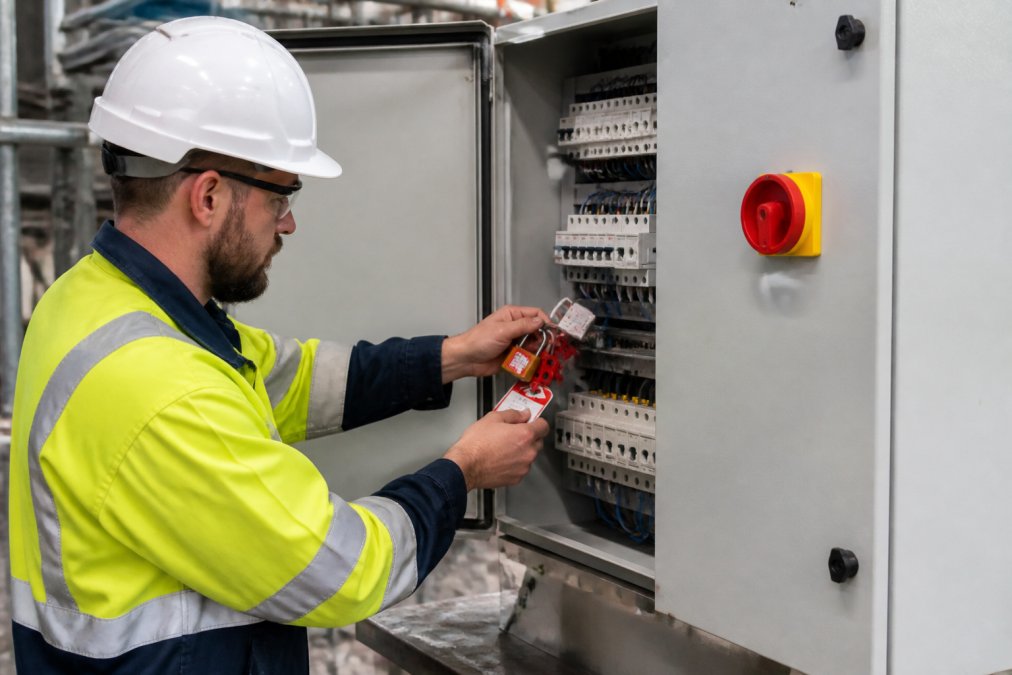
The safe isolation procedure follows a defined sequence: identify the correct isolation point, switch off and lock off the supply using a suitable isolation device, and verify that the circuit is dead using appropriate test equipment. Lock-out tag-out (LOTO) is the formal system for controlling isolation. A lock physically prevents the isolation device from being switched back on, and a tag explains why the lock is in place and identifies the person who applied it.
The critical mistake is treating isolation as a one-time action. Voltage testing should be carried out using a suitable test instrument at the point of work. Dead working, carrying out work on de-energised equipment, is always preferable to live working. Live working should only occur when it’s genuinely impossible to isolate the circuit, and requires a permit-to-work system, a competent person supervising, and enhanced PPE.
A permit-to-work (PTW) system is a formal procedure for authorising and controlling high-risk work. For electrical maintenance, it creates a documented hand-off between the person requesting the work, the person authorising it, and the person carrying it out, reducing the risk of miscommunication and ensuring that all necessary precautions are in place.
The PTW system typically involves a supervisor or competent person identifying work that requires a permit, usually high-risk tasks like live working or work on complex systems. They complete a permit form documenting the work to be done, the hazards involved, the isolation points, the control measures, and the competency requirements. The permit remains in force for a defined period or until the work is complete.
The permit serves as evidence that someone has thought through the risks and approved the work based on adequate control measures. It’s also a communication tool, ensuring the person carrying out the work knows what’s been assessed, what controls are in place, and what the boundaries of the work are. Digital permit-to-work systems offer advantages over paper-based systems by enforcing mandatory fields, routing permits to the right approvers automatically, and creating an audit trail. The weakness in many PTW systems is that they become bureaucratic tick-boxes rather than genuine risk management tools. The system only works if people believe it’s there to protect them.
The Electricity at Work Regulations place a duty on the duty holder to ensure that personnel are competent. Competency requires both knowledge and practical skill. A person might understand the theory of electrical safety but lack the practical experience to identify hazards on a real installation.
GS6, the HSE’s guidance on competency for electrical work, sets out what competent people need to know and be able to do. It covers understanding electrical systems, recognising hazards, applying safe systems of work, using test equipment correctly, and responding to emergencies. HSG47 training provides the regulatory framework and practical guidance, covering the Electricity at Work Regulations, risk assessment, isolation procedures, permit-to-work systems, and emergency response.
The duty holder must ensure that training is refreshed regularly, typically every two to three years, to maintain competency levels across the team.
Competent person status must be maintained through ongoing practice, refresher training, and regular assessment. Personal protective equipment (PPE) for electrical work includes insulating gloves, arc-rated clothing, safety helmets, and eye protection. The specific PPE required depends on the voltage, the type of work, and the arc flash risk.
Flame-retardant clothing is essential for anyone working on electrical systems where arc flash is a risk. Arc-rated clothing is designed to self-extinguish and protect the skin beneath. Earthing and bonding are fundamental control measures that reduce electrical hazards. Earthing provides a low-resistance path for fault current, allowing protective devices to operate quickly. Bonding ensures that all conductive parts are at the same potential, preventing electric shock from potential differences.
Emergency procedures must be documented and practised. If someone receives an electric shock, the first step is to isolate the source of the current. CPR and first aid training are essential for anyone working in electrical environments, as many electrical incidents result in cardiac arrest.
HSE guidance on competency in electrical work
Implementation is where most organisations struggle. Excellent documentation means nothing if it doesn’t translate into changed behaviour on site. Implementation requires management commitment, adequate resources, and a culture where safety is everyone’s responsibility.
Start by assigning clear roles and responsibilities. Who is the duty holder? Who carries out the risk assessments? Who authorises work? Who verifies competency? These roles must be defined, communicated, and understood by everyone involved. Training should cover not just the procedures but the reasons behind them. People are more likely to follow procedures they understand and believe in.
Audit is the mechanism for checking that the system is working in practice. An audit should include reviewing documentation, observing work in progress, and interviewing workers about their understanding of the procedures. Common findings include permits being issued without proper assessment, isolation not being verified in practice, and workers not understanding the hazards they’re exposed to.
Digital systems can support auditing by creating records of permits issued, training completed, and assessments carried out. They also make it easier to identify trends. Regular review of the safe system of work is essential. As operations change, new hazards emerge, or incidents occur, the system must be updated to reflect current risks.
Managing electrical risks effectively requires a systematic approach that integrates risk assessment, competency, isolation procedures, and emergency response into a coordinated framework. At SJB Electrical Training, we work with contractors, maintenance teams, and industrial organisations across the UK to design and implement safe systems of work tailored to their specific operations. Our specialist training in HSG47, GS6, and practical electrical safety equips your team with the knowledge and confidence to identify hazards, apply control measures, and respond effectively to electrical emergencies. Book Training with our team to assess your current system and identify where improvements will have the greatest impact on safety and compliance.
A safe system of work for electricity comprises risk assessment, hazard identification, isolation procedures, permit to work systems, competent person involvement, appropriate PPE, and emergency protocols. These elements work together to protect workers from electrical hazards including electric shock, arc flash, and contact with live conductors. Documentation and regular auditing ensure the system remains effective and compliant with the Electricity at Work Regulations 1989.
The Electricity at Work Regulations 1989 require duty holders to ensure electrical systems are designed, installed, maintained, and used safely. Key obligations include conducting risk assessments, implementing safe isolation procedures, providing competent persons for electrical work, and ensuring all work is carried out dead (de-energised) where reasonably practicable. HSG47 and GS6 guidance documents expand on these requirements with practical implementation strategies.
Effective isolation begins with identifying all sources of supply and confirming de-energisation using voltage testing. Lock-out tag-out (LOTO) prevents accidental re-energisation during work. A competent person must verify isolation before work starts. Dead working is the preferred method whenever possible. Documentation of isolation steps, testing results, and who performed the work is essential for compliance and traceability. Regular training ensures all personnel understand isolation procedures relevant to their role.
An Authorised Person holds specific competency to work on or near live electrical systems when dead working is not reasonably practicable. They must understand electrical hazards, carry out risk assessments, use appropriate testing equipment, and apply safe working methods including live working techniques. Authorised Persons require formal training and ongoing competency assessment. Their role is critical in high-risk environments such as airport lighting systems or battery energy storage installations where live working may be unavoidable.
Essential documentation includes risk assessments identifying electrical hazards, safe isolation procedures specific to your equipment, permit to work forms for high-risk tasks, competency records for personnel, training logs, maintenance schedules, and incident investigation reports. Digital permit-to-work systems improve tracking and compliance. Documentation must be reviewed regularly and updated when electrical systems change. This creates an audit trail demonstrating compliance with the Electricity at Work Regulations and HSG47 guidance.
HSG85 (Electricity at Work: Safe Working Practices) provides practical guidance on implementing the Electricity at Work Regulations 1989. It emphasises risk-based approaches, the importance of dead working, safe isolation procedures, competency requirements, and the role of permit to work systems. HSG85 complements HSG47 (Avoiding Danger from Live Working) and helps organisations design safe systems of work that reduce electrical risks. Following HSG85 principles strengthens compliance and demonstrates due diligence.
Core electrical safety principles include: identify all sources of supply; isolate and lock-out before work; test isolation with appropriate equipment; treat all circuits as live until proven otherwise; use appropriate PPE including flame-retardant clothing; ensure competent persons supervise work; maintain safe distances from overhead power lines; never work alone on high-risk tasks; and document all work. These rules underpin safe systems of work and reduce the risk of electric shock, arc flash, and other electrical incidents in the workplace.
This article was written using GrandRanker
Learn what an 18th edition course for electricians covers, who needs i
Understand competent person electrical training, who needs it, what it