
We use cookies to optimize your experience, analyze traffic, and personalize ads. Please choose whether you accept our use of non-essential cookies. Read More
York
08:00 AM - 05:00 PM
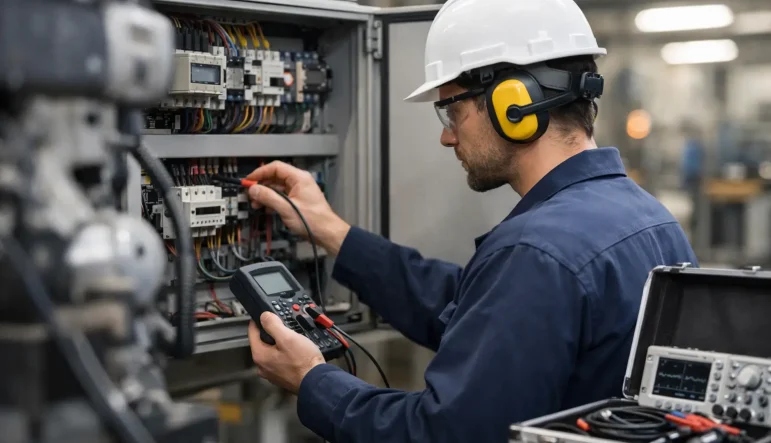
When a production line stops without warning, every minute has a cost. Delays to output, pressure on maintenance teams and the risk of repeat failure all make industrial fault finding services a practical necessity, not an optional extra. In industrial settings, electrical faults rarely stay isolated for long. One issue in a panel, control circuit or power distribution path can quickly affect safety, productivity and compliance.
The difficulty is not just finding what has failed. It is finding why it failed, whether there are wider system weaknesses, and what needs to be done to prevent the same disruption happening again. That is where an experienced electrical contractor adds real value. Good fault diagnosis is methodical, evidence-based and carried out with a clear understanding of how industrial systems behave under load, during start-up and across normal operating conditions.
Industrial fault finding services are used to locate, diagnose and resolve electrical problems in working environments where systems are often complex, interconnected and business-critical. That may include distribution boards, control panels, three-phase supplies, machinery circuits, emergency systems, lighting, containment, isolation points and protective devices.
In practice, the work usually starts with symptoms rather than answers. A breaker may keep tripping. A motor may fail to start. A machine may run intermittently, overheat or show unexplained voltage irregularities. Sometimes the issue is obvious, such as visible damage or a failed component. More often, the fault sits behind a chain of conditions that need to be tested properly before any repair is carried out.
This is why competent diagnosis matters. Replacing parts based on assumption can waste time and money, and in regulated environments it can also create further risk. A structured fault finding process looks at supply integrity, load behaviour, control logic, earthing arrangements, protective coordination and environmental factors before recommending remedial work.
Industrial clients are right to care about response time. Unplanned downtime can affect production targets, service delivery and contractual obligations. In sectors such as transport, warehousing, manufacturing and processing, a fault may also create knock-on issues for adjacent systems or site access.
Even so, speed without proper diagnosis can become expensive. A quick fix that gets equipment running for a few hours is not much use if the root cause remains in place. The better approach is to restore safety first, isolate the problem accurately and then decide whether a temporary measure or full repair is the right course. That decision depends on the site, the equipment and the operational impact of a shutdown.
There is always a trade-off to manage. Some facilities need an immediate short-term solution to maintain critical operations, followed by planned remedial works during a maintenance window. Others are better served by taking the affected system fully offline until testing and repair are complete. A capable contractor will explain that judgement clearly rather than pushing a one-size-fits-all answer.
Industrial electrical systems are exposed to heavier loads, longer operating hours and harsher environments than many commercial installations. That creates fault patterns that need both technical knowledge and sector experience to interpret correctly.
One common issue is nuisance tripping, but the term itself can be misleading. Breakers and protective devices usually operate for a reason. The real task is identifying whether the cause is overload, insulation breakdown, earth leakage, inrush current, poor discrimination, equipment deterioration or an installation defect.
Control faults are another regular concern. A system may have power available but still fail because of relay issues, damaged contactors, failed interlocks, loose terminations or deterioration within the control panel. In older installations, undocumented modifications can complicate diagnosis further. What appears to be one fault may actually be the result of several changes made over time.
Power quality problems also deserve attention. Voltage imbalance, harmonics, poor connections and degraded components can create intermittent behaviour that is hard to trace without proper testing. In sites with mixed loads and sensitive equipment, these faults may present as recurring performance issues rather than a complete system failure.
Environmental conditions add another layer. Moisture, dust, vibration, heat and corrosion all affect electrical reliability. In those cases, repairing the immediate failure is only part of the solution. The wider installation may need review to improve protection, containment or maintenance practice.
Reliable diagnosis is built on process. That starts with safe isolation, verification and a clear understanding of the affected system. From there, a contractor can review available records, inspect the installation, question site staff about the sequence of events and carry out targeted testing.
Testing may include continuity checks, insulation resistance testing, earth fault assessment, voltage measurements, phase verification, load analysis and examination of protective devices. The exact sequence depends on the fault. A recurring trip on a distribution circuit needs a different approach from a non-responsive machine control panel.
Good fault finding also means resisting the urge to jump to the most obvious answer. For example, if a motor protection device has operated, the issue may not be the motor itself. It could be mechanical load, supply imbalance, cable damage or settings that no longer match the actual duty of the equipment. In the same way, a failed fitting in an industrial lighting system may point to a wider issue with supply quality, switching arrangements or environmental ingress.
The advantage of using an approved and experienced contractor is that diagnosis is informed by installation knowledge as well as test results. That matters when faults sit at the boundary between existing infrastructure, recent modifications and operational use.
Some faults are straightforward for in-house teams to identify, particularly where the site has strong maintenance capability and good documentation. But there are clear points where external support is the sensible option.
If a fault keeps returning after repair, that usually indicates the original cause has not been fully established. If protective devices are operating repeatedly, if there is evidence of overheating, or if testing points to deterioration in critical circuits, specialist intervention is warranted. The same applies where there are compliance concerns, uncertainty over safe reinstatement or systems that affect operational continuity across a wider site.
Industrial environments also often contain a mix of old and new equipment. Extensions, temporary works and legacy infrastructure can leave installations harder to interpret than the drawings suggest. An external contractor brings an independent view and the discipline to assess the system as it actually exists, not only as it was originally intended.
For procurement leads and facilities managers, there is another practical benefit. Using a competent contractor for diagnosis, remedial works and related electrical assessment helps maintain a clearer line of accountability. That can be especially useful where records, compliance evidence and follow-on recommendations are needed.
Not every electrical contractor is set up for industrial diagnosis. The right provider should be able to work safely in live operational environments, understand industrial distribution and control systems, and communicate findings in a way that supports action.
Approval status, sector experience and technical range all matter. Fault finding is rarely isolated from the wider condition of the installation. A contractor that also carries out surveys, installations and workforce training can often offer more practical value because they understand how diagnosis fits into the full life cycle of an electrical system. SJB Smart Electricals operates in that broader service space, which is often beneficial for clients who need more than a one-off repair.
It is also worth asking how findings will be reported. A good service should do more than state that a fault was fixed. It should explain the likely cause, what testing was undertaken, whether any associated risks remain and what remedial or preventive actions are advisable. For asset owners and operators, that information is often as important as the immediate repair.
The best outcome is not simply getting power back on. It is using the incident to improve the installation, reduce repeat failures and support safer operation. Sometimes that means replacing ageing components. Sometimes it means improving circuit segregation, updating documentation, reviewing protection settings or arranging further inspection.
Not every fault justifies a major upgrade, and not every recurring issue has a single neat cause. Industrial systems are shaped by age, environment, loading and operational pressures. What matters is having a contractor who can identify the real issue, advise honestly on priorities and carry out work to the required standard.
When electrical faults affect industrial operations, guesswork is expensive. A clear diagnosis, competent remedial work and practical advice for what comes next will always put a site in a stronger position than a temporary fix left to chance.

Learn what an 18th edition course for electricians covers, who needs i

Understand competent person electrical training, who needs it, what it