
We use cookies to optimize your experience, analyze traffic, and personalize ads. Please choose whether you accept our use of non-essential cookies. Read More
York
08:00 AM - 05:00 PM
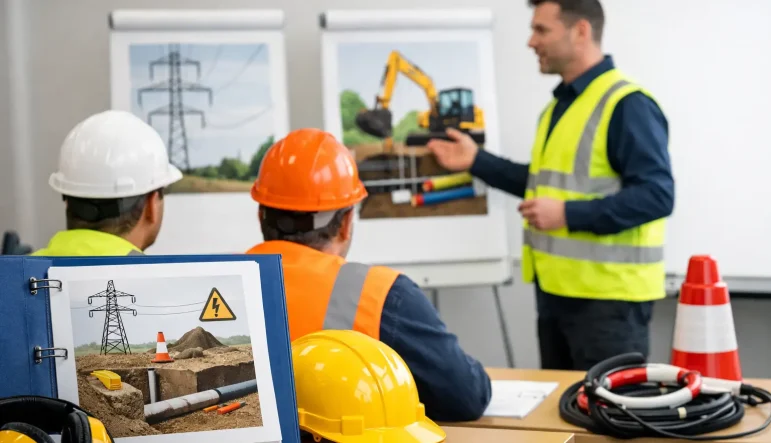
Groundworks, lifting operations and routine maintenance can all place people close to electrical hazards that are not immediately obvious. An HSG47 & GS6 training course combined brings together two critical areas of safety awareness: avoiding underground services and working safely near overhead power lines. For organisations managing construction, utilities, estates, industrial sites or transport infrastructure, this combined knowledge supports better planning before work starts.
The value is not simply in knowing that cables may be present. It is in understanding how to identify risk, interpret available information, establish safe systems of work and stop work when site conditions do not match the plan. HSG47 and GS6 training should strengthen practical decision-making for those whose work could disturb ground or bring plant, loads and people into the vicinity of electrical networks.
HSG47 is Health and Safety Executive guidance on avoiding danger from underground services. It is particularly relevant wherever excavation, drilling, piling, fencing, groundwork or intrusive surveys are planned. Underground electricity cables, gas pipes, water mains, communications infrastructure and other services can be damaged by poorly controlled work, with potentially severe consequences for workers, the public and surrounding operations.
The guidance promotes a structured approach. Information must be obtained from utility owners and other relevant sources, drawings should be reviewed critically, and the ground should be surveyed using suitable locating equipment. Safe digging methods then matter just as much as initial detection. Plans and cable avoidance tools are useful controls, but neither should be treated as proof that a service is absent.
GS6 addresses the avoidance of danger from overhead power lines. It applies where cranes, telehandlers, tipper lorries, excavators, access equipment, scaffolding, ladders or long materials could enter a hazardous area. Overhead line incidents can occur quickly, especially where site traffic, deliveries and lifting operations change during the course of a project.
Workers need to recognise that electricity can arc across a gap. Physical contact with a line is not required for a dangerous event to occur. Effective controls may include avoiding the area entirely, arranging isolation or diversion where reasonably practicable, setting exclusion zones, installing goalposts and height restrictions, and supervising plant movements.
On many sites, underground and overhead hazards are managed by the same teams. A civils contractor may excavate for ducting while mobile plant, delivery vehicles and lifting equipment operate nearby. A facilities team may arrange repairs to buried supplies and need access equipment close to overhead lines. Treating these risks in isolation can leave gaps between planning, site set-up and day-to-day supervision.
A combined course helps delegates see the shared principles. Both subjects require reliable pre-start information, clear communication, competent people, practical site controls and a willingness to challenge unsafe assumptions. The course can also help managers and supervisors apply a consistent standard across contractors and work packages.
There is a practical efficiency benefit too. Rather than arranging separate awareness sessions, organisations can cover related electrical service risks in one planned training event. This is particularly useful for teams with mixed duties, provided the course remains suitably detailed and relevant to their actual work.
However, combined training is not automatically the right answer for every role. A designated cable avoidance operator, lifting supervisor or person planning complex works near high-voltage infrastructure may require more focused, role-specific instruction. Training must match the level of responsibility and the nature of the work being carried out.
This type of training is well suited to supervisors, site managers, operatives, machine drivers, groundworkers, maintenance teams, facilities personnel and anyone responsible for planning or overseeing work near electrical services. It can also be valuable for project managers, surveyors and procurement teams who need to understand the information and controls required before appointing contractors.
For commercial and industrial property operators, the training supports safer management of alterations, repairs and planned maintenance. In infrastructure settings, where site rules, permits and service records may be more complex, it can provide a useful foundation for managing contractor activity.
Homeowners and smaller businesses arranging external works can also benefit from understanding the basic risks. Installing fencing, foundations, drainage, lighting columns or outbuildings can involve excavation and plant movements. The work should still be undertaken by competent contractors, with the correct enquiries and site controls in place.
A credible course should go beyond a presentation of guidance documents. Delegates should leave with a clearer understanding of what to do before work begins, what warning signs to look for during the job and when to escalate a concern.
For underground services, this normally includes the limits of records and drawings, use of cable avoidance equipment, the importance of safe excavation techniques, marking and protecting identified services, and actions to take if a strike or suspected strike occurs. It should reinforce that damaged insulation, exposed cables and unexplained changes in ground conditions are reasons to stop and reassess.
For overhead lines, delegates should understand line recognition, safe clearance principles, site layout, control of plant and loads, and emergency actions following contact or arcing. If a vehicle or machine contacts an overhead line, the safest immediate action may be to remain inside the cab, where safe to do so, and summon emergency assistance. Attempting to leave the vehicle can create a path to earth and significantly increase the risk of electric shock.
Training is most effective when examples reflect the delegates’ environment. An industrial maintenance team, for example, may need to consider restricted access and legacy services. A civil engineering team may need greater emphasis on excavation permits, utility searches, trial holes and daily plant controls.
One of the most important messages from HSG47 and GS6 is that competence is applied on site, not merely demonstrated in a classroom. A certificate does not make excavation or work near power lines safe by itself. Each task still requires proportionate planning, current service information, appropriate permits, suitable equipment and competent supervision.
For underground work, site teams should confirm that information has been requested from relevant service owners, reviewed and communicated. Where services are suspected, detection and verification measures should be built into the method of work before mechanical excavation begins. The exact approach will depend on the location, the quality of records, the type of work and the known services present.
For overhead lines, route planning for vehicles and plant should be considered early. Temporary changes such as new storage areas, altered access routes or additional lifting activity can introduce risk after the original plan has been approved. Controls need reviewing when the site changes, not only at the start of the project.
Clear responsibilities are equally important. Everyone should know who can authorise work, who checks controls, who communicates with service owners and who has the authority to stop work. This avoids the common and dangerous assumption that another contractor has already dealt with the issue.
When choosing training, decision-makers should look for a provider that understands the difference between guidance awareness and practical site implementation. The trainer should be able to explain how the principles apply to the organisation’s work, rather than relying on generic examples alone.
Ask how the course addresses current work activities, assessment of learning and delegate numbers. Smaller groups may allow more discussion around site scenarios, while larger workforce sessions can be useful for establishing a shared baseline. The right format depends on whether the objective is general awareness, supervisory confidence or preparation for a defined project.
It is also sensible to consider how training will be supported afterwards. Toolbox talks, pre-start briefings, refreshed procedures and visible site controls help turn knowledge into everyday practice. Records should be maintained, but the real measure of success is whether teams recognise hazards early and act before an incident occurs.
SJB Smart Electricals approaches training with the same practical focus applied to electrical surveys and installation work: understanding the environment, identifying the relevant risk and applying controls that stand up to real site conditions. For organisations managing varied sites and contractors, that connection between training and operational delivery matters.
A combined HSG47 and GS6 course is a sound investment where work may affect buried services or take place near overhead lines. Its greatest benefit comes when it prompts better questions before the first machine moves, better controls while work is under way and the confidence to stop when conditions are unsafe.

Learn what an 18th edition course for electricians covers, who needs i

Understand competent person electrical training, who needs it, what it