
We use cookies to optimize your experience, analyze traffic, and personalize ads. Please choose whether you accept our use of non-essential cookies. Read More
York
08:00 AM - 05:00 PM
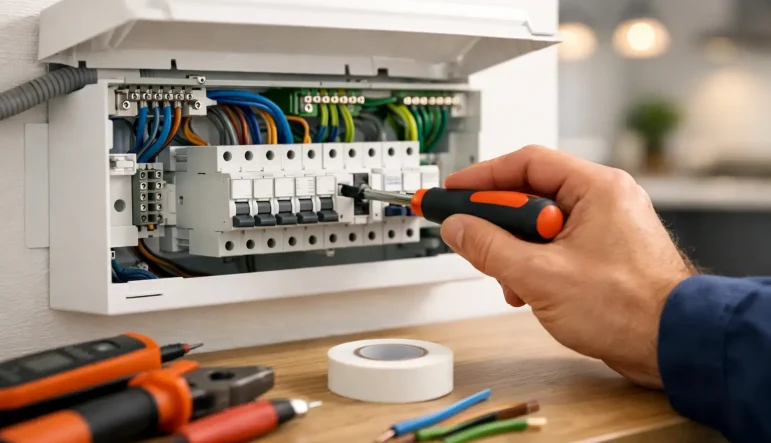
A consumer unit may sit quietly in a hall cupboard or under the stairs, but it is the point at which a home’s electrical safety is coordinated. A proper guide to domestic consumer unit upgrades therefore starts with the condition of the installation behind it, not with the appearance of a new fuse box. Replacing the board without assessing circuits, earthing and existing defects can leave important safety issues unresolved.
For homeowners, landlords and property managers, the decision is usually prompted by an Electrical Installation Condition Report, a renovation, repeated tripping, or the need to add higher-demand equipment. The right approach is a surveyed, compliant upgrade completed by a competent electrician, followed by clear certification.
Age alone does not automatically make a consumer unit unsafe. Some older installations remain serviceable, while a relatively recent board may require attention because of poor workmanship, damage or changes to how the property is used. The question is whether the installation can provide appropriate protection and whether it is suitable for current and planned demand.
Older rewireable fuse boards, wooden-backed equipment, damaged enclosures and boards without residual current device protection are common reasons for further investigation. A lack of spare ways can also become significant when a household is adding an electric vehicle charger, heat pump, electric shower, induction hob, garden office or loft conversion. These additions can affect circuit capacity, protective device selection and the overall load on the supply.
Frequent tripping should not be treated as an inconvenience to be worked around. An RCD or RCBO may be responding correctly to a fault, appliance issue, moisture ingress or deteriorating cable. Resetting it repeatedly without diagnosis can mask the cause. Equally, a circuit that never trips is not necessarily proof that it has suitable protection.
An Electrical Installation Condition Report is often the most useful starting point. It records observed defects, assesses the condition of the installation and identifies whether remedial work is required. It also helps determine whether a complete consumer unit replacement is justified, or whether a more limited repair can safely address the issue.
A modern consumer unit is more than a row of switches. It should distribute circuits safely, isolate power when necessary and provide suitable protection against electric shock, overload, short circuit and, where required, transient overvoltages.
In many homes, individual RCBO protection is preferred because each circuit has its own combined overcurrent and residual current protection. If a fault develops on one circuit, only that circuit should disconnect, reducing disruption to lighting, refrigeration, alarms or home-working equipment elsewhere. This is not the only compliant arrangement, but it is often a practical choice where continuity matters.
Surge protection devices, commonly called SPDs, may also be required following an assessment under current BS 7671 requirements. They help reduce the risk of damage caused by transient overvoltages, which can arise from external network events or switching within an installation. Whether an SPD is necessary depends on the assessment and the potential consequences of equipment damage, rather than simply on the value of the consumer unit.
Arc fault detection devices are another consideration. These are designed to detect certain dangerous arcing faults that conventional protective devices may not identify. They are not a universal requirement in every domestic setting, but can be considered where the property, occupancy or risk profile makes the additional protection appropriate.
A sound upgrade also considers labelling, circuit schedules, safe access and enclosure suitability. Consumer units are commonly installed with metal enclosures to reduce fire risk, but location remains important. A board should be accessible for operation and inspection, without being exposed to avoidable damage, damp or unsuitable environmental conditions.
Changing a consumer unit is one of the points at which hidden defects become visible. Before work is agreed, the electrician should establish how the existing installation is arranged and whether it can be safely connected to new protective devices.
The assessment typically includes the incoming supply, main earthing conductor, main protective bonding, meter tails, isolation arrangements, circuit identification and the condition of accessible wiring. Tests may also be needed to confirm insulation resistance, polarity, earth fault loop impedance and the effectiveness of existing protective measures.
This matters because modern protective devices can expose faults that an older fuse board did not reveal. For example, low insulation resistance, borrowed neutrals between circuits or poor connections can lead to nuisance tripping after an upgrade. These are not faults caused by the new consumer unit. They are pre-existing conditions that need correction before the installation can be safely certified.
For properties undergoing refurbishment, the survey should also account for future work. It can be sensible to allow capacity for a planned extension or electrical heating system, but adding spare ways is not a substitute for load assessment. A larger board does not increase the capacity of the incoming supply, and high-demand additions may require consultation with the distribution network operator.
There is no single consumer unit specification that suits every home. A small flat with modest electrical demand requires a different approach from a larger house with an electric vehicle charger, solar generation, battery storage and outdoor circuits.
The electrician should consider the number and type of circuits, diversity of demand, existing cable condition and any specialist equipment. Outdoor sockets, garage supplies, showers, cookers and electric vehicle charging equipment all require careful circuit design. Solar photovoltaic and battery systems introduce further considerations around isolation, labelling and the relationship between generation equipment and the main installation.
It is also worth separating essential loads where practical. A home office, medical equipment, security system or refrigeration may justify circuit arrangements that minimise unnecessary loss of supply. The aim is not to add complexity for its own sake, but to create a maintainable installation that responds sensibly when a fault occurs.
A consumer unit replacement normally requires the electrical installation to be isolated. The duration depends on the number of circuits, the condition of the wiring and whether remedial work is identified. A straightforward change can often be completed within a day, but this should never be promised before the survey and testing requirements are understood.
The work should begin with safe isolation procedures. Existing circuits are identified, disconnected and assessed before being transferred to the new unit. The electrician then installs and terminates the new equipment, confirms protective device selection, labels circuits and carries out the full range of required inspection and testing.
Testing is not an optional final check. It is the evidence that verifies, as far as reasonably practicable, that the altered installation meets the relevant requirements. If defects are found during the work, they should be explained clearly, with the options and implications set out before further remedial work proceeds.
Residents should prepare for a planned loss of electricity by charging essential devices, considering refrigerated or frozen food, and making arrangements for electrically operated access equipment. Sensitive electronics should be shut down properly before isolation. If the property contains medical equipment or other critical loads, this must be raised during planning rather than on the day.
Following a consumer unit upgrade, the client should receive an Electrical Installation Certificate with schedules of inspection and test results. This documentation is valuable at sale, for landlord records, insurance queries and future electrical work. Keep it alongside previous electrical reports and any details of solar, battery or charging equipment.
Replacing a consumer unit is generally notifiable work in England and Wales under building regulations. The route for notification depends on the installer and local requirements. Scotland and Northern Ireland operate under different arrangements, so property owners should confirm the relevant process for their location. A competent contractor will explain what certification and notification apply before work starts.
The cheapest quotation is not always the most economical decision. An unclear scope may exclude testing, remedial work, certification, surge protection assessment or notification. A useful quotation identifies what is included, what assumptions have been made and what may change if concealed defects are found.
For domestic work requiring survey, installation and certification, SJB Smart Electricals approaches the consumer unit as part of the wider installation, rather than as an isolated replacement. That is the practical route to an upgrade that supports safety, compliance and the way the property will be used in the years ahead.

Learn what an 18th edition course for electricians covers, who needs i

Understand competent person electrical training, who needs it, what it