
We use cookies to optimize your experience, analyze traffic, and personalize ads. Please choose whether you accept our use of non-essential cookies. Read More
York
08:00 AM - 05:00 PM
Last Updated: August 23, 2026
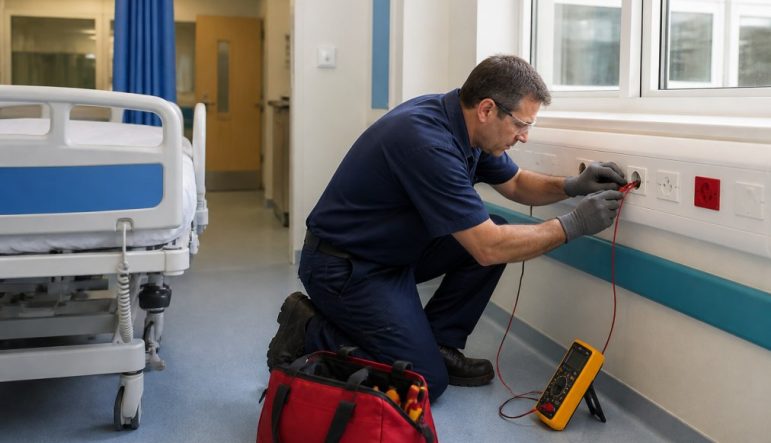
Electrical safety for hospital maintenance staff is one of the highest-stakes disciplines in facilities management. Hospitals combine high electrical loads, life-critical equipment, and environments where moisture, sterility requirements, and continuous 24-hour operation make every routine task a potential hazard. This guide provides a practical framework: from identifying hazards specific to clinical settings, to lockout/tagout procedures for medical devices, to what a compliant maintenance schedule looks like.
Hospital electrical environments are fundamentally different from standard commercial or industrial sites. The combination of diagnostic equipment running on uninterruptible power, wet clinical areas, and patients connected to life-saving devices creates a risk profile that standard electrical safety guidance does not fully address.
Electrical hazards common in hospital settings include:
Electrical shock thresholds that cause ventricular fibrillation in a healthy adult can be reached at far lower leakage current levels in patients with direct cardiac connections. This is why IEC 60601 sets microampere-level leakage current limits for medical electrical equipment, far stricter than anything applied in standard commercial buildings.
Sterile areas, decontamination units, and wet clinical rooms present elevated ground fault circuit interrupter requirements. Insulation resistance degrades faster in high-humidity environments, and standard visual inspection intervals are insufficient. Moisture ingress into socket outlets, junction boxes, or equipment enclosures can create fault conditions that are invisible until they become dangerous.
Equipment that passed its last PAT test may not remain safe in a wet environment between testing cycles. Insulation testing should be repeated more frequently in high-humidity zones, and any equipment showing signs of moisture ingress should be taken out of service immediately.
Maintenance work near life-saving devices requires a fundamentally different approach to isolation. Before any electrical isolation in a ward or critical care environment, maintenance staff must:
No assumption is safe in a clinical environment.
The [Electricity at Work Regulations 1989(/electricity-at-work-regulations-training/) full text | legislation.gov.uk] place absolute duties on employers, the self-employed, and employees to prevent danger from electrical systems. For NHS and independent healthcare sites, every electrical system, from the main HV intake to a bedside socket, must be constructed, maintained, and used in a way that prevents danger. This responsibility cannot be delegated away.
Under Regulation 4, duty holders must ensure electrical systems are maintained to prevent danger. In practice, for a hospital site, this means:
Regulation 16 requires that no person carries out electrical work unless they possess the technical knowledge or experience to prevent danger. This applies to anyone who interacts with electrical systems, including maintenance staff who reset circuit breakers, change fuses, or operate isolation switches. According to HSE guidance on the Electricity at Work Regulations, the duty to maintain extends to ensuring that protective devices, earthing arrangements, and insulation are all in effective working order.
Lockout/tagout is the most critical safe system of work for hospital maintenance staff carrying out electrical work. A lockout/tagout procedure physically prevents equipment from being re-energised while maintenance is in progress, using padlocks and warning tags applied at the point of isolation.
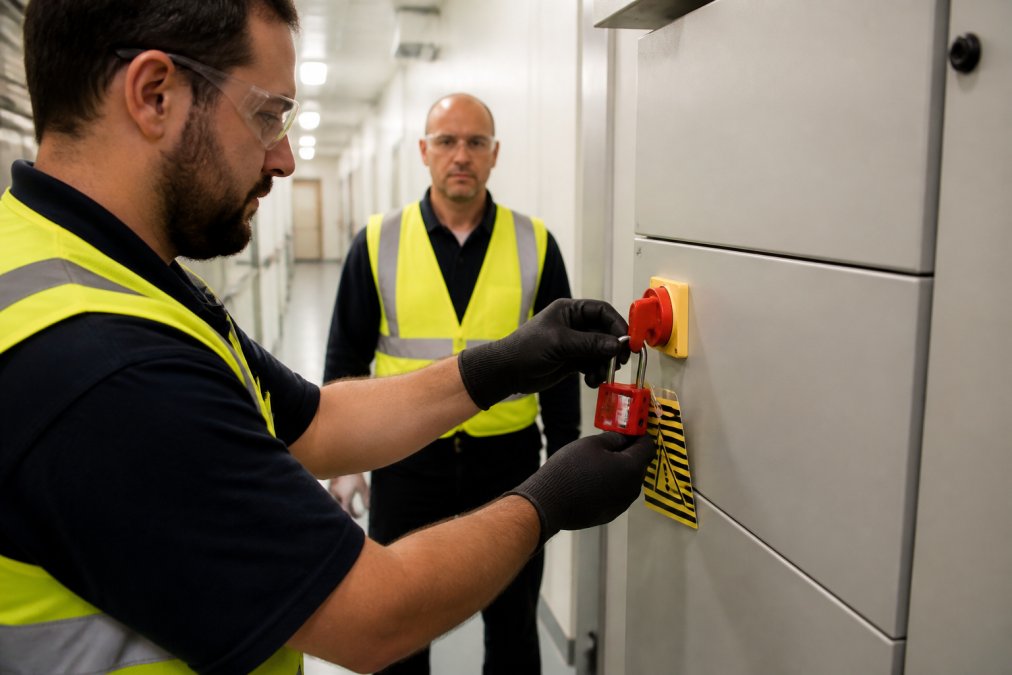
The critical difference between standard industrial LOTO and hospital LOTO is the need to account for multiple power sources. Hospital plant equipment frequently has both mains supply and emergency generator backup. Isolating only the mains supply leaves the equipment energised via the emergency power system.
A compliant LOTO procedure for hospital plant includes these steps:
Isolating equipment in a ward where patients are present requires a permit-to-work system, not just a LOTO tag. The permit must be authorised by the responsible person for the area, must confirm that clinical staff have made alternative arrangements for any affected equipment, and must specify the exact scope of the isolation.
A structured hospital electrical maintenance checklist is the operational backbone of Electricity at Work Regulations 1989 compliance. The frequency of checks must match the risk level of the equipment and environment.
| Task | Frequency | Responsible | Record Required |
|---|---|---|---|
| Visual inspection of portable appliances in use | Daily | Ward/maintenance staff | Defect log |
| Check emergency lighting function indicators | Weekly | Maintenance staff | Maintenance log |
| Test RCDs and ground fault circuit interrupters | Monthly | Competent person | Test log |
| Inspect fixed wiring in high-humidity areas | Quarterly | Competent person | Inspection report |
| PAT testing of Class I and Class II equipment | Per risk assessment | Competent person | PAT register |
| Full electrical installation condition report | Every 5 years (or per risk) | Registered electrician | EICR certificate |
| Thermographic survey of switchgear and distribution | Annual | Specialist | Survey report |
| Emergency power system load test | Annual | Specialist | Test report |
| Equipotential grounding continuity checks | Annual | Competent person | Test record |
| Insulation resistance testing of fixed wiring | Annual | Competent person | Test record |
Daily visual inspection of portable appliances is a user check for obvious damage, frayed cables, damaged plugs, and signs of overheating. Staff carrying out these checks need basic awareness training, not full competence certification.
Weekly checks of emergency lighting function indicators confirm that the self-test systems are reporting correctly. These checks must be recorded.
Monthly RCD and ground fault circuit interrupter testing is mandatory under BS 7671 for circuits in patient areas. The test button on an RCD is a functional check only; a proper test using an approved RCD tester confirms trip time and current threshold.
Quarterly inspections of fixed wiring in high-humidity and sterile areas address accelerated insulation degradation. Annual insulation resistance testing of fixed wiring, thermographic surveys of switchgear, and full emergency power system load tests form the annual inspection cycle that underpins the site’s electrical safety policy.
PAT testing frequency in hospitals is governed by risk assessment, not a fixed statutory schedule. The IET Code of Practice for In-Service Inspection and Testing of Electrical Equipment and HSE guidance both make clear that there is no legal requirement to PAT test annually: the frequency must be determined by the type of equipment, the environment in which it is used, and the history of faults.
In practice, for a hospital environment, the risk assessment almost always results in shorter intervals than in a standard office. Equipment used in wet or high-humidity clinical areas should be tested more frequently than equipment in dry administrative areas.
A practical PAT testing frequency framework for hospital equipment:
PAT testing is not a substitute for regular visual inspection. A device that passes a PAT test can develop a fault if it is misused or damaged in use.
Competent person electrical training for healthcare teams is not the same as training electricians. The goal is to produce maintenance staff who can safely carry out defined tasks within a safe system of work, recognise hazards they are not qualified to address, and escalate appropriately.
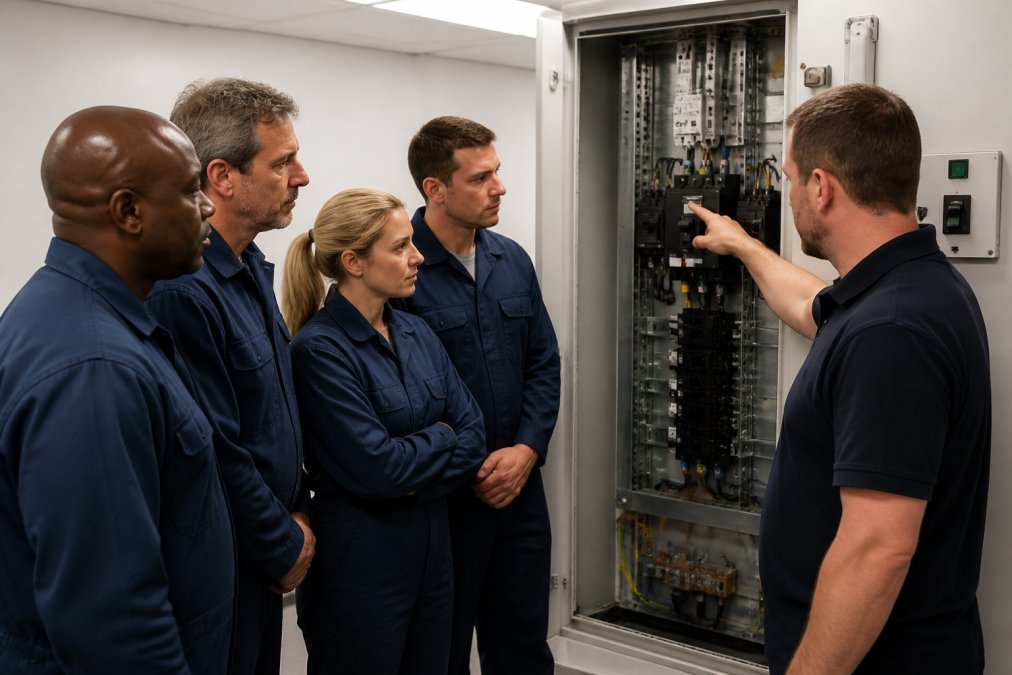
Training for non-electrician hospital maintenance staff should address the specific hazards of the clinical environment. A course that covers industrial switchgear but ignores leakage current in medical electrical equipment is not fit for purpose in a healthcare setting.
Core training content for hospital maintenance staff should include:
According to HSE guidance on competence for electrical work, competence is a combination of training, experience, and knowledge. For maintenance staff, training must be reinforced by supervised practice and regular refreshers.
Emergency power transitions are one of the most overlooked hazard scenarios in hospital electrical safety. When the site switches from mains supply to generator power, either automatically during a mains failure or manually during planned maintenance, the transition creates a brief period of electrical instability that can affect sensitive equipment, cause unexpected re-energisation of isolated circuits, and expose staff to unanticipated hazards.
Circuits that were isolated from mains supply can become live again when the generator cuts in, if isolation was not applied at the correct point. Maintenance staff must be briefed on the site’s emergency power system layout before carrying out any isolation work. The key question is always: does this circuit have an alternative supply path via the emergency power system?
Safe working during planned power transitions requires:
The electrical safety procedures for emergency power transitions should be documented in the site’s electrical safety policy and rehearsed, not just written down. A team that has practised the procedure under controlled conditions will respond correctly when it happens under pressure.
Hospital electrical safety is a discipline where the margin for error is genuinely zero. Maintenance teams need structured competence, documented procedures, and regular training that reflects the realities of a clinical environment. SJB Smart Electricals Training & Consultancy provides specialist, hands-on electrical safety training tailored for healthcare maintenance teams, covering safe isolation, LOTO procedures, emergency power management, and regulatory compliance. Book training with SJB Smart Electricals Training & Consultancy and give your team the competence to work safely in one of the most demanding electrical environments there is.
The main hazards include electric shock and electrocution from faulty or damaged equipment, arc flash from power distribution panels, leakage current affecting sensitive biomedical equipment, and ground fault risks in high-humidity areas such as wet rooms and theatres. Hospitals also face the added complexity of electrical hazards occurring near patients connected to life-saving devices, where even small leakage currents can be dangerous. Identifying these hazards through regular inspection and testing is the foundation of any hospital electrical safety policy.
The Electricity at Work Regulations 1989 place a legal duty on employers and employees to ensure all electrical systems are constructed, maintained, and used safely. For hospital maintenance teams, this means keeping maintenance logs, carrying out preventive maintenance on a documented schedule, ensuring only competent persons work on or near electrical systems, and maintaining insulation resistance and circuit protection to a safe standard. The regulations apply to all electrical equipment on site, including portable appliances, fixed wiring, and emergency power systems.
PAT testing frequency in hospitals depends on the risk level of the equipment and its environment. The IET Code of Practice for In-Service Inspection and Testing of Electrical Equipment does not set fixed intervals but requires a risk-based approach. In clinical settings, portable equipment used near patients is typically tested every 6 to 12 months. High-risk areas or equipment subject to heavy use may require more frequent checks. Maintenance teams should document each test result and review intervals annually as part of their hospital electrical maintenance checklist.
Non-electrician maintenance staff must receive training sufficient to make them a competent person for the tasks they perform, as required by the Electricity at Work Regulations 1989. This includes hazard identification, safe isolation procedures, correct use of PPE, understanding of lockout/tagout protocols, and recognition of when to escalate to a qualified electrician. Formal competent person electrical training for healthcare teams should cover the specific risks of the clinical environment, including working near medical equipment and managing electrical safety during emergency power transitions.
This article was written using GrandRanker

Learn what an 18th edition course for electricians covers, who needs i

Understand competent person electrical training, who needs it, what it