
We use cookies to optimize your experience, analyze traffic, and personalize ads. Please choose whether you accept our use of non-essential cookies. Read More
York
08:00 AM - 05:00 PM
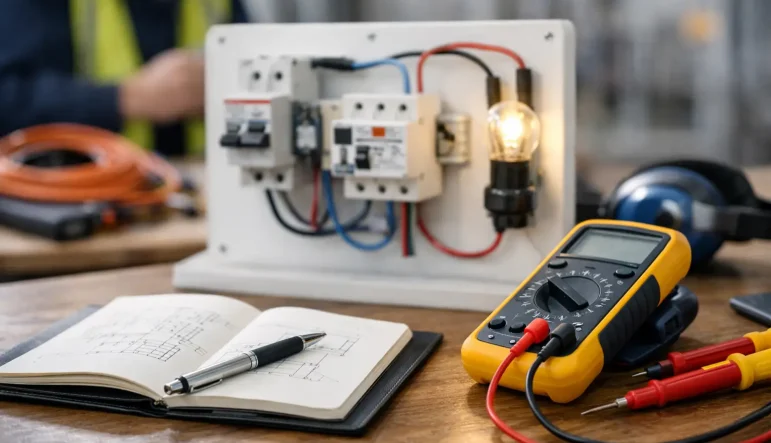
A BS7671 course review should begin with the reality of the work: the Wiring Regulations are not a document most electrical professionals can afford to treat as background reading. They inform design decisions, inspection outcomes, installation methods and the advice given to clients. The right course can sharpen judgement and support compliant work. The wrong one can leave a candidate with a certificate but little confidence when faced with a live site decision.
For electricians, facilities teams, designers and duty holders, BS 7671 training is most valuable when it builds practical understanding of the regulations rather than simply preparing people to locate answers in an assessment. That distinction matters across domestic, commercial, industrial and transport environments, where the consequences of poor electrical decisions can extend well beyond a failed inspection.
A course based on BS 7671 is commonly known as 18th Edition training. Its purpose is to help candidates understand the structure, scope and application of the IET Wiring Regulations. It usually covers the fundamental principles of electrical safety, definitions, protection against electric shock, selection and erection of equipment, inspection and testing requirements, and special installations or locations.
Good training also teaches candidates how to use the regulations efficiently. BS 7671 is a detailed technical standard, and competent use depends on knowing where requirements sit, how sections relate to one another and when a regulation must be read alongside supporting guidance, manufacturer information and the actual site conditions.
The course is not a substitute for electrical experience. It will not, by itself, make someone competent to design, install, inspect or certify every type of electrical installation. Competence comes from a combination of knowledge, practical ability, relevant experience and an understanding of the limits of one’s role. This is particularly important for employers responsible for assigning work and maintaining safe systems of work.
The strongest candidates are usually practising electricians and electrical professionals who need to keep their regulatory knowledge current. This includes installation electricians, approved electricians, electrical supervisors, maintenance engineers, designers, inspectors, testers and technical managers.
It can also be useful for those who do not carry out installation work every day but need to make informed decisions about electrical safety. Property managers, facilities personnel and commercial clients may benefit from a clearer understanding of the standards their contractors are working to. For these audiences, the aim is not necessarily to gain an electrical qualification for hands-on work, but to ask better questions, understand compliance evidence and recognise when specialist advice is required.
For new entrants, the course can provide useful context, but it should sit alongside foundational electrical training and supervised site experience. A candidate with limited exposure to installation work may find the regulation book technically dense, particularly around circuit design, protective measures and special locations. That does not make the course unsuitable, but it does mean the training provider should offer adequate explanation rather than assume prior knowledge.
Many BS 7671 courses cover similar syllabus headings. The difference lies in delivery. A worthwhile course explains why a regulation exists and how it affects the work being planned, installed, tested or reviewed.
For example, a tutor should be able to relate protection requirements to real risks such as damaged cables, fault currents, accessible conductive parts and changing environmental conditions. They should explain why a particular installation may need additional protection, why selection of equipment depends on external influences, and why a compliant design on paper may not be appropriate for every operational setting.
The best sessions make space for practical scenarios. A domestic consumer unit replacement, a commercial alteration, a warehouse distribution circuit and equipment installed in an outdoor or transport-related environment each raise different questions. Candidates should leave with a clearer method for working through those questions: identify the supply and earthing arrangement, assess the environment and intended use, establish the applicable requirements, select suitable equipment and verify the completed work.
Assessment preparation still matters. Many recognised courses use a formal assessment that tests a candidate’s ability to navigate the book accurately under time pressure. However, training that focuses only on page finding may produce a pass without developing sound professional judgement. Look for a provider that treats the assessment as one part of the course, not the entire purpose of it.
Before booking, confirm exactly which version of BS 7671 the course covers. Wiring Regulations are revised through new editions and amendments, and the applicable requirements can change. Training materials, permitted reference books and assessment arrangements must reflect the current version used by the awarding organisation and relevant industry arrangements.
This is not a minor administrative detail. A course based on superseded requirements may create uncertainty when a contractor is working on new installations, issuing certification or advising a client. If your organisation has a compliance programme, it is sensible to keep a record of which personnel hold current training and when updates are likely to be needed.
Candidates should also check whether the required copy of the regulations is included, whether it may be used during the assessment, and whether any tabs or annotations are permitted. These details vary, so assumptions can lead to unnecessary pressure on the day.
The best format depends on the candidate’s experience, learning style and working commitments. Classroom delivery is often the strongest option for people who value direct discussion, worked examples and immediate clarification. It can be particularly helpful where candidates are returning to study after several years or want to explore how regulations apply to unfamiliar work.
Virtual training may suit experienced professionals who can engage confidently with technical content remotely. It can reduce travel time and allow businesses to schedule training around operational demands. The trade-off is that candidates need a reliable working environment, good preparation and enough confidence to raise questions when something is unclear.
Blended delivery can work well where pre-course learning covers terminology and book structure, followed by tutor-led sessions focused on application and assessment practice. Whatever the format, candidates should be wary of training advertised as exceptionally quick if it offers little opportunity to understand the material. Speed has a place for experienced electricians updating their knowledge; it is less suitable for someone who needs a fuller grounding.
A credible provider should be clear about the qualification or assessment offered, the edition of BS 7671 covered, course duration, entry expectations and what is included in the fee. They should also explain how candidates are supported if they need additional help before assessment.
Ask about the tutor’s practical experience. A trainer who understands installation, inspection, fault finding and the pressures of delivering work on site can make technical requirements easier to apply. This does not mean every lesson needs to become a collection of site stories. It means examples should be relevant, accurate and tied back to the regulations.
It is also worth asking how the course handles areas that regularly cause confusion, such as earthing arrangements, additional protection, cable selection, isolation and switching, bathrooms and other special locations. Clear teaching in these areas gives candidates far more value than generic slides read aloud.
For employers, consider the wider capability need. A BS 7671 course may be the right first step, but it may need to be supported by inspection and testing training, design knowledge, manufacturer-specific instruction or site-specific procedures. SJB Smart Electricals approaches training as part of safe electrical delivery, recognising that current regulation knowledge must be applied properly within the environment where people work.
BS 7671 is influential, but it is not the only requirement affecting electrical work. Building Regulations, health and safety duties, the Electricity at Work Regulations, network operator requirements, client specifications and manufacturer instructions may all be relevant. Certain sites may also have strict local rules, security controls, operational restrictions or permit systems.
A course should therefore encourage professional judgement, not overconfidence. If a situation is complex, unusual or outside an individual’s experience, the correct response may be to consult a competent designer, senior electrical person, manufacturer or specialist adviser. That is a sign of proper control, not a lack of competence.
The value of a BS 7671 course becomes clear after the assessment. Candidates should use the regulations in day-to-day planning, toolbox discussions, design reviews, inspections and conversations with clients. Managers can reinforce this by giving trained staff access to current reference material and involving them in technical decisions rather than treating the certificate as a filing requirement.
A well-chosen course will not remove every difficult judgement from electrical work. It should give you a sounder way to make those judgements: read the requirement carefully, understand the risk it addresses, assess the installation in front of you and act within your competence. That is the standard clients, colleagues and end users should be able to rely on.

Learn what an 18th edition course for electricians covers, who needs i

Understand competent person electrical training, who needs it, what it