What is Electrical Risk Assessment and Why It Matters
Electrical risk assessment is the systematic process of identifying electrical hazards in your workplace, evaluating the likelihood and severity of harm, and implementing control measures to protect your workforce.
Why does this matter? Electrical hazards cause serious injury and death. They’re often invisible until something goes wrong. A competent electrical risk assessment catches problems before they become incidents.
The difference between a workplace that handles electrical safety well and one that doesn’t comes down to one thing: systematic hazard recognition followed by proportionate control. Many organisations skip the systematic part.
Step 1: Identify Electrical Hazards in Your Workplace
The first step is straightforward: walk your workplace and identify every electrical hazard.
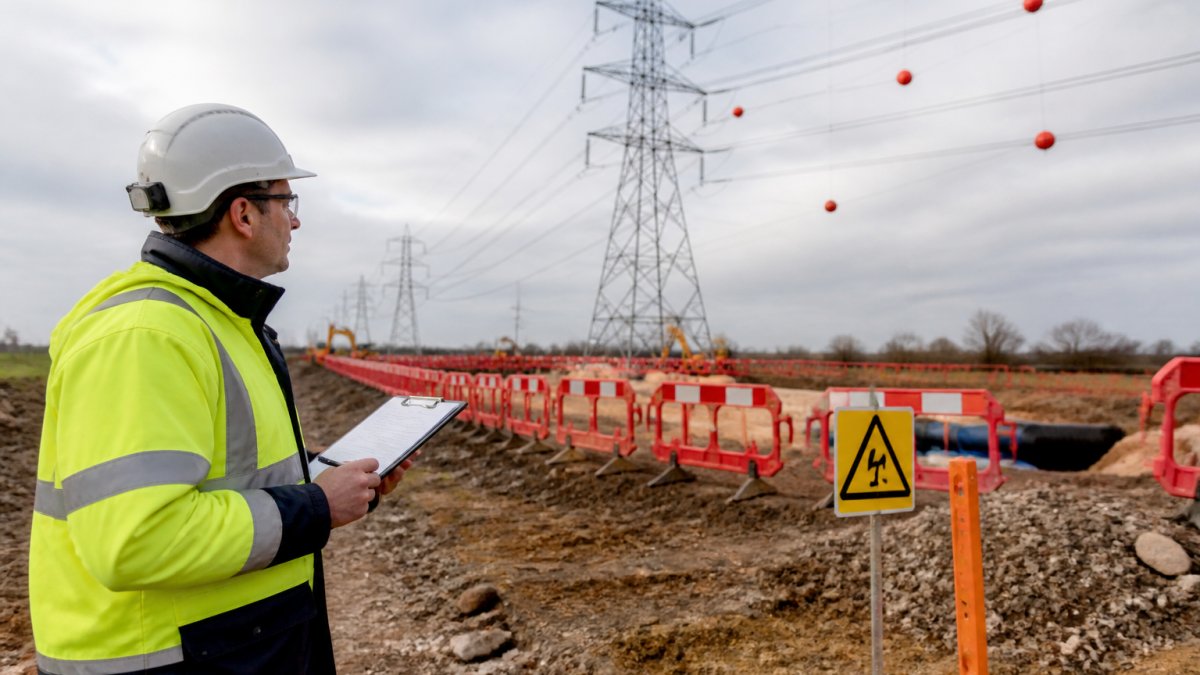
Site supervisor using an electrical risk assessment checklist to inspect power line markers on a construction site.
Common electrical hazards include:
Overhead power lines – Risk of contact during work at height or with equipment
Hazard recognition requires you to think about work activities, not just equipment. What are your teams actually doing? Where are they doing it?
A construction site near underground services needs a different assessment than a healthcare facility. A hospital maintenance team faces different risks than an industrial plant operator.
Document every hazard you identify. Write it down. Don’t rely on memory. A simple list is enough at this stage, you’ll evaluate risk next.
Step 2: Evaluate Risk Using an Electrical Risk Assessment Checklist
Now you assess each hazard. Risk assessment means answering two questions for every hazard you’ve identified:
How likely is harm to occur? (Likelihood: low, medium, high)
How serious would the harm be? (Severity: minor, major, fatal)
Multiply likelihood by severity to get risk level. This gives you a simple scoring system to prioritise where to focus your control efforts.
Hazard
Likelihood
Severity
Risk Level
Priority
Contact with overhead power line during scaffolding erection
High
Fatal
High
Immediate
Damaged extension lead in wet environment
Medium
Major
Medium
Soon
Unmarked underground cable during groundworks
High
Fatal
High
Immediate
Untrained person working on live switchboard
Medium
Major
Medium
Soon
Portable appliance with frayed lead
Low
Minor
Low
Monitor
Likelihood factors:
How often is the hazard present?
How many people are exposed?
Is the work routine or occasional?
Are controls already in place?
Severity factors:
What type of injury could occur? (Shock, arc flash, thermal burn, electrocution)
Could it cause death?
Could it cause permanent disability?
An electrical shock can stop a heart. An arc flash can cause severe burns. Underground cable strikes can be fatal. Don’t underestimate severity.
Use a checklist to ensure you evaluate every hazard consistently. Your assessment should cover work activities, environmental conditions, equipment condition, and competence of personnel.
Step 3: Apply Electrical Risk Control Measures
Once you’ve identified and scored risks, you control them. The hierarchy of controls tells you what to do first:
Eliminate the hazard – Remove the source entirely (not always possible with electrical work)
Substitute – Replace with a safer alternative (e.g., use cordless tools instead of trailing leads)
Administrative controls – Work systems, training, competence checks, supervision
Personal protective equipment – Last resort, only when other controls aren’t sufficient
For overhead power lines, you can’t eliminate the hazard. You control it through safe systems of work: planning routes, using spotters, maintaining safe distances, and ensuring competent supervision.
For underground cables, controls include cable plans, hand-digging protocols, and marking hazard zones before work starts.
For live equipment work, controls include safe isolation procedures, lockout/tagout systems, and ensuring only authorised persons carry out the work.
The key is matching the control to the risk level. A high-risk hazard needs multiple controls. A low-risk hazard needs monitoring and basic precautions.
Pro Tip The most effective controls are those that don’t rely on human memory or behaviour. Engineering controls, like RCD protection, barriers, and safe isolation systems, work even when someone has a bad day. Use them first.
Electrical Risk Assessment Examples Across Different Workplaces
Risk assessment looks different depending on your setting. Here’s how it works in three common scenarios.
Construction Site Near Underground Cables
A construction site is excavating a new building foundation. Underground cables run beneath the site. The hazard is cable strike during digging.
Hazard identification: Underground cables (live, buried, unmarked on older drawings)
Risk evaluation:
Likelihood: High (excavation is planned, cable location uncertain)
Severity: Fatal (direct contact with live cable)
Risk level: High
Controls applied:
Obtain accurate cable plans from utility companies (weeks before work)
Mark cable routes on site with warning signs and barriers
Hand-dig in cable zones, no mechanical excavation
Provide cable avoidance training to all operatives
Assign a competent person to supervise cable-sensitive work
Use cable detection equipment if route is uncertain
Residual risk: Low (if controls are followed)
This is how it should work: a high-risk hazard gets multiple, layered controls. No single control is relied upon alone.
Healthcare Facility with Critical Electrical Systems
A hospital maintenance team services backup generators and UPS systems. These are live, high-voltage installations critical to patient safety.
Hazard identification: Live electrical equipment; risk of shock and arc flash during maintenance
Risk evaluation:
Likelihood: Medium (maintenance is routine, but only trained staff access the equipment)
Severity: Major (arc flash and shock injuries possible, but fatal outcome less likely due to equipment design)
Risk level: Medium
Controls applied:
Only authorised persons (AP) trained in electrical safety access the equipment
Safe isolation procedures documented and followed before any work
Lockout/tagout systems prevent accidental re-energisation
Personal protective equipment (arc-rated clothing, insulated tools) worn during live work if isolation isn’t possible
Regular inspection and testing of equipment to identify defects early
Clear labelling and warning signs on all live equipment
Residual risk: Low (with competent personnel and strict procedures)
Healthcare facilities can’t always shut down electrical systems. Critical systems must remain live. That’s why multiple controls, competence, isolation procedures, PPE, and inspection, are essential.
Industrial Plant with Overhead Power Lines
An industrial plant has overhead power lines running across the site. Cranes, mobile elevated work platforms, and tall equipment operate underneath or nearby.
Hazard identification: Contact between equipment and live overhead lines
Risk evaluation:
Likelihood: Medium (cranes operate regularly, but safe systems are in place)
Severity: Fatal (direct contact with overhead lines causes electrocution)
Risk level: High
Controls applied:
Safe working distance: maintain 3 metres clearance from overhead lines (minimum, check with utility company for your voltage)
Banksman and crane operator briefing before each lift
Visual markers on crane boom to indicate safe height
Utility company liaison before any new work near lines
Regular inspection of overhead line condition
Competent persons supervising all work near lines
Alternative routes or methods considered to avoid overhead lines entirely
Residual risk: Low (with strict adherence to safe systems)
The common thread in all three examples: high-risk hazards get multiple controls, competent supervision, and clear procedures. Low-risk hazards get basic precautions and monitoring.
Watch Out The biggest mistake is treating all electrical hazards the same. A frayed lead and an overhead power line are not equivalent risks. Your controls must match the severity and likelihood. Under-controlling a high-risk hazard is how incidents happen.
Electrical Safety Responsibilities at Work and Competence
Every organisation has legal duties under the Health and Safety at Work etc. Act 1974. These duties fall on employers, managers, and anyone in control of work.
Employers must:
Identify electrical hazards in the workplace
Assess the risks they present
Implement control measures
Ensure competent personnel carry out electrical work
Provide information, instruction, and training
Maintain electrical equipment in safe condition
Managers and supervisors must:
Ensure hazard identification happens before work starts
Check that control measures are in place and being followed
Stop unsafe work
Report defects or hazards immediately
Ensure only competent people do electrical work
Individual workers must:
Follow safe systems of work
Report hazards or defects
Use equipment and PPE correctly
Not work beyond their competence
Competence is critical. A competent person has the knowledge, training, and experience to safely carry out electrical work or supervise others. They understand the hazards, can recognise problems, and know how to respond.
Many organisations discover during assessment that their teams lack the competence they assumed they had.
Recording and Reviewing Your Electrical Risk Assessment
Document your assessment. Write down:
What hazards you identified
Who you consulted (electricians, site managers, equipment suppliers)
How you evaluated risk (likelihood and severity for each hazard)
What controls you implemented
Who is responsible for maintaining each control
When you’ll review the assessment
A simple spreadsheet or form works. It doesn’t need to be elaborate. What matters is that it’s clear, complete, and accessible to the people who need it.
Review your assessment:
When work activities change
When new equipment arrives
When new staff join
When an incident or near-miss occurs
Annually as a minimum
An assessment that sits in a file and never changes is useless. Your workplace evolves. New hazards emerge. Controls fail. Your assessment must evolve too.
Key Takeaway The assessment is only valuable if it drives action. A perfect document that doesn’t change behaviour is paperwork, not safety.
Common Mistakes to Avoid During Assessment
1. Skipping the walk-through. Don’t assess from an office. Walk the site.
2. Underestimating severity. Electrical injuries are often fatal or permanently disabling.
**3.
4. Implementing controls nobody follows. A control that isn’t used is useless.
5. Assuming training equals competence. Someone can pass a course and still not be competent.
6. Never reviewing the assessment. Work changes. Hazards evolve. Your assessment must too.
**7.
8. Forgetting about contractors. Contractors working on your site face the same hazards as your staff.
Electrical risk assessment isn’t complicated. It’s systematic hazard thinking followed by proportionate control. Walk your workplace.
If your team needs specialist support, whether that’s training on safe isolation procedures, competence assessment, or help designing your assessment process, SJB Electrical Training delivers hands-on programmes tailored to your workplace. Our expert-led courses cover HSG47 guidance, safe systems of work, and practical risk management so your team can confidently identify hazards, assess risk, and implement controls that actually work. Book Training to get started.
Frequently Asked Questions
How do you carry out an electrical risk assessment at work?
Start by identifying all electrical hazards in your workplace: overhead lines, underground cables, portable appliances, and live equipment. Evaluate the likelihood and severity of harm for each hazard using a scoring system. Apply control measures following the hierarchy of controls: elimination, substitution, engineering controls, safe systems of work, and personal protective equipment. Document findings, assign responsibility, and set review dates. HSG47 provides the framework for this process. Competent persons should lead the assessment, though all team members contribute hazard identification.
What should an electrical risk assessment include?
A thorough electrical risk assessment checklist must cover: identification of all electrical equipment and installations, recognition of hazards (shock, arc flash, fire, thermal burns), evaluation of who might be harmed and how, assessment of existing control measures, determination of residual risk, and selection of additional controls needed. Include details of work activities, work environment conditions, maintenance and inspection schedules, and competence levels of personnel. Document any overhead or underground services, portable appliances, and systems requiring safe isolation procedures. Record findings with dates and responsibility assignments.
Who is responsible for assessing electrical risks in the workplace?
Employers and duty holders have legal responsibility under the Health and Safety at Work etc. Act 1974 to ensure electrical risk assessment is completed. A competent person, with sufficient knowledge, training, and experience in electrical safety, must lead the assessment. For complex installations or high-risk environments, an Authorised Person with specialist qualifications may be required. Site supervisors, maintenance managers, and team leaders contribute by identifying workplace-specific hazards. All workers share responsibility for reporting new hazards or changes that affect the assessment.
How often should an electrical risk assessment be reviewed?
Electrical risk assessments should be reviewed at least annually or whenever significant changes occur: new equipment installation, workplace layout changes, staffing changes, or incidents. After any near-miss or accident involving electrical equipment, reassess immediately. If work activities or environmental conditions change (moving to a site with overhead lines, for example), update the assessment before work begins. Competent persons should also review findings when control measures are not working effectively or when inspection and testing results reveal new issues. Keep dated records showing when assessments were completed and reviewed.
We use necessary cookies to keep this website secure and working. With your permission, we also use optional cookies to understand site performance and improve our services. Choose Accept All, Reject All or Preferences. You can change your choice at any time.
Cookie Policy
Necessary cookies support security and functions you request. Optional analytics and functional cookies are used only after consent. Some optional cookies may be set by service providers used on our pages. See the Cookie Policy for details.
Necessary cookies help make a website usable by enabling basic functions like page navigation and access to secure areas of the website. The website cannot function properly without these cookies.
Marketing cookies are used to track visitors across websites. The intention is to display ads that are relevant and engaging for the individual user and thereby more valuable for publishers and third party advertisers.
Preference cookies enable a website to remember information that changes the way the website behaves or looks, like your preferred language or the region that you are in.